
Beliefs & Stories · Introduction
Jelling: Kingship Written in Stone

In Brief
At Jelling in Denmark, runestones, enormous mounds, and traces of a vast enclosure place family memory beside royal ambition. The monuments are powerful evidence, but they also present the claims that rulers wanted others to remember.
Jelling, Denmark · Tenth century CE
Harald's public statement
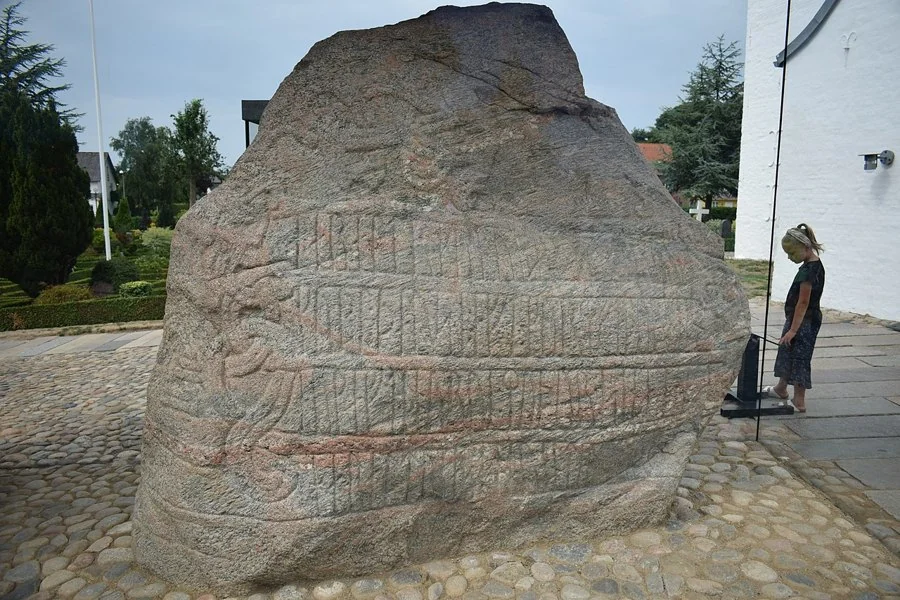
Around 965 CE, Harald Bluetooth erected the larger Jelling stone in memory of his parents, Gorm and Thyra. Its inscription also credits Harald with gaining Denmark and Norway and making the Danes Christian. A carved image of Christ appears on one face, while another carries an animal entangled with a serpent.
The stone therefore combines commemoration with a declaration of achievement. Reading it as a royal statement is essential: it tells us what Harald chose to proclaim. It is not a survey of the religious convictions of every household or a neutral account of how political change unfolded.
A much larger complex
The standing stones and mounds are only part of the story. Excavations between 2006 and 2013 revealed a diamond-shaped enclosure with sides approximately 360 meters long. The National Museum of Denmark describes a massive oak palisade surrounding about 120,000 square meters. Within it were the mounds, stones, church area, and a huge ship-shaped stone setting.
The North Mound lay at the intersection of the enclosure's diagonals. This planned arrangement helps explain why archaeologists read Jelling as a deliberately organized monumental complex. Its scale demanded more than an individual family's small memorial.
Continuity and change
UNESCO emphasizes the combination of non-Christian monuments and evidence of Christianization. The present stone church stands on a site with earlier wooden churches. The two great mounds look similar from outside, but their contents differ: the North Mound contained a burial chamber, while the South Mound did not.
That contrast is a useful warning against judging a monument by shape alone. At Jelling, inscription, excavation, and landscape arrangement answer different questions. Reading them together produces a richer history than treating any one feature as the whole story.
The Evidence
The sources below support this article. Interpretations and limits are explained in the text; this is not an exhaustive research review.