
Journeys & Encounters · Deep dive
Harald Bluetooth: Building a Royal Message at Jelling
In Brief
The stone’s words belong to a larger sequence of mounds, enclosure, church, and carefully organized space.
On this page
The inscription makes several claims at onceA declaration did not begin every Christian lifeTwo mounds with different historiesScale was part of the messageThe palisade changed the archaeological pictureDating the timber rather than the ambitionA church and a possible reburialReading the whole arrangementSourcesThe inscription makes several claims at once
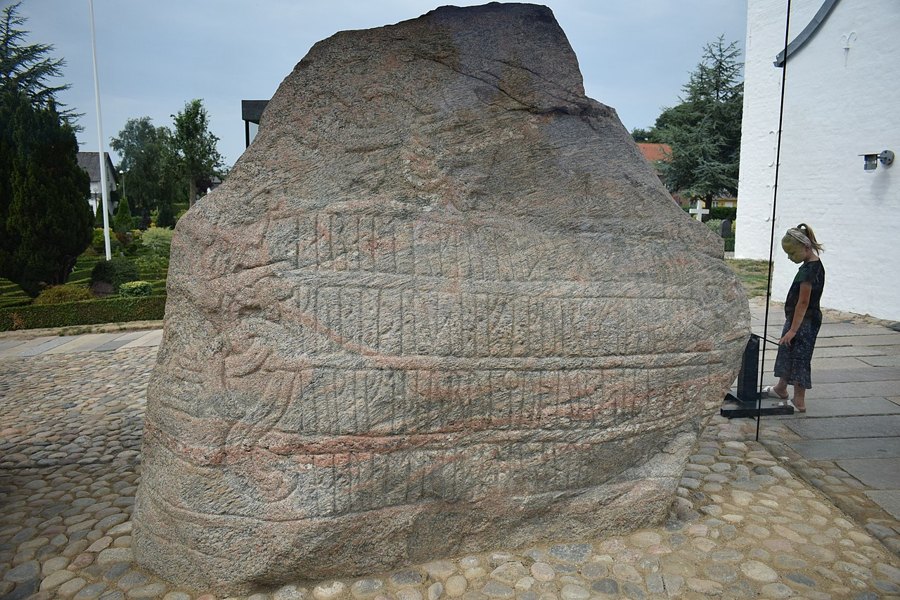
Harald’s large Jelling stone commemorates his parents while also proclaiming territorial achievement and the Christianization of the Danes. Family memory and royal accomplishment are deliberately joined. The National Museum dates the stone to around 965 and identifies images of Christ and an animal entwined with a serpent on its other surfaces. The monument therefore communicated through more than a sentence that could be transcribed. Its scale, imagery, position, and relationship with surrounding structures helped make the inscription authoritative. Reading it as a simple announcement of a modern nation’s birth removes the dynastic and religious work it was intended to perform.
Sources for this section: 1
A declaration did not begin every Christian life
The museum’s discussion of the stone explicitly notes Christian influence before Harald’s proclamation. It points to earlier baptism and Christian objects rather than assuming that the entire population changed belief on the same day. This distinction does not diminish the monument. It identifies its political ambition more precisely: the king claimed responsibility for a transformation larger than one personal conversion. A royal statement can organize the memory of change by presenting it as a ruler’s achievement. Archaeology and earlier records help distinguish that claim from the longer history through which communities encountered Christianity.
Sources for this section: 1

Two mounds with different histories
The North Mound incorporated an older Bronze Age mound and contained a burial chamber dated to 958–959. The South Mound, constructed later, contained no burial. The National Museum also describes remains of a large ship-setting beneath the mounds. These details show why the monument complex cannot be interpreted as two identical royal graves. Reusing an older mound, constructing an empty monumental counterpart, and incorporating or covering earlier stone arrangements were different actions. Their relationship created a landscape of memory, but the sequence must be reconstructed rather than assumed from the visual balance of the two mounds today.
Sources for this section: 2
Scale was part of the message
The southern mound measures approximately 70 meters across and about ten meters high in the museum account. The ship-setting is reconstructed at roughly 360 meters long. Such dimensions made the complex visible and required organized labor. Yet size alone does not specify how that labor was obtained. It cannot distinguish paid service, obligation, coercion, or combinations of arrangements. What can be inferred more securely is the capacity to gather materials and coordinate substantial work. Monumental scale made that capacity perceptible to people encountering the place, whether or not they could read the inscription.
Sources for this section: 2
The palisade changed the archaeological picture
Excavations revealed a much larger enclosure around the familiar monuments, covering approximately 120,000 square meters. The museum’s account places the North Mound centrally within it and notes large buildings and more than one construction phase. This discovery changed the unit of interpretation. The stones, mounds, and church were no longer only neighboring monuments; they belonged within an extensive planned setting. A possible royal residence becomes part of the discussion, but the precise sequence of buildings and monuments remains a research question. The enclosure’s geometry is evidence of spatial organization even where the functions of particular internal areas are not fully understood.
Sources for this section: 3
Dating the timber rather than the ambition
A 2013 National Museum report describes tree-ring analysis of preserved palisade wood from Smededammen. Eleven of twelve samples were dated, with felling around 968 and one sample retaining wood close to the bark. The researchers treated 968 as the most likely construction date while acknowledging a margin around it. This is stronger evidence than dating the enclosure merely because it looks appropriate to Harald’s reign. It connects a specific building operation to a narrow period. The report also relates the result to other major projects of the later tenth century, making coordinated royal investment a question that can be tested chronologically.
Sources for this section: 4
A church and a possible reburial
The museum’s account of Jelling’s new faith describes a wooden church between the mounds and human remains in a chamber beneath its floor. The remains had previously been buried elsewhere. The suggestion that Harald moved Gorm from the North Mound into the church is an interpretation, not an identification established by an inscribed coffin. The hypothesis is attractive because it connects dynastic commemoration with a Christian setting. Its evidential status should nevertheless remain explicit. A secondary burial supports movement of remains; the identity and full political meaning of that movement require additional inference.
Sources for this section: 5
Reading the whole arrangement
Jelling’s message emerges from relationships: a son commemorating parents, a ruler claiming achievement, older monumental forms beside a church, and an enclosure organizing the entire setting. The sequence includes both continuity and alteration. This is why the runestone should be read alongside excavation and dating rather than used as a caption that settles every question. The inscription tells us how Harald wanted his accomplishments remembered. The built environment shows resources and decisions committed to making that remembrance durable. Together they reveal royal power as something publicly asserted, materially constructed, and continually interpreted by later generations.
Sources for this section: 1, 2, 3, 4, 5
For the introductory context, read Jelling: Kingship Written in Stone.
The Evidence
The sources below support this article. Interpretations and limits are explained in the text; this is not an exhaustive research review.