
Research & Sources · Deep dive
Runic Literacy: Who Could Read a Monument, and Who Could Understand It?
In Brief
Rune stones addressed audiences through words, arrangement, images, and setting. Those audiences need not have possessed identical reading skills.
On this page
Separate several abilities hidden inside literacyAn arrangement can guide a readerA monument may have more than one entry pointConnected stones create a larger reading problemA memorial can address the futureReading direction changes a practical encounterDo not confuse a project’s questions with established resultsContext helps, but it does not supply a literacy rateSourcesSeparate several abilities hidden inside literacy
Asking whether the Vikings were literate compresses several different questions into one. Recognizing a writing system, understanding a familiar name, following a complete inscription, composing a memorial, and cutting its characters are different activities. Marco Bianchi’s research on Uppland and Södermanland approaches monuments as communication through visual as well as linguistic forms. This makes it possible to ask what different viewers could understand without assigning everyone to a single literate or illiterate category. The distinction is an analytical tool, not a recovered census: a surviving stone cannot tell us how every passerby responded or how many people could independently compose its text.
Sources for this section: 1
An arrangement can guide a reader
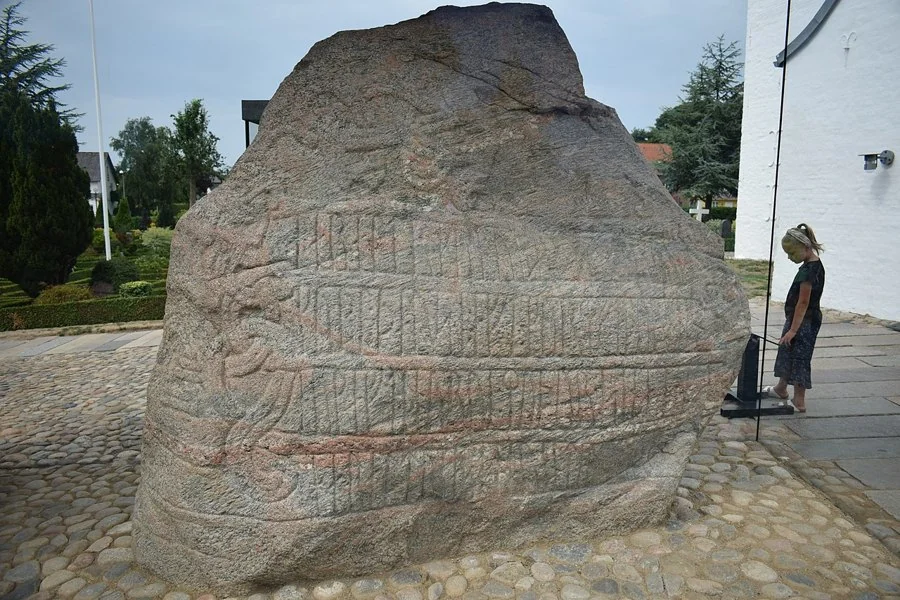
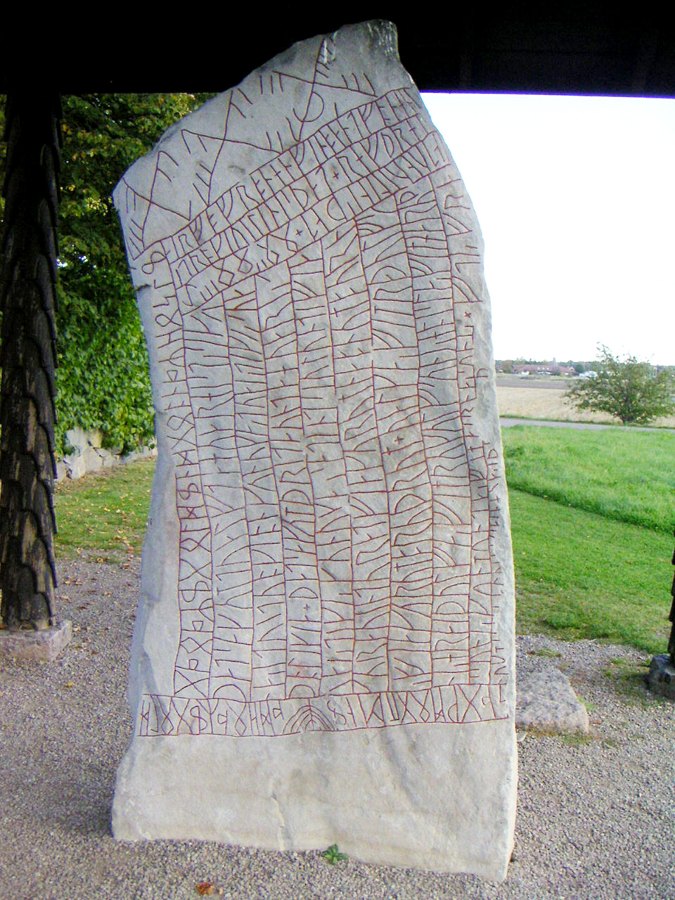
The National Museum of Denmark distinguishes several arrangements in Danish inscriptions. Parallel lines can run upward in succession, alternating lines can reverse direction, and another arrangement follows the stone’s contour. The large Jelling stone instead presents horizontal lines, which the museum relates to manuscript practice. These differences matter because reading is an action carried out across a surface. An inscription’s information is not experienced in exactly the same order when it is copied into a modern paragraph. A useful comparison starts by recording how the reader is directed around the object before asking what the completed sentence says about rulers, families, or journeys.
Sources for this section: 2


A monument may have more than one entry point
Bianchi found that some inscriptions divide their information into visually distinct sections without prescribing one continuous reading order. Ornament and lettering can therefore work together rather than compete for attention. This observation encourages a different classroom exercise: compare the stone’s overall composition with a plain transcription and identify what disappears. The exercise does not reconstruct an ancient observer’s thoughts. It exposes a limitation in our own source presentation. If an interpretation depends on one phrase dominating the encounter, the monument’s actual placement of that phrase needs examination; its position in a modern translation does not establish its original visual prominence.
Sources for this section: 1
Connected stones create a larger reading problem
A Uppsala research project led by Maja Bäckvall explicitly investigated monuments whose texts are distributed across several surfaces or related stones. Its proposed approach combined language, imagery, and layout while examining how syntax is divided among the surfaces. The project description sets out research questions rather than providing results for every monument. Nevertheless, it identifies an important methodological problem: the unit of analysis need not be one photographed face. A museum display, database entry, or detached stone can make a connected message appear self-contained. Readers should ask whether the published text belongs to a larger arrangement before treating it as an independent statement.
Sources for this section: 3
A memorial can address the future
The Randbøl stone commemorates Thorgunn and attributes the memorial to Tue. The Viking Ship Museum notes the inscription’s explicit expectation that the runes will endure for her. This is evidence about the memorial’s stated purpose, rather than a measure of the size or literacy of its audience. Its language invites a useful distinction between immediate recognition and long-term remembrance. Someone who knew the family might understand the occasion without reading every character, while a later reader might recover names without knowing the people. Those are possible modes of reception, not documented conversations, and they should be described as such.
Sources for this section: 4
Reading direction changes a practical encounter
The museum’s Danish examples include Øster Alling for parallel arrangement, Kolind for alternating direction, and Glenstrup for writing along an edge. Comparing them raises concrete questions about the reader’s task. Where does a line begin? When does the reader change direction? Does a photograph reveal the entire sequence? These are questions that can be answered from the object and its documentation more securely than a guessed literacy percentage. They also explain why a neat caption is an interpretation of access: it gathers information that may originally have required movement, turning attention, or knowledge of a conventional starting point.
Sources for this section: 2
Do not confuse a project’s questions with established results
Bäckvall’s project description proposes comparing multiple-inscription monuments across time and space. That is a research design, not proof that all Scandinavian audiences shared the same reading habits. The distinction matters when an attractive theoretical approach is summarized for a general audience. It is reasonable to say that scholars investigate how separate surfaces organize a message. It would require additional evidence to claim that a particular visitor followed a known route around every monument. The same caution applies to regional comparison: a pattern established in one corpus should be tested against another, with differences in date, preservation, and monument form made visible.
Sources for this section: 3
Context helps, but it does not supply a literacy rate
At Randbøl, the museum describes a stone surviving in its original position and discusses its association with a mound and possible burial. That setting provides a different interpretive situation from a monument moved into a church wall or museum. Yet even unusually good placement evidence cannot count ancient readers. To estimate literacy would require an argument about who made, commissioned, encountered, and understood writing, together with an account of what has failed to survive. The more defensible conclusion is narrower and more interesting: runic monuments could communicate through several channels, and the people who encountered them need not have participated in all those channels equally.
Sources for this section: 4
For the introductory context, read A runestone is a message to an audience.
The Evidence
The sources below support this article. Interpretations and limits are explained in the text; this is not an exhaustive research review.