
Research & Sources · Deep dive
How Manuscript Variants Shape an Edition of Njáls Saga
In Brief
The printed saga is an editorial achievement built from surviving copies, fragments, and decisions about differences between them.
On this page
The saga and a manuscript are different objectsStart by describing what survivesA small variant can change a literary effectCompare witnesses before arranging a family treeMargins may preserve another phase of compositionA fragment can be more than an incomplete copyAn edition should explain what it is trying to representMaterial appearance belongs beside textual comparisonSourcesThe saga and a manuscript are different objects
Njáls saga concerns the world of Iceland’s earlier settlement society, but the surviving books are later material objects. The Árni Magnússon Institute places the saga’s composition around 1280 and notes that its original manuscript is lost. Kálfalækjarbók, among the earliest surviving witnesses, belongs around 1300. This distinction establishes the basic problem for an editor: there is no surviving authorial document that can simply be reprinted as the unquestioned original. Nor is every surviving book interchangeable. A manuscript witnesses a particular stage in transmission, with its own physical condition, writing practices, and history of use.
Sources for this section: 1
Start by describing what survives
Reykjabók contains a nearly complete text, but its present physical state includes losses and replacement. The University of Copenhagen describes a missing leaf replaced in the seventeenth century and another leaf lost after Árni Magnússon acquired the book. The second loss is partly recoverable through a careful earlier copy made by his brother Jón. This case shows why an editor needs more than the oldest surviving material. A later transcription can preserve information from a medieval leaf that subsequently disappeared. Its usefulness depends on evaluating the copyist’s practices, not merely rejecting it because its paper and handwriting are younger.
Sources for this section: 2

A small variant can change a literary effect
The early fragment AM 162 B fol. delta offers a concrete example. In a retort associated with the confrontation at Knafahólar, it uses a word for chin-beard where related manuscripts have a word for head. The Institute discusses whether the expression reflects conscious adaptation or an association with another known narrative. The variant need not change the plot to matter. It changes the verbal texture of the exchange and potentially the network of literary associations. An editor who silently replaces it with the more widespread reading removes evidence about how one version of the saga was written or remembered.
Sources for this section: 3
Compare witnesses before arranging a family tree
The Institute’s account of the saga’s manuscript tradition describes three principal groupings identified in Einar Ólafur Sveinsson’s work. Reykjabók and Möðruvallabók represent different groups, while Gráskinna represents another. Such classification gives editors a framework for comparing readings rather than counting copies as independent votes. To see the principle, imagine five manuscripts copied from one intermediate exemplar and a sixth preserving another branch. Agreement among the five might reflect one inherited choice. This hypothetical example explains why the number of witnesses supporting a reading cannot alone establish its age or authority; relationships among those witnesses also matter.
Sources for this section: 4
Margins may preserve another phase of composition
Reykjabók includes verses not preserved in other versions, many placed in its margins by a hand different from the main scribe’s but apparently contemporary. The Copenhagen account treats these additions as evidence that sources were brought together during the book’s production. For an editor, the issue is not simply whether the verses are interesting. It is whether the chosen edition aims to represent the main written text, the manuscript after additions, or a reconstructed earlier form of the saga. Each objective can produce a different presentation. Placing every marginal item into the main text without explanation conceals the physical evidence for that decision.
Sources for this section: 2
A fragment can be more than an incomplete copy
The Institute’s discussion of the delta fragment emphasizes detailed transcription before comparison with other early witnesses. It also considers archaic grammatical forms concentrated in direct speech as a possible deliberate stylistic choice. That interpretation is qualified: an older-looking form does not automatically prove an older textual layer. The example demonstrates why fragments deserve independent analysis even when they cannot supply a continuous reading text. A damaged witness may preserve an unusual form, a distinctive phrase, or evidence of scribal technique absent from more complete copies. Completeness is a practical advantage for an edition, not an automatic measure of textual value.
Sources for this section: 3
An edition should explain what it is trying to represent
The three manuscript groups identified in the Institute’s overview illustrate why a modern edition needs a stated policy. A reader-friendly text may select a principal witness and report significant alternatives; another project might make several versions available for comparison. These are different editorial products rather than different amounts of accuracy. The reader’s task is to locate the policy in the introduction and check how it governs a disputed passage. If a historical argument relies on one word, the relevant question is whether that word occurs in the chosen manuscript, comes from another witness, or represents an editorial reconstruction.
Sources for this section: 4
Material appearance belongs beside textual comparison
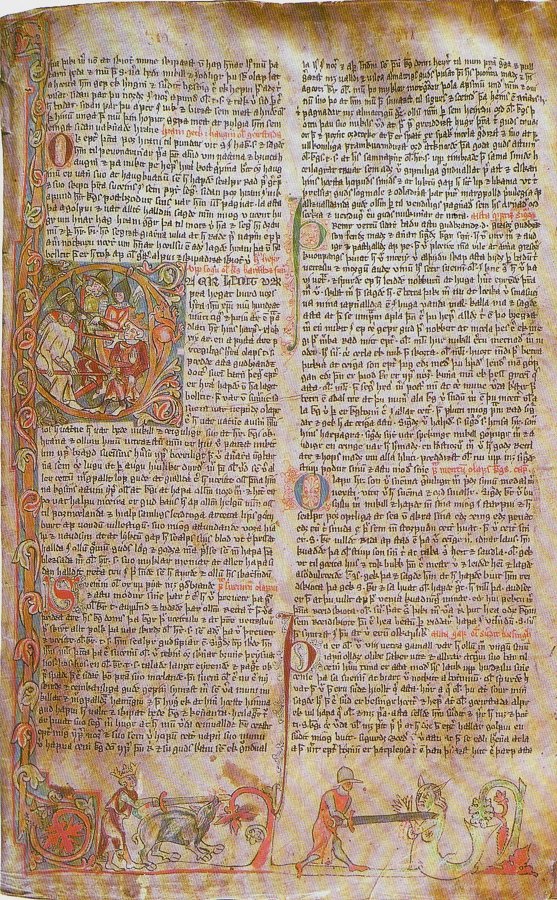
Kálfalækjarbók also preserves decorated initials whose possible connections with other manuscript production have prompted research. The Institute’s account distinguishes proposed artistic parallels from conclusions requiring further work. Decoration, layout, and the selection of texts can help investigate the circumstances in which a saga was copied, even when they do not settle a disputed sentence. For the historian of the Viking Age, the resulting discipline is essential: distinguish the earlier world represented by the story from the medieval and later communities that transmitted it. An edition makes that transmission readable, but a good interpretation should keep its layered history visible.
Sources for this section: 1
For the introductory context, read Who wrote the Viking story?.
For the introductory context, read Viking Games: Boards, Pieces, and the Limits of the Rules.
For the introductory context, read Reading Icelandic Sagas Through Their Manuscripts.
The Evidence
The sources below support this article. Interpretations and limits are explained in the text; this is not an exhaustive research review.