
Research & Sources · Deep dive
Conserving Viking Objects: Intervention, Evidence, and Future Options
In Brief
Conservation changes an object in order to preserve it. Oseberg’s treated wood shows why the long-term effects and the surviving information must be considered together.
On this page
Preservation is an active decisionThe old treatment is now part of the materialA consolidant must reach the material that needs supportMinimum intervention protects more than appearanceOne collection can require several solutionsUnexpected ingredients change the retreatment questionTesting should expose a treatment’s limitationsThe best intervention leaves a usable recordSourcesPreservation is an active decision
The Saving Oseberg project addresses objects whose present fragility is connected to conservation carried out after the 1904 excavation. The museum describes an interdisciplinary program involving documentation, analysis, neutralization, consolidation, and preventive care. These are separate activities with related purposes: documenting an object does not strengthen it, and strengthening it does not necessarily stop the chemical processes weakening it. The distinction matters when a visitor asks whether an artifact has been saved. Conservation is often an ongoing management problem rather than a single successful procedure followed by permanent stability. Its goals must include both the surviving material and the information that future researchers may seek.
Sources for this section: 1
The old treatment is now part of the material
Research on alum-treated Oseberg wood identified ammonium alum as well as the potassium alum associated with the historical treatment. The authors emphasize consequences for understanding the objects and developing retreatment. An artifact’s present composition therefore includes more than its original wood and burial environment. Earlier conservators introduced substances whose distribution and later behavior must now be investigated. This is a concrete reason to retain treatment records and distinguish historical manufacture from modern additions. If an analysis detects a chemical component, interpretation must ask when and how it entered the object before treating it as evidence of Viking woodworking or the original burial conditions.
Sources for this section: 2

A consolidant must reach the material that needs support
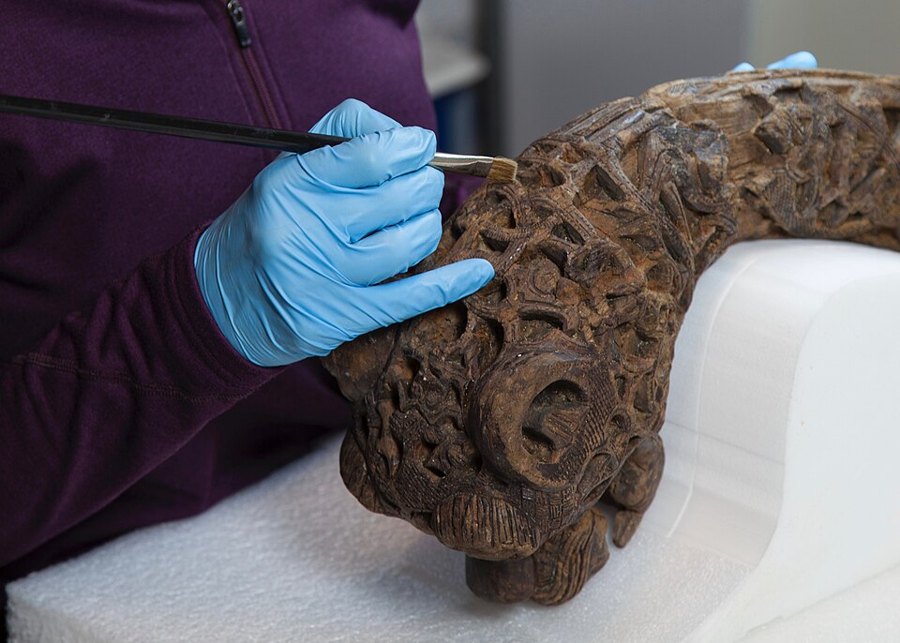
Museum research on two terpene-derived polymers assessed their potential as nonaqueous consolidants for degraded archaeological wood. The reported tests examined penetration and effects using measurements including microscopy, spectroscopy, and hardness. Both polymers reached the wood, but concentrations were greater toward the surface than the core. This is a useful distinction between applying a treatment and demonstrating its performance. A strengthened exterior does not establish uniform reinforcement throughout a fragment. An attractive surface appearance is likewise not a sufficient test. Conservation research must identify which part of the object changes, by how much, and whether that change addresses the actual structural problem.
Sources for this section: 3
Minimum intervention protects more than appearance
The Hellenic Centre for Research and Conservation of Archaeological Textiles emphasizes detailed documentation, future study, appropriate storage, and limiting intervention. Its guidance treats consolidation as a measure requiring particular justification rather than an automatic response to every fragile textile. Applied to a Viking textile, the principle asks what information might be altered by an apparently helpful treatment. Fibers, seams, residues, and associations with nearby material can all matter to later questions. The practical ethical issue is therefore broader than whether a cloth looks complete in a display. A treatment should have a defined conservation purpose and a documented relationship to the evidence it may affect.
Sources for this section: 4
One collection can require several solutions
The Oseberg project separates chemical investigation from the testing of stabilization and strengthening methods. Its program includes continued development and assessment rather than presenting one treatment as universally suitable. This is important for a collection containing objects with different shapes, conditions, and previous interventions. A procedure successful on a small sample may face additional constraints on a reconstructed object whose joints or attached materials behave differently. The reasonable inference is methodological: scale and complexity need testing. A research result becomes a treatment recommendation only after its relevance to the particular object has been assessed, not merely because both sample and object are described as archaeological wood.
Sources for this section: 1
Unexpected ingredients change the retreatment question
The ammonium-alum study shows why a historical treatment name can conceal material variation. If records simply say that an object was treated with alum, a present-day conservator still needs to determine what compounds are actually present. A useful hypothetical comparison is between two fragments carrying the same archival label but different chemical compositions. Applying the same retreatment to both on the strength of that label alone would ignore information available through analysis. The broader lesson is that records and measurements complement each other: documentation explains past intentions and procedures, while material investigation tests what those procedures have left behind.
Sources for this section: 2
Testing should expose a treatment’s limitations
The polymer research describes promising results alongside limits in penetration and suggestions for further investigation. This is the kind of reporting that makes conservation decisions reviewable. A useful test does not merely demonstrate that a substance can enter wood; it evaluates relevant effects and identifies what remains unknown. For a museum considering a Viking artifact, questions might include dimensional change, surface alteration, and the relationship between increased hardness and internal support. These are examples of decision criteria, not a recommendation to apply a particular polymer. The published experimental scope should remain visible when preliminary results are explained to an audience eager for a definitive rescue.
Sources for this section: 3
The best intervention leaves a usable record
Textile conservation guidance treats documentation as part of preserving access to a find, not as an administrative afterthought. A useful record should allow later researchers to distinguish observations made before treatment from appearances created afterward. Photographs, descriptions, sample locations, and treatment histories serve different purposes and need to remain connected to the object. If an intervention cannot be completely undone, its effects should still be traceable. That is the practical ethical standard running through these examples: explain why change was necessary, identify what was changed, preserve relevant evidence, and keep future investigation in view alongside present-day display and physical survival.
Sources for this section: 4
For the introductory context, read Underwater Archaeology: Recording Before Recovery.
For the introductory context, read Conservation Is Research: Oseberg and the Galloway Vessel.
The Evidence
The sources below support this article. Interpretations and limits are explained in the text; this is not an exhaustive research review.