Life & Society · Introduction
Growing Up: Children, Work, and Play
In Brief
Small wooden toys and a carefully furnished child’s grave bring childhood into view. They reveal participation in household life, but also the limits of what objects can tell us about an individual.
On this page
Learning within a householdSmall objects, several possibilitiesMeet the child from BirkaA face reconstructed todaySourcesLearning within a household
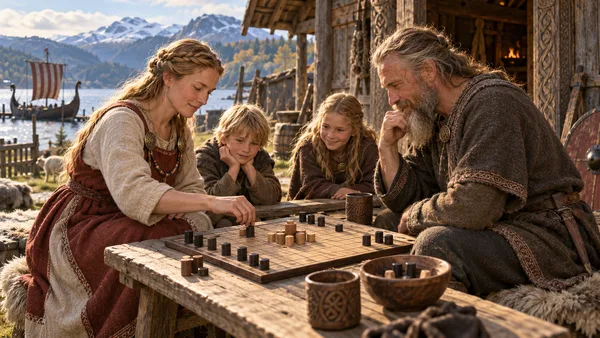
The National Museum of Denmark describes children helping with food preparation, animals, fieldwork, and collecting fuel and wild foods. Learning practical tasks belonged to the work of keeping a household going. Think of a farm as a place where younger people watched, practiced, and gradually took on responsibilities.
Small objects, several possibilities
Wooden miniature boats, swords, dolls, and animal figures have survived. Many are interpreted as children’s toys. The museum suggests that play could also prepare skills useful in adult life: handling objects, imitating work, or practicing movement.
That connection is plausible, but an object does not preserve a child’s thoughts. A miniature boat might inspire imaginative play without proving that its owner intended to become a sailor. The distinction matters whenever we turn an archaeological find into a vivid personal story.
Meet the child from Birka
At the Swedish History Museum, the child commonly called the Birka Girl comes from grave Bj 463. The museum estimates an age of five to six years at death. A gilded brooch, glass beads with precious-metal cores, a knife, and a container for sewing needles accompanied the burial.
These costly objects suggest a family with substantial resources. They also show the care devoted to the funeral. They do not make the burial representative of every child’s possessions or daily activities.
A face reconstructed today
The museum explains that the identification as a girl rests on the burial goods and is not completely certain. Its facial reconstruction was made in 2011 by archaeologist and sculptor Oscar Nilsson. The reconstruction helps visitors imagine an individual; the skeleton and recorded objects remain the archaeological evidence. Keeping those layers separate lets us appreciate the person without pretending to know a complete biography.
The Evidence
The sources below support this article. Interpretations and limits are explained in the text; this is not an exhaustive research review.