
Journeys & Encounters · Deep dive
The Siege of Paris: What a Defender’s Chronicle Lets Us See
In Brief
Abbo’s account of 885–886 combines an eyewitness perspective with poetry, Christian interpretation, and the politics of royal protection.
On this page
An eyewitness who wrote a poemWhy the bridges matteredThe author makes leaders visibleSalvation gives the narrative its directionThe emperor’s settlement looked different from the wallsTribute challenged an image of kingshipLater historians inherited a story of declineHow to read the siege without flattening itSourcesAn eyewitness who wrote a poem
Abbo of Saint-Germain-des-Prés experienced the siege of Paris and later composed the Bella Parisiacae urbis. His presence makes the poem exceptionally valuable, but it does not make it an unfiltered record. Scholarship places the events covered by its first two books between 885 and 896 and consequently dates completion after that sequence. The author was remembering a crisis whose political aftermath he already knew. His text thus brings together observation, information received from others, and retrospective arrangement. The distinction is fundamental: a witness may possess firsthand knowledge while still selecting incidents, shaping speeches, and presenting a moral interpretation of events.
Sources for this section: 1
Why the bridges mattered
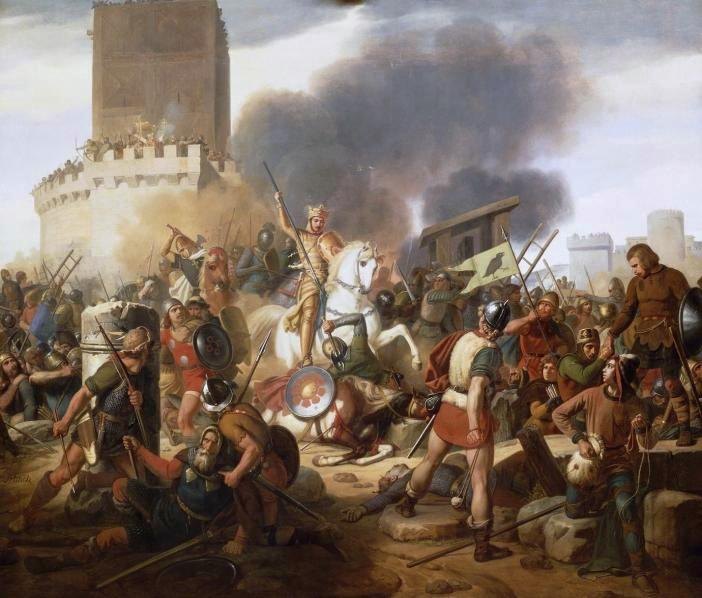
In the translated extract, the struggle concentrates on a fortified tower controlling access to a bridge. The attackers attempt to force passage; the defenders fight, repair damage, and add a wooden upper structure overnight. This sequence reveals a practical contest over movement along and across the Seine. The city’s importance was not limited to whatever valuables it contained. Its defenses could obstruct an army’s route to other targets. The account also makes maintenance part of warfare: surviving an assault was insufficient unless damaged structures could be repaired before the next one. Labor, timber, access, and endurance belong beside individual bravery in explaining resistance.
Sources for this section: 2

The author makes leaders visible
Abbo repeatedly places Count Odo, Bishop Gauzelin, and Abbot Ebolus at the center of the defense. In one especially dramatic scene, Odo returns through enemy forces to reach the defended tower. The concentration on named leaders gives the siege a recognizable cast and a structure of exemplary action. It also leaves many ordinary participants less distinct. We should therefore resist converting the poem’s distribution of attention into a complete social map of the defense. The author’s heroes were people whose conduct could embody the community’s survival. Their prominence tells us both about leadership and about the literary form through which the event was remembered.
Sources for this section: 2
Salvation gives the narrative its direction
The modern scholarly translation published by Peeters emphasizes that Abbo’s purpose extends beyond impartial description. His account concerns the salvation of individuals and the Frankish people. Threat, suffering, courage, and deliverance acquire meaning within that Christian interpretation. This helps explain why a historian should analyze religious language as part of the argument rather than merely remove it to uncover supposedly neutral facts underneath. The language shapes causal explanation and defines the community being defended. It can also make opponents appear as a collective moral danger, obscuring their differing leaders, objectives, and negotiations. Recognizing this design strengthens rather than diminishes the source’s historical value.
Sources for this section: 3
The emperor’s settlement looked different from the walls
A historical study of tribute compares the accounts of Charles the Fat’s arrival and settlement in 886. It notes that the Annals of Saint-Vaast credit imperial operations with forcing a withdrawal from one position and reinforcing the city, even though the subsequent agreement attracted criticism. The settlement permitted the invading force to move toward Burgundy and included payment. For defenders who had endured months of danger, redirecting the threat elsewhere could seem a poor reward. For a ruler coordinating a wider realm, negotiation might address a different set of constraints. These perspectives need not yield the same judgment about what counted as an effective outcome.
Sources for this section: 4
Tribute challenged an image of kingship
Timothy Reuter’s study of Carolingian plunder and tribute provides a revealing comparison from Asselt in 882. A writer of the Annals of Fulda condemned Charles for paying a leader from whom, in the writer’s view, he should have demanded tribute and hostages. The complaint exposes a hierarchy as much as an economic calculation. A ruler’s prestige depended on appearing to receive submission, not purchase relief. Applied cautiously to Paris, this comparison helps explain the emotional force of criticism without assuming that every payment was strategically identical. Money transferred under pressure had political meanings that extended beyond its amount or immediate effect.
Sources for this section: 5
Later historians inherited a story of decline
Simon MacLean’s study of Charles the Fat opens by examining the enduring influence of an account that explains the Carolingian Empire’s end through inadequate rulers and ambitious aristocrats. He contrasts that familiar model with the need to reassess the reign in its own setting. Paris easily becomes a ready-made illustration of decline: courageous local defenders face a disappointing emperor. Yet a compelling example is not a complete explanation of the empire’s political transformation. The siege should be compared with other decisions, resources, and relationships rather than allowed to carry the entire argument. A ruler’s later reputation can turn one negotiated outcome into a summary of a whole reign.
Sources for this section: 6
How to read the siege without flattening it
The most productive reading keeps several scales in view. At the tower, repair and defense determine immediate survival. In the poem, exemplary leaders and religious meaning organize memory. At the level of the realm, payment and movement redirect an armed threat. In later history, the episode becomes evidence in arguments about changing kingship. These layers explain why the same siege can support different narratives without making every interpretation equally convincing. Abbo remains indispensable because his work preserves experiences unavailable elsewhere. His value increases when his proximity to the fighting is considered alongside his genre, loyalties, retrospective knowledge, and specific choices about who deserves to be remembered.
Sources for this section: 1, 3, 4, 5, 6
The Evidence
The sources below support this article. Interpretations and limits are explained in the text; this is not an exhaustive research review.
- Archivum Latinitatis Medii Aevi: Abbo of Saint-Germain-des-Prés ↗
- Fordham Medieval Sourcebook: Abbo’s siege account ↗
- Peeters: scholarly edition of Viking Attacks on Paris ↗
- University of Chicago: The Danegeld after 877 ↗
- Timothy Reuter: Plunder and Tribute in the Carolingian Empire ↗
- Simon MacLean: Kingship and Politics in the Late Ninth Century, introduction ↗