
Research & Sources · Focused study
Filed Viking Teeth: Decoration, Identity, or a Merchant's Sign?

In Brief
Some Viking-Age people had deliberately cut grooves across their front teeth. The marks are real; familiar explanations about terrifying warriors or secret membership remain interpretations that require separate evidence.
On this page
Recognizing a deliberate alterationA larger sample changes the questionModification is not the same as dental treatmentWhy the warrior explanation is temptingBodies as evidence of belongingSourcesRecognizing a deliberate alteration
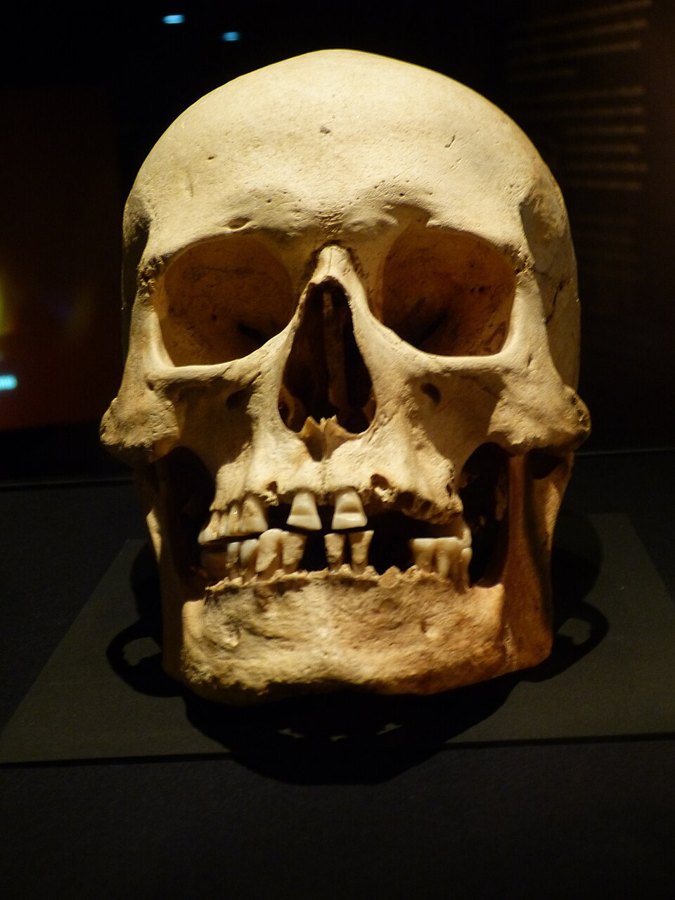
Caroline Arcini's 2005 study described twenty-four men from present-day Sweden and Denmark with carefully made horizontal furrows on their upper front teeth. Some had a single groove; others had several. Their regular form led the researcher to interpret the marks as deliberate work requiring skill, rather than ordinary wear.
The observation is more specific than a claim that Vikings sharpened their teeth. These were grooves across tooth surfaces, not necessarily pointed teeth. Accurate description matters because a frightening modern image can quietly replace the actual archaeological feature under discussion.
Sources for this section: 1
A larger sample changes the question
A later study by Matthias Toplak and Lukas Kerk assembled around 130 male-gendered individuals with dental alterations, many from Gotland. They proposed that the practice could have identified a restricted community of merchants. The concentration and distribution of the finds are therefore important, not just the appearance of an isolated tooth.
This is a hypothesis about social communication: people may have recognized a mark whose meaning is now lost. It should not become a statement that archaeologists have discovered a documented Viking merchants' guild with a known initiation ceremony. No such ceremony follows automatically from the proposed interpretation.
Sources for this section: 2
Modification is not the same as dental treatment
Research on teeth from Varnhem illustrates a different reason for studying mouths. A University of Gothenburg investigation examined 3,293 teeth from 171 individuals and reported tooth decay, wear, and evidence interpreted as attempts at dental treatment, as well as a case of filed front teeth.
These observations should not be collapsed into one category of Viking dentistry. A groove intended to change appearance asks a different question from a modification associated with pain or a diseased tooth. The purpose has to be argued from the location, form, and condition of the affected area, rather than assumed because someone used a tool.
Sources for this section: 3
Why the warrior explanation is tempting
Modern audiences readily connect altered teeth with intimidation. Yet Arcini's study left the purpose unresolved and considered decoration or an occupational association among the possibilities. The later merchant hypothesis also reminds us that conspicuous bodily practices need not be military.
A useful reading test is to ask what evidence would distinguish the alternatives. A weapon in a grave may be relevant, but does it identify a habitual fighter or a funerary ideal? A trading-site distribution may be relevant, but could it reflect the people sampled? A convincing interpretation must address the pattern rather than select the most dramatic individual.
Sources for this section: 1, 2
Bodies as evidence of belonging
Filed teeth invite us to consider identity at a scale smaller than a whole people. Even if a shared social meaning is eventually established, it would not imply that all Scandinavians used the practice or understood it identically. The surviving examples represent particular people, places, and burial conditions.
The most defensible account therefore begins with the physical alteration and then offers competing explanations with their limits. These small marks can reveal deliberate choices about appearance and belonging without yielding a single universal Viking custom. Their uncertainty is part of the historical information, not an empty space to fill with a modern costume idea.
Sources for this section: 1, 2, 3
The Evidence
The sources below support this article. Interpretations and limits are explained in the text; this is not an exhaustive research review.