
Journeys & Encounters · Deep dive
Stamford Bridge: A Battle, a Legend, and an Uneven Ending
In Brief
The defeat of Harald Hardrada ended an invasion. Its place at the end of the Viking Age requires a much wider comparison.
On this page
What ended on September 25The northern campaign had already changed directionA memorable negotiation belongs to a later narrativeTactical detail is not automatically stronger evidenceThe battlefield is a changing landscapeScandinavian intervention continued in 1069Orkney offers a different chronologyUsing an ending without mistaking it for a boundarySourcesWhat ended on September 25
At Stamford Bridge in Yorkshire on September 25, 1066, Harold Godwineson defeated the force led by Harald Hardrada and Tostig Godwineson. Both opposing leaders died. These central facts establish a decisive outcome without requiring acceptance of every later story about the fighting. Historic England registers the battlefield as a significant historic landscape, but registration does not turn its entire narrative reconstruction into contemporary testimony. A useful starting distinction is between the end of this campaign, the death of a particular king, and the end of a historical period. The first two can be attached to an event. The third is a framework created by historians.
Sources for this section: 1
The northern campaign had already changed direction
Five days earlier, Harald and Tostig had defeated the forces of Eadwine and Morcar at Fulford. English Heritage explains that York subsequently provided hostages and provisions, while the sources differ in their presentation of the negotiations. The invasion was therefore more than an isolated raid followed by a dramatic defeat. It had already produced arrangements with an important city. Harold’s rapid arrival overturned an emerging political situation as well as a military one. Reading Fulford and Stamford Bridge together prevents the Norwegian campaign from becoming merely a prelude to Hastings. Its participants were pursuing an immediate contest whose result they could not know in advance.
Sources for this section: 2

A memorable negotiation belongs to a later narrative
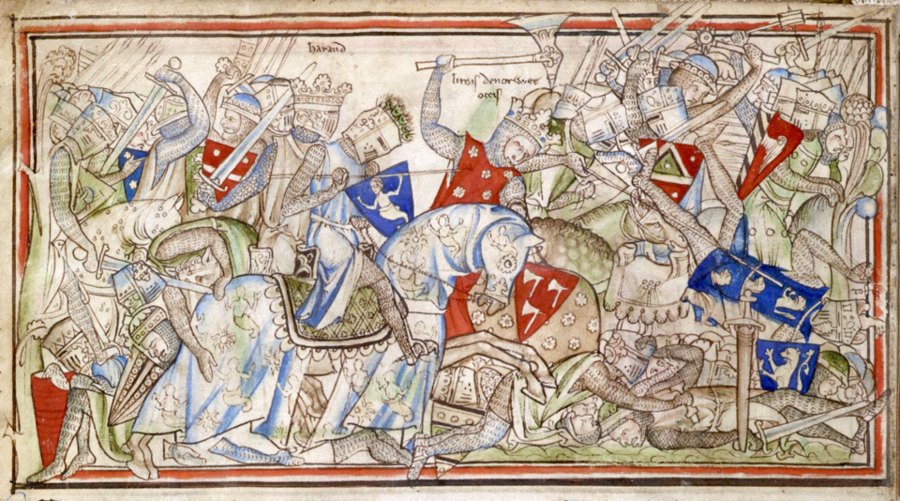
The saga of Harald in Heimskringla stages a striking exchange before battle. Harold offers Tostig restoration and a share of royal power; Harald is offered only enough English earth for his grave. Tostig refuses to abandon his ally. The dialogue makes competing obligations visible: loyalty to a brother, loyalty to a foreign king, and the cost of changing sides. It is excellent evidence for how a later storyteller organized those moral questions. It is not a transcript. The work was assembled in the thirteenth century, long after the participants died. Its polished speeches should be identified as literary narrative whenever they are retold.
Sources for this section: 3, 2
Tactical detail is not automatically stronger evidence
The same saga describes a circular formation, ranks of spearmen, mounted attacks, and the collapse of order when the defenders pursue their opponents. Such detail can make a reconstruction feel unusually secure. Yet detail and proximity are different qualities. English Heritage contrasts the saga’s elaborate account with the earlier chronicle’s terse description of surprise beyond the bridge. Combining every attractive episode into one seamless story can conceal disagreement between sources. The better comparison asks what each account needs the battle to demonstrate. Tactical narrative may give a hero opportunities to display courage and judgment, while a brief annal may concentrate on the reversal of political fortune.
Sources for this section: 3, 2
The battlefield is a changing landscape
Historic England’s description identifies open agricultural ground associated with the fighting and the strategic importance of a Derwent crossing. Modern hedges, roads, buildings, and bridges belong to later phases of that landscape. A visitor can understand why a river crossing mattered without treating the current bridge as a surviving stage set. This distinction is especially useful for the famous story of a lone defender holding the crossing. A dramatic anecdote may acquire a precise modern location through repetition, although its early textual history remains uncertain. Landscape interpretation works best when it explains movement, access, and later alteration alongside the limits of narrative placement.
Sources for this section: 1
Scandinavian intervention continued in 1069
York’s Historic Environment Record describes a renewed crisis in 1069, when English opponents of Norman rule cooperated with a Scandinavian fleet. Their combined forces attacked York and its Norman strongholds. Whatever period label we attach to 1066, this later intervention prevents us from equating Stamford Bridge with the immediate disappearance of Scandinavian military involvement in England. It also changes the political comparison. Alliances were not simply English people resisting all newcomers. Groups could cooperate across the North Sea against a different ruling power. The actors, objectives, and circumstances had changed, but the maritime connections that made intervention possible had not suddenly ceased to exist.
Sources for this section: 4
Orkney offers a different chronology
The surviving church of St Magnus on Egilsay points toward another regional timescale. Historic Environment Scotland connects it with the cult of Earl Magnus, killed according to saga tradition around 1116 and recognized as a saint in 1136. Its round tower has architectural parallels around the North Sea. Here Norse authority, Christian institutions, and distant cultural contacts remained intertwined decades after Stamford Bridge. This does not mean that every practice traditionally associated with the Viking Age continued unchanged. It means that the transition must be described through institutions and places. A battle in Yorkshire cannot supply the same terminal date for an earldom’s political and religious development.
Sources for this section: 5
Using an ending without mistaking it for a boundary
Stamford Bridge remains a useful landmark because a major royal expedition ended decisively there. Its historical importance does not depend on making it the last instance of every Scandinavian activity abroad. Comparing the battlefield, later narrative, renewed intervention at York, and Orkney’s churches produces a more precise account: one campaign failed, stories transformed its memory, and wider networks continued under changing conditions. A period boundary can help organize a book or exhibition while remaining approximate. The practical question is always what is being dated: raiding, royal expansion, settlement, language, religious institutions, or a modern category. Those processes seldom move together.
Sources for this section: 1, 2, 4, 5
For the introductory context, read When was the Viking Age?.
The Evidence
The sources below support this article. Interpretations and limits are explained in the text; this is not an exhaustive research review.