
Journeys & Encounters · Introduction
Staraya Ladoga: Where Baltic and River Routes Met

In Brief
A settlement on the Volkhov connects Scandinavian activity with the waterways of northeastern Europe.
Volkhov River, present-day Russia · Eighth–eleventh centuries
On this page
A location between water systemsEarly buildings and later textsWhat wet ground preservesExchange without a single identitySourcesA location between water systems
Staraya Ladoga stands beside the Volkhov River, about twelve kilometers from Lake Ladoga. From the Baltic, boats could pass through the Gulf of Finland and the Neva into the lake, then continue toward the Volkhov. Archaeologist Natalja Grigorjeva emphasizes this accessibility when explaining the settlement’s attraction for Scandinavian traders, craftspeople, and farmers. It was a place along a route, rather than the distant endpoint imagined from a map centered on Scandinavia.
Early buildings and later texts
Tree-ring dates place the earliest known wooden domestic structures no later than 753. That is a different type of evidence from the Primary Chronicle of Rus’, compiled in the early twelfth century, or the Icelandic sagas that call the place Aldeigjuborg. The buildings establish activity at a particular time. Later writing preserves names, political narratives, and remembered connections, but cannot simply be read as an eyewitness account of eighth-century settlement.
What wet ground preserves
The Hermitage’s account of Ladoga explains why its excavations are unusually informative. Moist deposits preserved building logs, roadway planks, small wooden objects, leather, textiles, and grain alongside metal and pottery. Collections include material from early twentieth-century excavations and later campaigns. This survival lets researchers connect portable goods with the physical environments where people lived. A leather object or wooden implement can reveal activities that a collection limited to coins and jewelry would largely miss.
Exchange without a single identity
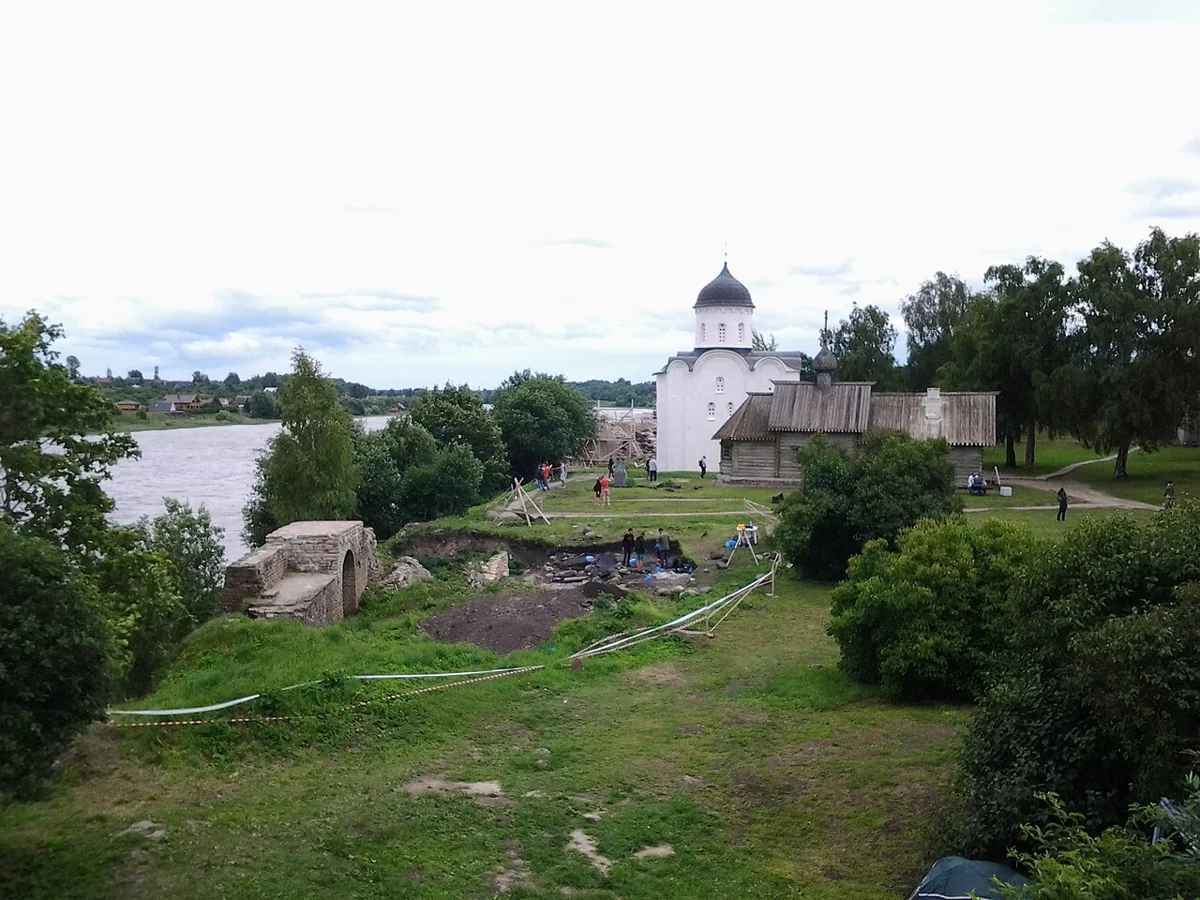
The museum describes Arabic silver moving westward and Scandinavian jewelry, western swords, beads, and combs traveling through wider networks. Local crafts also developed. Such a mixture should not be converted into a claim that every inhabitant shared one origin. A trading settlement could gather materials and techniques from multiple directions. Ladoga’s significance is precisely this intersection: routes, workshops, and successive political relationships met in one place. Its surviving churches and fortifications also belong to different periods, so the visible monument landscape must not be treated as a single Viking-age scene.
The Evidence
The sources below support this article. Interpretations and limits are explained in the text; this is not an exhaustive research review.