Life & Society · Introduction
Before the Voyage: Making a Sail
In Brief
A seaworthy ship depended on textile work as well as timber and iron. Reconstructing a sail reveals the preparation and skilled labor hidden behind the familiar silhouette of a vessel at sea.
On this page
Start before the loomWool makes the scale visibleA sail must suit its hullWhat the experiment can establishSourcesStart before the loom
For its Gislinge Boat reconstruction, the Viking Ship Museum describes the long sequence required to turn flax into thread. Stems are pulled, stripped of seeds, and retted to loosen the fibers. After drying, breaking, beating, and combing, the material is ready for spinning. Weaving is only one stage in producing the cloth.
The museum’s reconstructed sail consists of five panels sewn together. This is a documented modern project, not a surviving Viking sail. The museum notes that no flax sails from the Iron or Viking Ages had been found for this reconstruction, although other evidence demonstrates flax cultivation and processing.
Wool makes the scale visible
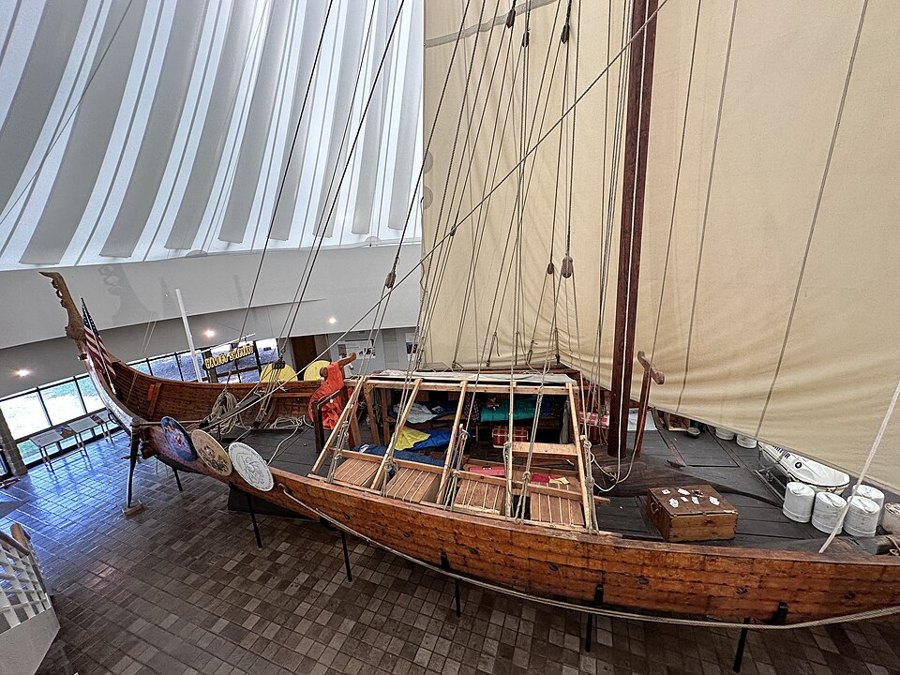
For the reconstruction Ottar, a wool sail made in 1999 covered ninety square meters and used wool from about two hundred sheep. These figures describe one modern experiment. They show the possible scale of material demand without providing a fixed formula for every ancient ship.
A sail must suit its hull
The museum’s sailing research emphasizes the relationship between hull, sail, and rudder. Width and height change how a vessel responds to the wind. A sail that is too broad or narrow for a particular hull can make steering difficult; excessive height adds loads that affect safe handling.
Cargo and ballast matter too. The sail cannot be studied as a detached rectangle of cloth. It belongs to a working arrangement of weight, shape, rigging, and crew decisions.
What the experiment can establish
Few archaeological sail traces survive, so reconstruction draws on comparisons as well as direct finds. A modern voyage can test whether a proposed arrangement works. It cannot prove that every choice of fiber, cut, treatment, or rigging exactly matches the original. Read a reconstruction as a carefully argued proposal whose details can be revised.
The Evidence
The sources below support this article. Interpretations and limits are explained in the text; this is not an exhaustive research review.