
Journeys & Encounters · Deep dive
Wool Sails: Cloth, Treatment, and the Limits of Reconstruction
In Brief
Producing a wool sail required selecting fibers, spinning suitable yarn, weaving, sewing, and finishing. Modern projects let researchers examine this chain without pretending that a complete Viking sail survives.
On this page
Wool is a starting material, not a specificationArchaeology and later traditions supply different evidenceOttar’s sail as a documented projectFinishing changed the clothTextile engineering asks a different questionWhat a fair comparison would requireSourcesWool is a starting material, not a specification
The Viking Ship Museum’s sailcloth research distinguishes different weave structures and yarn arrangements. Its work on reconstructed late Viking Age sails has concentrated on a particular twill, informed by archaeological textile evidence and later northern traditions. The museum presents this as a research choice within a wider range of possibilities, not proof that one weave served every vessel.
The distinction matters because two cloths can both be called wool while behaving differently. Fiber preparation, yarn twist, weave density, and finishing influence the result. Comparing only the animal source hides most of the manufacturing decisions. A useful sail experiment must document those decisions well enough that another maker could understand what was tested. Otherwise, success or failure attaches to the vague category wool rather than to a specific cloth.
Sources for this section: 1
Archaeology and later traditions supply different evidence
The museum draws on both archaeological fragments and surviving wool sails from later northern seafaring traditions. These sources do not have equal chronological relationships to Viking ships. A later sail can preserve a workable technique and offer a comparison, but it is not a surviving eleventh-century sail simply because its makers used wool.
This distinction also prevents a circular argument. A reconstruction based on later practice may sail successfully; that success establishes feasibility, not the date when the practice began. Stronger historical claims require a connection to dated evidence. The role of analogy is therefore to supply testable possibilities where direct material is incomplete. Its contribution should be named openly, especially when a reconstructed sail’s finished appearance makes the uncertain stages of its design easy to forget.
Sources for this section: 1, 2


Ottar’s sail as a documented project
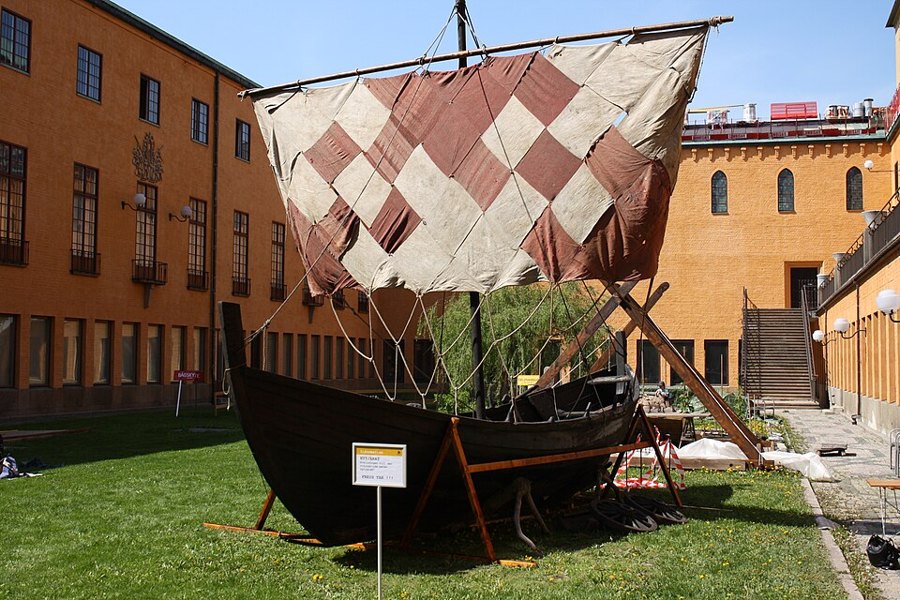
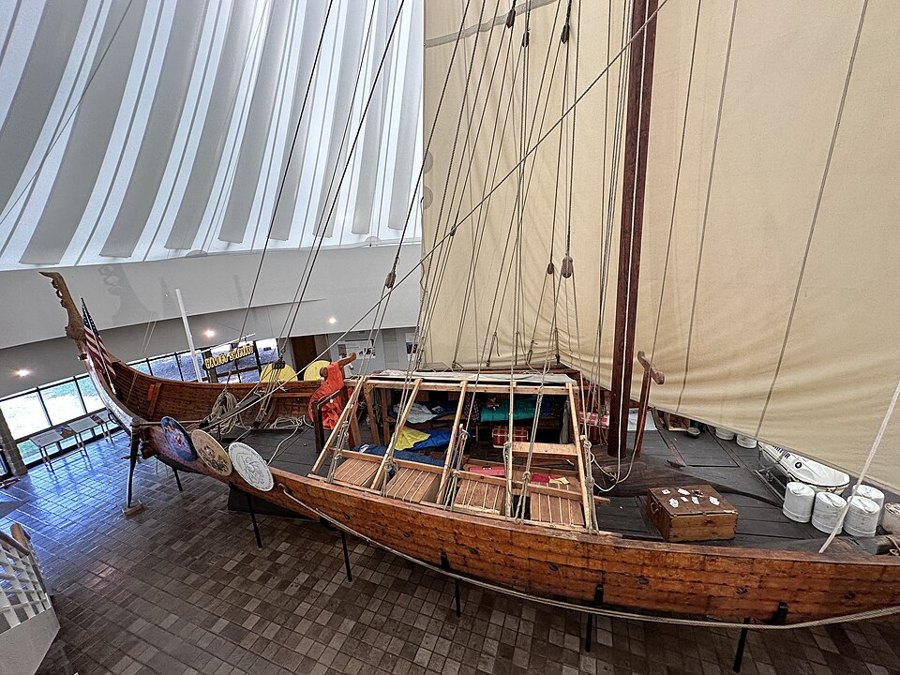
For Ottar’s original wool sail, the museum reports an area of ninety square meters, a dry weight of ninety kilograms, wool drawn from roughly two hundred sheep, and thousands of hours of textile work. These figures belong to the modern project. They are not a recovered account book specifying the cost of the original Skuldelev 1 sail.
The figures nevertheless expose a practical issue that the phrase build a ship can conceal. A hull without its sail is incomplete for the intended sailing task. Textile labor can be a major requirement even though it leaves less durable archaeological evidence than timber or iron. Calculating a hypothetical ancient fleet from hull-building hours alone would therefore omit an essential production chain. The modern project helps reveal what must be counted, while leaving historical workforce size and scheduling unresolved.
Sources for this section: 3
Finishing changed the cloth
The museum records treating Ottar’s wool sail with ochre and a prepared fat mixture, followed by further treatment after use. Its account distinguishes the role of the mineral component in tightening the cloth from the role of the fat. This was a specific reconstructed sail-making procedure, not a universal recipe established for all Viking textiles.
A technical comparison should consequently examine finished cloth rather than untreated fabric alone. The material raised aboard the ship is the outcome of several processes. Its weight, flexibility, and passage of air may differ from the cloth that first left the loom. Treatment can also require renewal, introducing maintenance into the production history. These observations explain why a sail’s making and its use cannot be reduced to separate, unrelated subjects.
Sources for this section: 3
Textile engineering asks a different question
Bill Cooke, Carol Christiansen, and Lena Hammarlund applied textile-engineering methods to reconstructed wool sailcloth. Their paper’s abstract identifies the Trondenes material used as a comparison as mid-thirteenth century: later than the Viking Age. They examined fabric cover factor and compared reconstructed wool textiles with linen sails from the Vasa. That comparison crosses both time and material, so it is an analytical comparison rather than a claim that the ships carried identical cloth.
The approach asks how the arrangement of yarn affects a fabric’s properties. It supplements a visual comparison with a question about construction and behavior. The accessible abstract does not supply every result, so it should not support invented performance rankings. Its value here is identifying an appropriate line of investigation: examine the manufactured fabric, date the comparative material correctly, and state which properties are actually being assessed.
Sources for this section: 2
What a fair comparison would require
A useful comparison between wool and another sail material would keep the vessel, approximate sail geometry, loading, and observed conditions as similar as practicable. It would record repairs and changes over time, not merely the first successful outing. Any differences in yarn, treatment, or handling would need to remain part of the explanation.
This is a proposed experimental framework drawn from the problems these projects reveal. It guards against two opposite simplifications: that wool was inherently primitive, or that any reconstructed wool sail must reproduce Viking performance. The museum’s sail exhibition also points to the wide labor network behind collecting fibers, spinning, weaving, and sewing. The exact ancient organization remains uncertain, but the technological requirement is clear. A functioning sail was a complex manufactured object, and its makers belong in the history of seafaring alongside the people who handled it at sea.
Sources for this section: 2, 4
For the introductory context, read Before the Voyage: Making a Sail.
The Evidence
The sources below support this article. Interpretations and limits are explained in the text; this is not an exhaustive research review.