
Journeys & Encounters · Deep dive
Shipbuilding Labor: What Modern Work Records Can—and Cannot—Measure
In Brief
A ship required connected streams of timber, metal, fiber, fuel, and skilled work. Reconstruction projects reveal this scale, but their hours need careful interpretation before becoming claims about Viking society.
On this page
The hull was one part of the undertakingProcurement extends beyond visible componentsThe tool’s use matters as much as its outlineLater craft traditions are evidence, not a time machineEarly records can be useful and incompleteLabor scale does not identify the labor systemSourcesThe hull was one part of the undertaking
The Viking Ship Museum’s Skuldelev 2 reconstruction account reports approximately 27,000 hours for the ship itself and about 40,000 when associated production was included. These are modern project figures, accompanied by estimates about how a differently organized workforce might complete the task more quickly. They are not a medieval payroll.
The distinction between work hours and elapsed time is essential. Ten people working for a day contribute more labor than one person working for that day, but not every operation can be accelerated simply by adding people. Some tasks depend on other tasks being finished; some require scarce skill or suitable material. A historical claim about how many months construction took therefore needs more than a total number of hours divided by an assumed workforce. A schedule would also need to identify which jobs could proceed together and which had to wait. Preparing cordage while timber was shaped could shorten elapsed time without reducing total labor; waiting for a necessary component could lengthen it without adding much recorded work.
Sources for this section: 1
Procurement extends beyond visible components
The same account records timber, materials for tar, fiber for cordage, and metal among the resources needed. The project used a provisional cotton sail, while discussing the material requirement for a sail made from the reconstructed historical alternatives. That substitution must remain visible when comparing totals.
A resource account can begin at several different points. It might count a finished plank delivered to the yard, a felled trunk, or the search and transport needed to obtain that trunk. These boundaries change the apparent cost without changing the ship. An honest comparison states where its accounting begins and ends. It also distinguishes material retained in the vessel from material consumed, rejected, or transformed during production. The completed ship’s weight cannot stand in for the total resources committed to building it.
Sources for this section: 1

The tool’s use matters as much as its outline
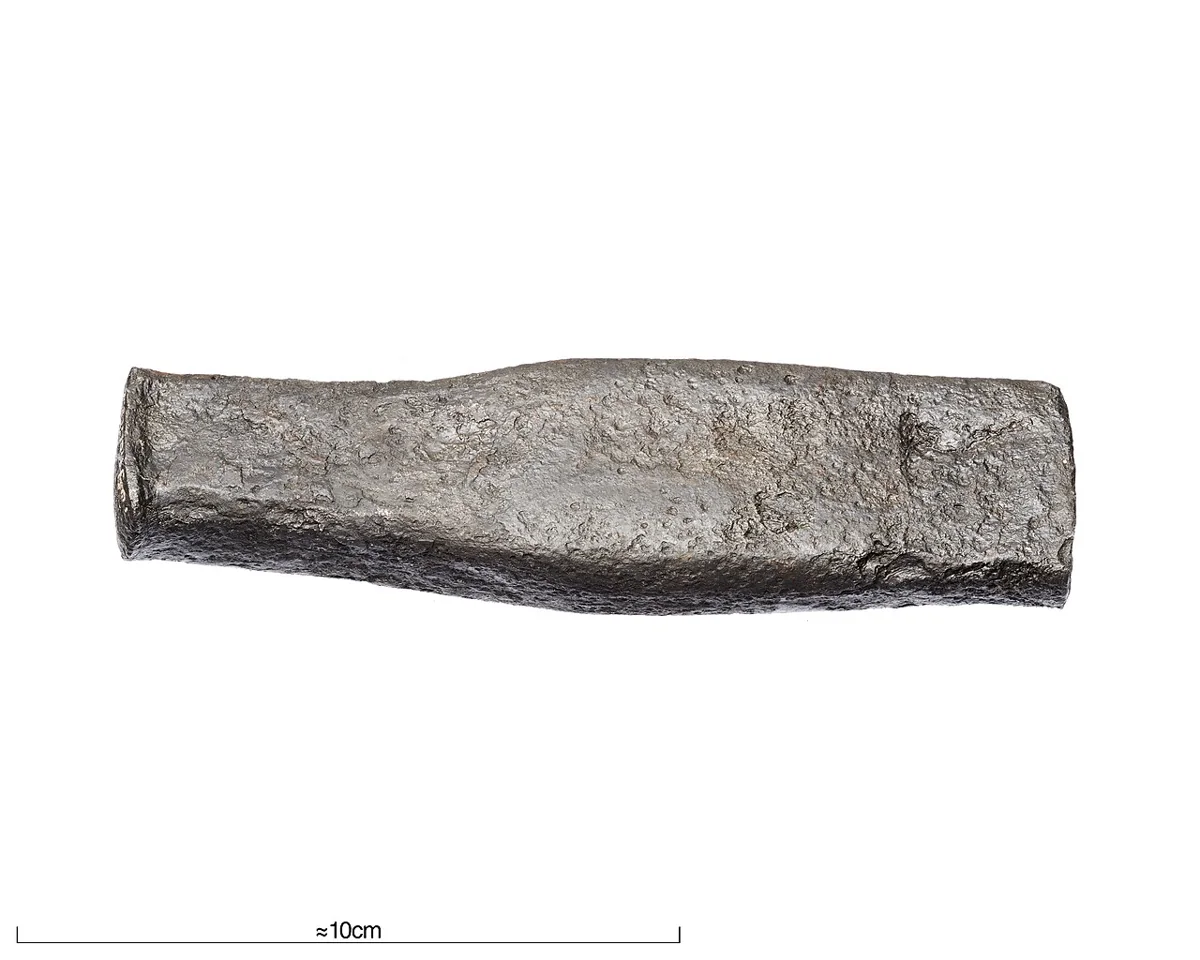
During Ottar’s construction, unfamiliar marks on an original timber prompted investigation of a particular Norwegian hewing technique, sprett-telgjing. The museum describes how recognizing the technique expanded attention to the shape, sharpening, and movement of tools. Reproducing a metal object’s outline was not enough to reproduce the work that made the marks.
This is a concrete example of skill affecting a labor estimate. Two people using superficially similar axes may work differently because one has learned the relevant technique. A reconstruction crew’s early hours can include relearning and experimentation. Those hours are valuable research, but they should not automatically be attributed to an experienced historical builder. Conversely, a modern specialist may benefit from infrastructure or experience unavailable in the past. Neither direction of difference can be assumed away.
Sources for this section: 2
Later craft traditions are evidence, not a time machine
The museum’s maritime-technology discussion emphasizes both continuities and differences between Viking techniques and later woodworking. It notes the importance of fresh timber and the distinct production histories of cordage and sails. A later traditional boatbuilder provides valuable knowledge, but not an unchanged package of Viking practice.
This creates a productive tension. Craft expertise can identify workable solutions that are difficult to infer from drawings alone. Archaeological evidence can challenge familiar modern habits and force a different solution. The strongest experiment uses both, recording where they agree and where a choice remains uncertain. A build undertaken only to finish quickly answers a different question from one that pauses to test competing interpretations. Their labor totals should not be compared as though their objectives were identical.
Sources for this section: 3

Early records can be useful and incomplete
The EXARC history of Roar Ege describes a project in which the team developed proficiency while constructing the vessel. It also notes limitations in its material records: timber quantities were recorded, but exact log dimensions were not consistently preserved, and some categories grouped several components together. The account does not disguise those gaps.
This matters because a later analyst cannot recover missing detail merely by calculating more precisely. A recorded cubic volume may support a broad resource comparison while failing to establish how many trees of a particular form were required. The record remains valuable if used at the level it supports. It becomes misleading only when the uncertainty disappears and an aggregate quantity is transformed into a seemingly exact reconstruction of ancient procurement.
Sources for this section: 4
Labor scale does not identify the labor system
Large requirements demonstrate that shipbuilding depended on coordinated work. They do not independently establish whether that work was paid, owed, coerced, seasonal, household-based, or organized through several arrangements. Those social interpretations need evidence beyond the successful completion of a modern hull.
The reconstruction figures nevertheless provide a disciplined starting point. They reveal categories that a historical explanation must accommodate and dependencies it must solve. A proposal for fleet construction should include sail and rope production, access to suitable timber, metal and fuel supply, and continuing maintenance. It should also state which quantities are measured, which are estimated, and which remain unknown. Shipbuilding then becomes a tractable economic and technical question rather than a contest to produce the largest impressive number.
Sources for this section: 1, 2, 3, 4
For the introductory context, read Woodworking and the Evidence of Tool Marks.
The Evidence
The sources below support this article. Interpretations and limits are explained in the text; this is not an exhaustive research review.