
Journeys & Encounters · Deep dive
Rivets and Roves: The Small Connections That Held Ships Together
In Brief
Shipbuilding depended on metal as well as timber. Fastenings connect the hull to the wider work of ore gathering, fuel production, smithing, and continuing maintenance.
On this page
A fastening is a small assemblyThe forge was near the end of a longer chainNumbers need their original settingWhy copying the shape was insufficientRecording connections after the wood is lostFrom fastenings to a history of workSourcesA fastening is a small assembly
A ship rivet works with a separate inner plate, commonly called a rove. The end of the fastening is secured over that plate, joining the pieces held between it and the outer head. The Viking Ship Museum describes this arrangement in its discussion of the iron used in reconstructed ships. The rove is part of the connection, not an ornamental extra.
Mechanically, the arrangement distributes restraint across surfaces on both sides of a joint. Its behavior depends on more than the nail’s length. The surrounding timber, the hole, the shape of the plate, and the quality of the metal all matter. A surviving rivet can therefore answer several different questions, but none automatically. Before assigning it to a vessel, an archaeologist also needs its context: comparable fastenings could be displaced, reused, or found without the wood they once joined.
Sources for this section: 1
The forge was near the end of a longer chain
The museum’s blacksmith account follows iron back to bog ore. Ore preparation, smelting with charcoal, and further working of the resulting bloom preceded the manufacture of bars and finished fastenings. The forge was therefore one stage in production, not the starting point. Fuel and labor were consumed before a boatbuilder received a single nail.
This sequence changes how the material cost of a ship should be understood. Counting fastenings records an important final requirement, but it omits conversion losses and the work behind the usable metal. The same distinction applies to labor: a person forging rivets and a person preparing fuel are contributing to one technological system through different tasks. The archaeological ship preserves the assembled outcome more readily than the complete organization that supplied it.
Sources for this section: 2
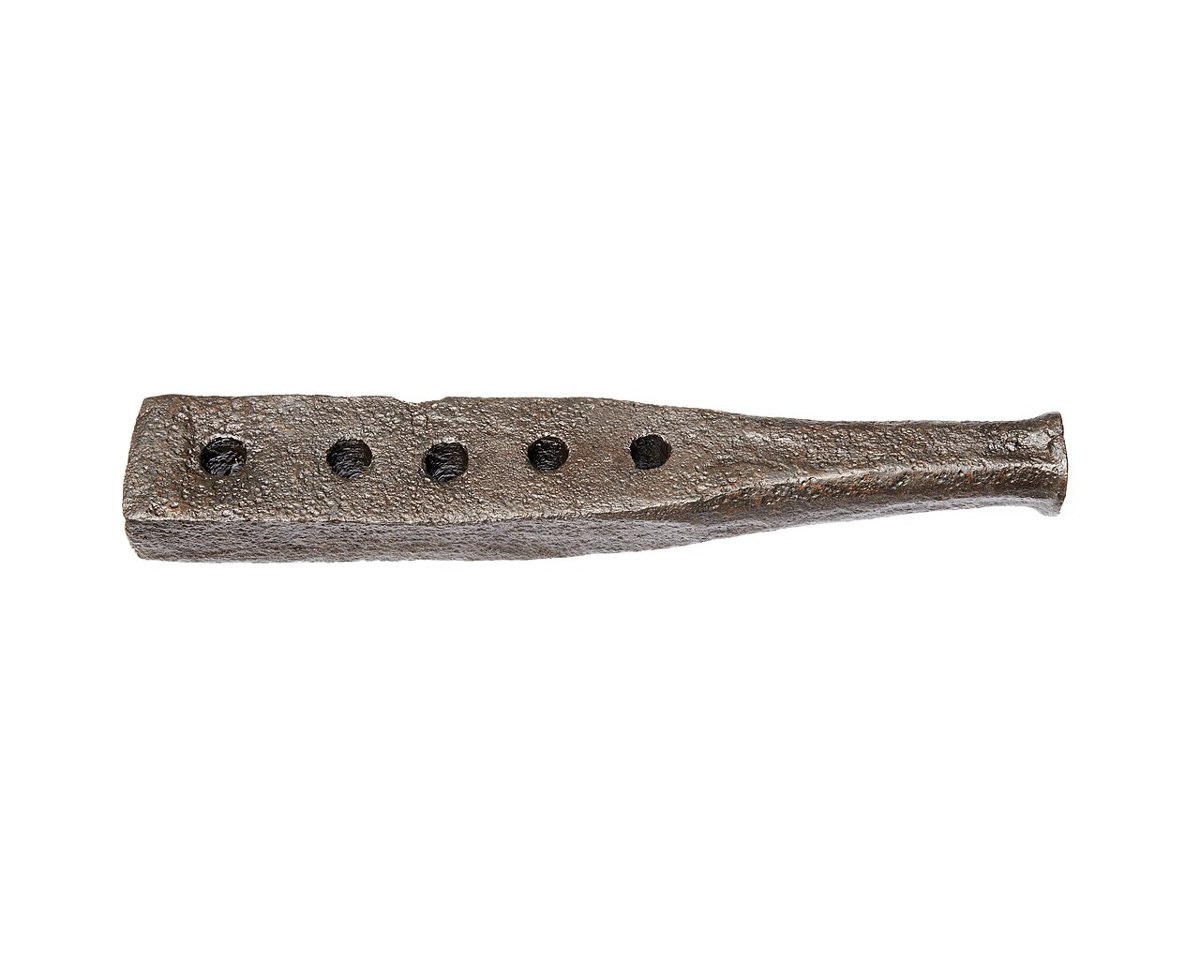

Numbers need their original setting
An older museum exhibition text gives approximately 7,000 hand-forged rivets, 400 kilograms of iron, and about 1,000 modern labor hours for its longship reconstruction example. The museum’s separate blacksmith page describes the large Skuldelev 2 reconstruction as having just under 8,000 rivets. These are not a license to state one exact universal rivet count for Viking longships.
The useful response to such figures is to retain their project context and ask what was counted. Do totals include every fastening, replacements, or particular categories? Was the estimate made before completion? Even where the sources do not resolve the difference, the broad implication remains: thousands of repeated components required organized production. The precise count is less secure than that order of magnitude. Readers should not mistake the visual similarity of two large ships for identical bills of materials.
Sources for this section: 2, 3
Why copying the shape was insufficient
The museum reported a serious problem with relatively pure modern iron in its earlier reconstructions: corrosion could expand the fastenings and damage planks. It consequently chose copper for a later Skuldelev 3 reconstruction while openly acknowledging that this was a modern compromise. That decision illustrates how an apparently authentic material label can conceal significant differences in composition and behavior.
A nail described simply as iron does not specify its microstructure, inclusions, or production history. Those differences can matter during repeated wetting and exposure. The implication is methodological rather than romantic: neither a visually convincing modern nail nor an assumed traditional recipe is automatically equivalent to the archaeological material. An experiment must explain its material choices and the conclusions those choices permit. Copper can serve a practical museum purpose without becoming evidence that the original ship used copper.
Sources for this section: 1
Recording connections after the wood is lost
The museum’s documentation workflow records fastenings and holes alongside timber surfaces and tool marks. This matters because the pattern can survive unevenly. An intact metal object might retain little wood; a timber might preserve a hole after most metal has disappeared. Combining observations is more informative than counting whichever category happens to remain visible.
Consider the questions a record should allow another researcher to ask. Did a hole pass through one member or an overlap? Does its position fit the neighboring component? Is a second hole evidence of repair, an earlier use, or later disturbance? These are interpretive possibilities, not automatic identifications. Recording before conservation or reconstruction is essential because subsequent treatment may obscure relationships. The quiet work of documenting a hole can determine whether a future proposal can be checked.
Sources for this section: 4
From fastenings to a history of work
Rivets connect several scales of history. At the smallest scale, a particular joint can be examined for construction and deterioration. Across a hull, repeated connections reveal assembly choices and sometimes changes during use. Beyond the vessel, demand for metal points toward fuel, raw materials, and people whose labor is otherwise less visible in the ship display.
These scales should not be collapsed. A large fastening total does not tell us whether workers were free, enslaved, seasonal, or permanently attached to an elite household. Likewise, a failed modern rivet cannot establish a standard ancient maintenance interval. The defensible account describes what the objects and experiments show, then identifies what additional evidence would be needed. This approach makes the fastening more interesting, not less: it places a small object within a technical and economic problem that can be investigated.
Sources for this section: 2, 3, 4
The Evidence
The sources below support this article. Interpretations and limits are explained in the text; this is not an exhaustive research review.