
Journeys & Encounters · Deep dive
Clinker Construction: How Overlapping Planks Make a Hull
In Brief
A clinker hull was a connected structure whose seams, fastenings, timber, and internal supports worked together. The overlap is the beginning of the explanation, not the whole design.
On this page
An overlap with structural consequencesBuilding a shape rather than assembling identical stripsWhy grain matters alongside geometryThe seam is also a fastening systemReading a dismantled hullWhat clinker construction does not tell usSourcesAn overlap with structural consequences
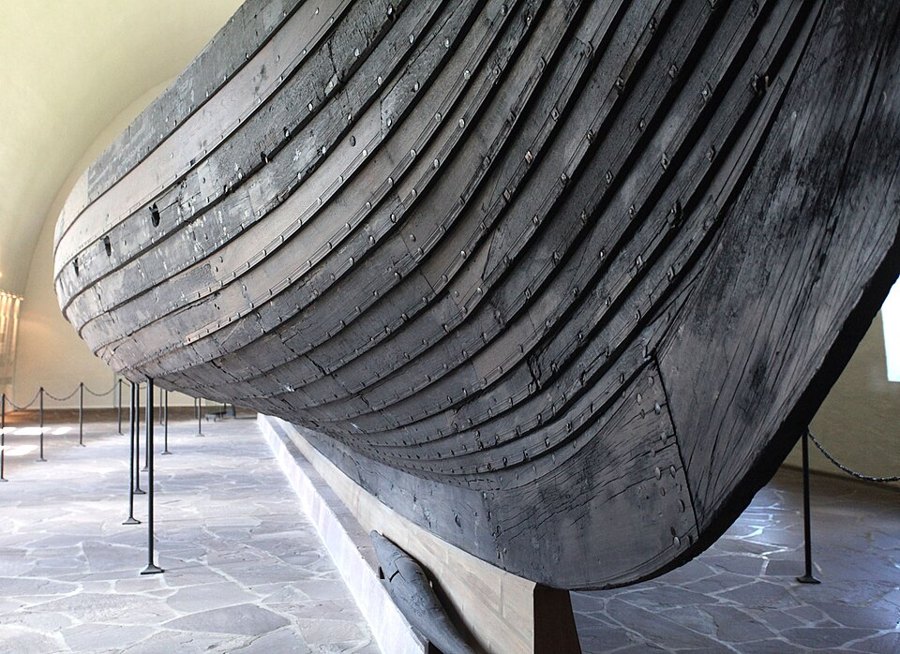
Clinker construction joins neighboring hull planks with their edges overlapping. Looking along a surviving ship, the repeated steps identify successive strakes, the rows of planking that run lengthwise. The Viking Ship Museum explains that these overlaps contribute longitudinal strength. Internal frames could consequently be relatively widely spaced, helping builders keep the hull light. This was an established northern tradition before the Viking Age, not an invention that appeared suddenly around 800.
The useful comparison is with a collection of disconnected boards. A loose board can bend independently; joined edges make adjacent boards share movement and loads. The hull is therefore more than a covering attached to an internal skeleton. Its geometry and its connections participate in supporting the vessel. Describing this as a strong shell helps, provided shell does not suggest a rigid, seamless container.
Sources for this section: 1
Building a shape rather than assembling identical strips
A strake follows a three-dimensional course: it may rise toward the ends, twist, and change width. The overlap must continue through those changes while leaving enough wood around the fasteners. This creates a practical relationship between the shape selected for a plank and the shape emerging in the hull. The builder cannot treat every plank as interchangeable stock.
The museum’s recent reconstruction of Skuldelev 3 illustrates the archaeological consequences. Reconsidering the excavation drawings produced a hull broader amidships and with a more curved keel than the earlier reconstruction. The original also contained asymmetries and irregularly shaped internal pieces. These were evidence to accommodate, not automatically imperfections to erase. A visually tidy reconstruction can depart from a historically untidy but workable vessel. The point is not that any irregularity is acceptable: the assembled structure still has to fit and function.
Sources for this section: 2

Why grain matters alongside geometry
The museum’s account of cleaved planking describes choosing substantial, relatively straight trees and splitting along their fibers. Subsequent shaping reduced the rough pieces to usable planks. A split piece could be twisted without being inherently weak; cutting across its fibers to force it into a desired straight appearance could undermine the advantage of the material.
That distinction separates two questions often collapsed into one: does a component look straight, and does its internal structure suit its job? In a bending plank, a continuous path through the wood matters. Material selection begins before the hull exists, and the developing hull must respect what that material can do. A model made from uniform sheet material can reproduce outlines while concealing this important constraint. Reconstructing a boat at full scale brings the relationship between form and timber back into view.
Sources for this section: 3
The seam is also a fastening system
An overlap alone cannot hold a vessel together. Museum research describes Viking Age hulls using wooden fastenings and iron nails, including rivets with separate roves. A riveted connection clamps material between a head and the secured inner end. Its performance depends on the metal, the wood around the hole, and the way the joint is made.
Thinking through the mechanics explains why simply making every fastening tighter is not a universal solution. Too little restraint permits unwanted movement; excessive local pressure can damage the surrounding wood. Thickness, hole placement, and contact between the overlapping surfaces all matter. This is an engineering explanation of the joint, not a recovered Viking instruction manual. Archaeological measurements constrain the possible arrangement, while reconstruction tests investigate how particular choices behave. A line of surviving holes can thus be as informative as a conspicuous decorative carving.
A modern reconstruction can also include deliberate material compromises. In its 2020 project account, the Viking Ship Museum explained that the new Skuldelev 3 reconstruction would use copper rivets and roves instead of iron. Modern iron fastenings in earlier reconstructions had corroded and damaged the surrounding planks. Copper was chosen to reduce that damage and conserve timber; it is not evidence that the original Viking-Age ship used copper fastenings. Hull shape and fastening material therefore need to be assessed separately when comparing the reconstruction with the archaeological vessel.
Sources for this section: 4
Reading a dismantled hull
Excavation rarely supplies a boat that can simply be lifted and sailed. The museum records individual timbers through photographs, measurements, descriptions, and three-dimensional documentation. Fastener holes, tool marks, and remnants of sealing material receive particular attention. These observations help reconnect pieces that have moved, broken, or changed shape after deposition.
A sensible reconstruction must satisfy several clues simultaneously. A plank’s edge has to meet its neighbor, its fastening pattern has to make sense, and its relation to an internal support cannot contradict the surviving evidence. One appealing outline is insufficient. This is why the recorded details remain valuable after the wood is conserved and displayed. They let researchers revisit an earlier solution without treating the first reconstruction as the final authority. The museum’s two interpretations of Skuldelev 3 make that process especially visible.
Sources for this section: 5, 2
What clinker construction does not tell us
Recognizing overlapping planks does not identify a warship, determine a voyage, or establish the social identity of its crew. The technique can support vessels with different proportions and purposes. Nor does the word clinker give a numerical speed or carrying capacity. Those require a reconstructed hull, an assumed load, and specified operating conditions.
The strongest interpretation therefore keeps three levels separate. The surviving overlap is an archaeological observation. The proposed original hull is a reconstruction constrained by observations. The behavior of a modern sailing version is experimental evidence about that version under recorded conditions. Moving between these levels is necessary, but doing so explicitly prevents the attractive modern ship from replacing the original find in our reasoning. Clinker construction was a sophisticated integration of material and shape; its success does not remove the need to examine each individual vessel.
Sources for this section: 1, 2, 5
The Evidence
The sources below support this article. Interpretations and limits are explained in the text; this is not an exhaustive research review.