
Journeys & Encounters · Deep dive
Selecting Timber: Why the Tree Was Already Part of the Design
In Brief
A boatbuilder needed more than a large quantity of wood. Straight trunks, branching pieces, fiber direction, and the intended component all influenced what counted as useful timber.
On this page
A forest is not a stack of identical boardsSplitting works with the materialWatching a split developDifferent woods in one vesselWhat a modern build can measureReading craftsmanship without inventing the craftsmanSourcesA forest is not a stack of identical boards
The modern search for timber at the Viking Ship Museum shows how selective traditional construction can be. For a reconstruction of Skuldelev 3, the museum sought large oaks with suitable form rather than simply buying an equivalent volume of timber. Its 2017 account describes using trees planted for Denmark’s nineteenth-century navy. This is a modern procurement story, not evidence that Viking woodland was managed by the same system.
The comparison is useful because it distinguishes quantity from suitability. Ten short trunks cannot automatically replace one long, clear trunk needed for a particular plank. Likewise, abundant straight timber cannot substitute without consequences for a naturally curved piece. A supply estimate expressed only in cubic volume therefore misses part of the problem. The range of shapes and qualities available matters alongside the total amount of wood.
Sources for this section: 1
Splitting works with the material
In oak, splitting tends to follow the fibers and radial structure of the trunk. The museum’s plank-making account emphasizes this relationship. A twisted split does not necessarily mean the wood has failed: the danger can arise when a builder cuts across the fibers while trying to impose an unrelated shape. Selection and shaping must therefore be considered together.
There is a practical distinction between removing unwanted wood and manufacturing an idealized outline. Every cut changes the remaining piece. A builder seeking a light plank wants enough strength left in the directions where loads will act. That requires reading the wood rather than treating it as uniform plastic. This interpretation explains why the apparent simplicity of wedges and axes should not be confused with a low level of knowledge. The tools place unusual demands on judgment.
Sources for this section: 2


Watching a split develop
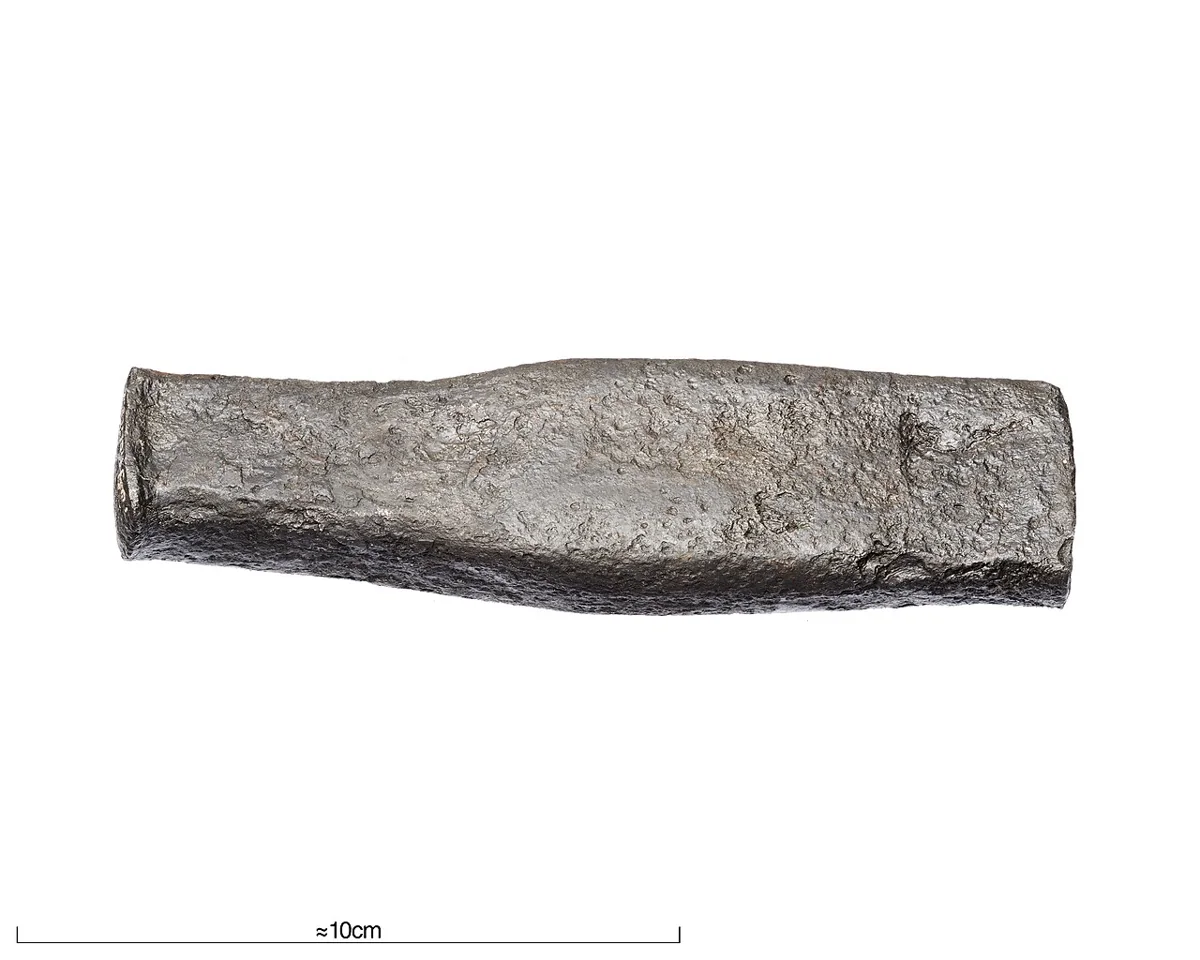
The Gislinge reconstruction diary describes a coordinated operation using wedges, mallets, axes, and observation. Workers opened the log progressively, watched the developing split, and adjusted their positions. Further divisions produced narrower sectors that could be shaped into planks. The original Gislinge boat dates to the early twelfth century, so this example is an explicitly later comparison within the northern building tradition.
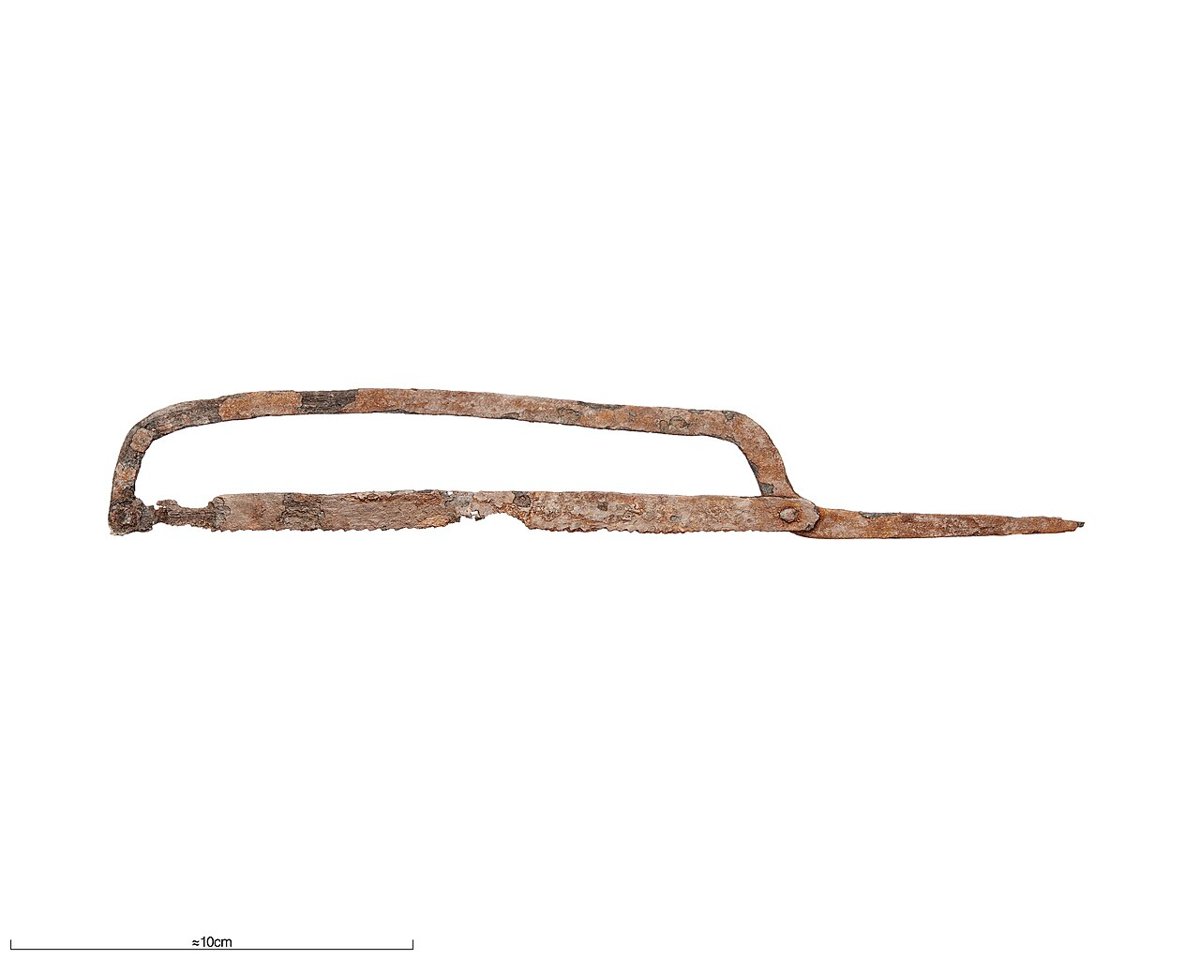
The diary also makes an important distinction about saws. Small saw blades existed, but the account reports no saw marks on the relevant Viking and early medieval ship timbers. The argument is therefore about observed woodworking practice, not the absolute absence of a tool from society. A reconstruction that uses axes is testing the evidence for these particular components. It should not become a claim that every wooden object in the period was made by splitting.
Sources for this section: 3
Different woods in one vessel
Skuldelev 5 provides a striking alternative to imagining a hull made entirely from one fresh, uniform supply. The museum’s 2023 building account describes lower oak strakes, higher pine planks reused from other vessels, and an upper strake largely of reused ash. The ship’s construction history involved a selection among available pieces, including timber with an earlier maritime life.
Reuse changes the questions asked of a plank. An extra hole might relate to an earlier position rather than the final vessel. A species difference might reflect procurement or rebuilding, not a decorative choice. Equally, reuse does not by itself prove poverty or emergency. Establishing motive requires more evidence than establishing that a component had already been used. The hull preserves decisions, but rarely the conversation or budget that produced them.
Sources for this section: 4
What a modern build can measure
An experimental project can record how many candidate trees were inspected, how much material each yielded, and where a split became unusable. Those measurements would help distinguish losses during conversion from wood retained in the finished hull. They would also make clear why the weight of a completed ship cannot be translated directly into the amount harvested.
Comparing two builds requires similar accounting. One project might count only shaping time, another include searching, felling, transport, and storage. A crew using prepared timber starts at a different point from a crew collecting its own. These are methodological deductions from the documented procurement and cleaving processes, not additional historical measurements. They identify the information needed before a modern labor total can support an argument about the resources controlled by an ancient shipowner.
Sources for this section: 1, 3
Reading craftsmanship without inventing the craftsman
The combination of suitable growth, controlled splitting, and selective reuse demonstrates that timber was an active constraint on construction. It does not tell us a builder’s name, employment status, or complete training history. Nor can one well-chosen component establish that every vessel was equally carefully made. Surviving ships represent particular decisions and particular histories of preservation.
A productive inspection moves from the piece to the claim. Which species is identified? How do fibers run through the component? Are there tool marks, unused fastener holes, or edges suggesting an earlier use? Which features belong to the original object, and which to conservation or reconstruction? Asking these questions keeps the discussion anchored in wood that can actually be examined. The result is a richer account of technical skill than praising unnamed Vikings as naturally gifted boatbuilders.
Sources for this section: 2, 4
For the introductory context, read Woodworking and the Evidence of Tool Marks.
The Evidence
The sources below support this article. Interpretations and limits are explained in the text; this is not an exhaustive research review.