
Journeys & Encounters · Deep dive
Caulking and Tar: Keeping Water Outside the Hull
In Brief
Sealing a wooden ship connected fine work at the seam with large-scale production in the forest. Archaeological residues and reconstruction records reveal different parts of that relationship.
On this page
A hull has many possible paths for waterA small thread can have a large jobTar begins in a controlled fireScaling up without false precisionProtection and sealing are related but differentA forest industry behind the sailing imageSourcesA hull has many possible paths for water
A wooden ship is assembled from separate components. Every seam and fastening passes through a structure that moves, becomes wet, and may spend time drying ashore. Keeping water outside therefore requires more than covering the visible surfaces with a dark substance. The fit of the parts, the condition of the connections, and material placed within the joints all contribute.
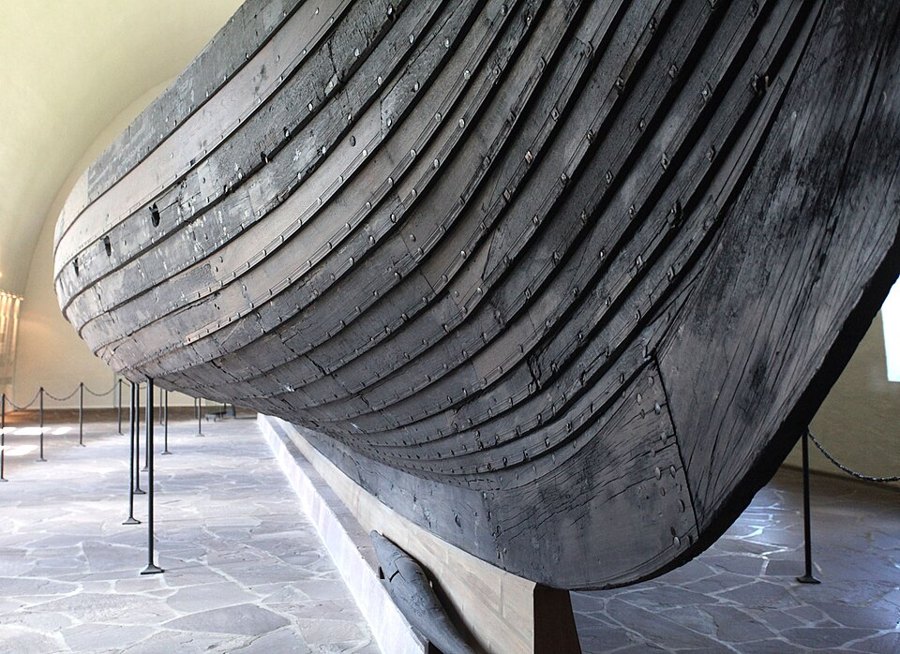
The Viking Ship Museum’s Gokstad boat project illustrates the distinction. Its description places tar-coated wool between carefully fitted planks. The cloth-like material occupies the joint; it is not merely a cosmetic coating on the finished boat. This example concerns a modern reconstruction of one of the small boats associated with the Gokstad burial, rather than a direct observation of every Viking ship. It offers a concrete way to understand how sealing and assembly interact.
Sources for this section: 1
A small thread can have a large job
The museum’s account of Estrid Byrding describes a three-strand tarred wool thread matching material found between the planks of the original Skuldelev 3. That connection to an excavated seam is especially valuable. It ties the reconstruction choice to evidence from the vessel being interpreted rather than only to later tradition.
The engineering inference is straightforward: the sealing material must fit the joint without preventing the timber surfaces from being properly connected. More material is not automatically better. Uneven packing could change contact and fastening behavior; insufficient packing could leave a route for leakage. To assess a reconstructed seam, researchers would need to record both the material and the way it was installed. The label wool alone does not specify thickness, preparation, placement, or the condition of the surrounding wood.
Sources for this section: 2

Tar begins in a controlled fire
Andreas Hennius’s study of tar production explains the heating of wood in a low-oxygen environment. Archaeological features in eastern Sweden were identified through their form and scientific analysis, including examination of wood and chemical residues. The study distinguishes smaller settlement-associated features from much larger forest production installations.
This is a different body of evidence from a coated ship plank. A production pit concerns manufacture, while residue on a vessel concerns use. Connecting them requires chronology, geography, and a plausible route between producer and consumer. The connection can be strong without identifying a particular shipment. We should not imagine a documented delivery from an excavated pit to a named ship unless evidence actually provides it. The broader significance is that maritime activity depended on materials made far from the waterfront.
Sources for this section: 3
Scaling up without false precision
Hennius interprets the larger installations as evidence for a changed scale and organization of production, perhaps beginning in the eighth century. He argues that intensified maritime activity likely increased demand. This is an explanatory relationship, not a calculation proving that every additional ship created a fixed number of new tar pits.
The museum’s exhibition gives a modern Finnish tar-burning example involving carefully stacked pine roots and a multi-day burn. Its production and labor estimates make the effort tangible, but they describe a particular process. Scaling them backward requires assumptions about wood quality, installation design, collection efficiency, and work organization. A numerical result can look authoritative while depending on all those choices. The responsible comparison uses modern experience to identify constraints and orders of magnitude, not to claim an exact annual Viking tar budget.
Sources for this section: 3, 4
Protection and sealing are related but different
Estrid Byrding’s documented treatment includes a surface mixture of wood tar and linseed oil. Its seam material, by contrast, is the tarred wool thread. These two uses should not disappear into one vague statement that the ship was waterproofed. Surface treatment concerns the exposed wood; packing a seam concerns a particular opening between members.
This distinction also guides diagnosis. If a reconstructed vessel admits water, changing its coating may not solve a loosened connection or a damaged plank. Conversely, sound joints do not remove the need to maintain exposed material. A useful maintenance record would identify where leakage occurred and which intervention changed it. This is a proposed way to evaluate the process, not a claim that an archaeological ship retains a complete log of treatments applied during its working life.
Sources for this section: 1, 2
A forest industry behind the sailing image
The combined evidence makes the ship’s supply network wider than a boatyard. Wood had to be obtained for structural components and for products used to treat and seal them. People needed to manage heat, collect the resulting material, and move it to where it was required. These tasks are analytically distinct even when one household or group might have carried out several of them.
The uncertainty lies in assigning institutions and people to that work. Larger installations do not by themselves tell us whether production was controlled by elites, organized cooperatively, or distributed through several arrangements. Nor does tar prove that a vessel was seaworthy in every condition. What survives supports a more grounded claim: sealing depended on both careful local workmanship and a wider material economy, and both deserve a place in the history of Viking seafaring.
Sources for this section: 3, 4
The Evidence
The sources below support this article. Interpretations and limits are explained in the text; this is not an exhaustive research review.