
Journeys & Encounters · Deep dive
Masts, Yards, and Rigging: Following the Forces through a Ship
In Brief
The sail’s force had to pass through ropes and timber into the hull. A working rig combined support, adjustment, lifting, and quick responses when conditions changed.
On this page
A mast is not a free-standing poleStanding support and moving controlsRaising a heavy sail aboard Sea StallionMechanical advantage does not eliminate workRig dimensions and the balance of the vesselWear can test a reconstructionSourcesA mast is not a free-standing pole
A square-rigged ship’s mast supports a yard from which the sail hangs, but the visible spars are only part of the system. The Viking Ship Museum’s diagram of Sea Stallion also identifies shrouds, stays, braces, a halyard, sheets, and their attachment points. The drawing records the rig of that modern reconstruction; it is not a complete surviving Viking rigging plan.
Following forces through the arrangement explains why these details matter. Wind acting on the sail creates loads that reach the yard, mast, ropes, and hull. A support that is adequate in one direction may need another connection to resist movement in a different direction. Increasing the size of the sail consequently affects more than the amount of cloth. It changes demands throughout the connected structure, including places far below the sail itself.
Sources for this section: 1
Standing support and moving controls
A useful distinction separates ropes supporting the rig from those used to operate it. The museum’s rigging diagram lets a reader follow several different jobs: holding the mast, raising the yard, controlling the yard’s angle, and managing the sail’s lower corners. These jobs should not be collapsed into the generic word ropework.
Imagine trying to turn the yard while also expecting the same unsecured line to provide dependable mast support. The conflict illustrates why functions are distributed through the rig. Likewise, a line that must be hauled repeatedly faces different practical demands from one that remains under tension. The diagram offers names and locations; understanding the arrangement requires considering movement and load. The historical reconstruction remains open to revision where archaeological fittings or comparative evidence permit different solutions.
Sources for this section: 1
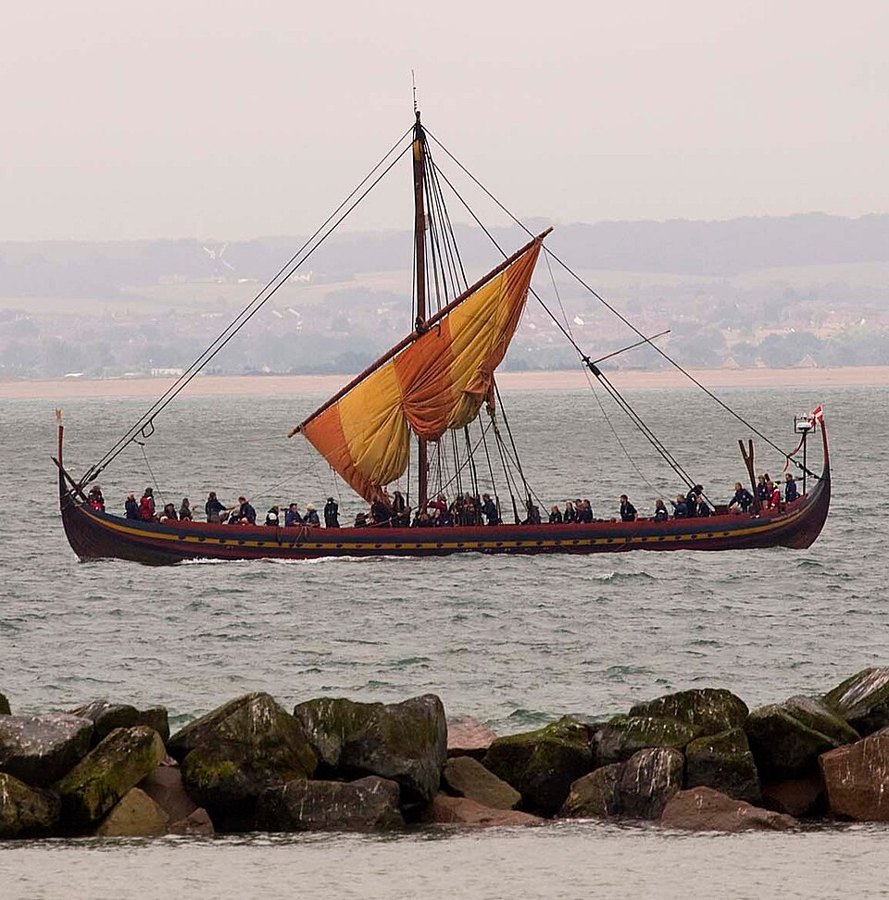

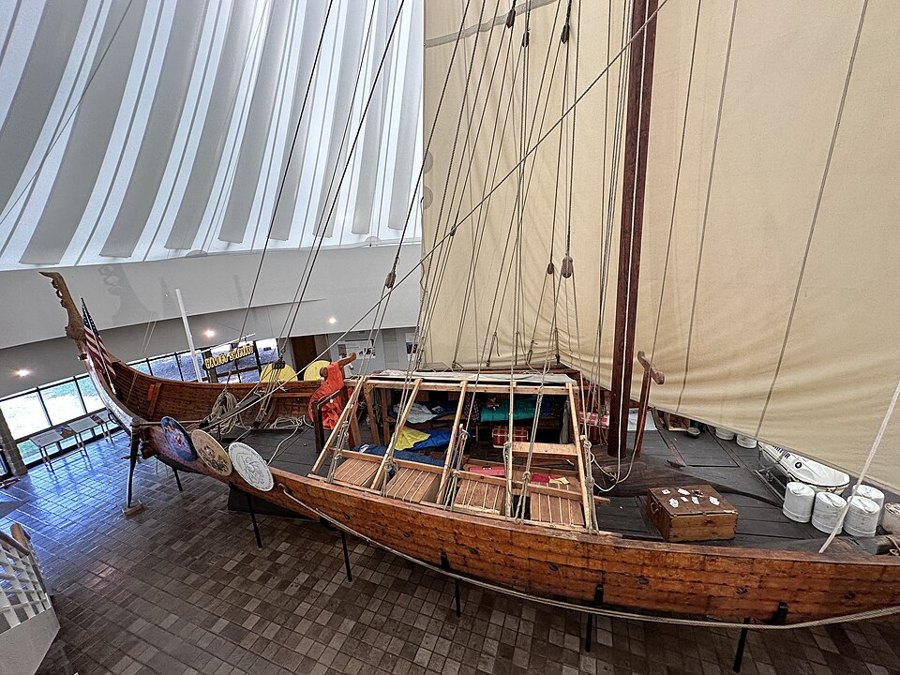

Raising a heavy sail aboard Sea Stallion
A 2008 voyage report describes Sea Stallion’s halyard system using a pair of pulley blocks, each with two wheels. Crew members hauled together while others secured the line. The report also explains that a fragmentary pulley from Hedeby informed the reconstruction, but did not establish whether the original block had one wheel or two.
This is a strong example of the difference between an archaeological constraint and an operational choice. The find supported the use of a pulley arrangement; the precise reconstruction also depended on what the team considered necessary for handling the sail. The arrangement worked, but successful operation alone cannot recover the missing half of the archaeological object. It demonstrates a feasible solution within the stated assumptions. That is valuable experimental evidence, provided the assumptions travel with the result.
Sources for this section: 2
Mechanical advantage does not eliminate work
The same voyage report describes the effort involved in making sail even with a multi-part tackle. The mechanical principle helps explain this experience. A purchase can reduce the force each haul must overcome, but it requires more rope movement. Friction and the need to control the load also remain. The rig exchanges one kind of difficulty for another rather than creating free energy.
This means crew coordination belongs to the technology. Enough people must be able to reach the appropriate line, pull without obstructing one another, and secure or release it when needed. A rig that can lift a sail slowly in a calm harbor may still be awkward during a maneuver. Evaluating it requires attention to the working space and timing, not only the breaking strength of individual ropes.
Sources for this section: 2
Rig dimensions and the balance of the vessel
The museum’s maritime technology account explains that sail dimensions must suit the hull and steering arrangement. Too much or too little breadth can produce undesirable steering tendencies. Excessive height increases demands on the vessel, while an undersized arrangement can leave it ineffective in ordinary conditions. Surviving fittings on Skuldelev 3 help constrain the position and breadth of its reconstructed sail.
These relationships explain why copying a sail from a larger ship and shrinking it visually is a weak method. The hull’s underwater form, the load it carries, and the location of the rig interact. A reconstruction needs a defensible set of proportions, followed by testing under stated conditions. A handsome photograph does not show whether the vessel can balance its forces efficiently or how much correction the helmsman must apply.
Sources for this section: 3
Wear can test a reconstruction
The museum’s broader sail account emphasizes how few traces of complete sails and rigs survive. Comparative material must therefore fill gaps. Testing those choices means looking not only at whether the ship moves, but also at how its equipment wears and how easily its crew can operate it.
A useful record would identify the rope material, the loading arrangement, the sail area in use, and the state of the blocks and attachment points. If a line wears rapidly, several explanations remain possible: material, alignment, friction, or operating practice. Changing all of them at once may produce a reliable ship but obscure which change mattered. The mast and yard become historical evidence through this disciplined comparison. Their value lies in showing how a proposed system works, while preserving the distinction between the original find and the modern working solution.
Sources for this section: 4, 2
The Evidence
The sources below support this article. Interpretations and limits are explained in the text; this is not an exhaustive research review.