
Journeys & Encounters · Deep dive
Square Sails and Sailing Angles: What Progress against the Wind Means
In Brief
A square sail did not restrict a ship to drifting downwind. The harder questions concern leeway, turning, effective progress, and the conditions behind a performance figure.
On this page
The sail and the underwater hull work togetherHeading and actual track are differentSpeed is not the same as useful progressChanging tack has a costA speed diagram compares like with likeWhat an experimental voyage can establishSourcesThe sail and the underwater hull work together
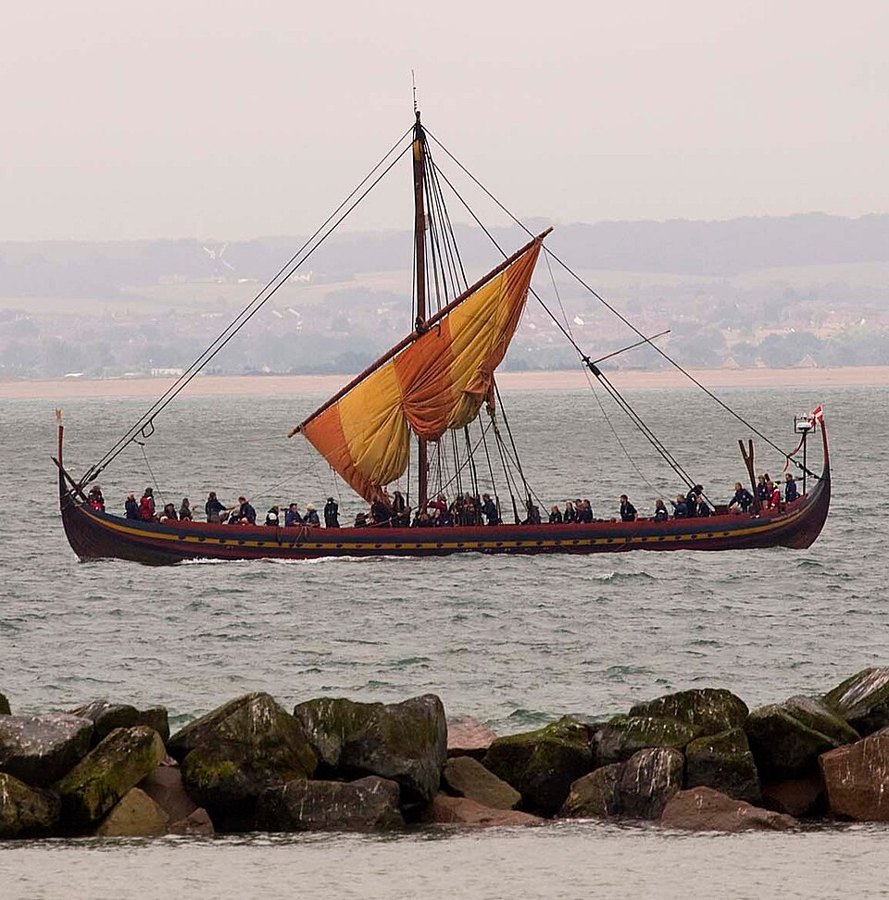
The Viking Ship Museum explains sailing obliquely toward the wind through the combined action of sail and hull. The sail produces a force with both forward and sideways components. The submerged hull resists sideways movement, though some leeway remains. The result can be forward progress on a course that is neither directly downwind nor directly into the wind.
That account corrects a common visual misconception. The outline of a square sail does not tell us that it behaves only as a flat wall pushed from behind. Its orientation and shape matter. Equally, the explanation does not imply that a Viking reconstruction can sail at any desired angle. Wind, hull, load, and handling set practical limits. A claim about sailing ability must therefore specify the vessel and the conditions in which the ability was observed.
Sources for this section: 1
Heading and actual track are different
The museum’s tacking exercise asks readers to compare the ship’s steered course with its course made good. This is important because a bow pointing in one direction does not guarantee that the ship travels precisely along that line. Leeway and moving water can separate the intended direction from the path over the ground.
A simple example illustrates the consequence without claiming a historical measurement. If a ship points toward a distant headland while steadily sliding sideways, a photograph of its bow direction exaggerates its progress toward that target. Position measurements over time are needed to establish the track. The distinction matters particularly close to shore, where apparent clearance may differ from the route actually followed. Navigation and sail performance cannot be separated merely by assigning one to the helmsman and the other to the sail.
Sources for this section: 2

Speed is not the same as useful progress
The museum uses velocity made good to describe effective progress in the required direction. This differs from the distance traveled along a zigzag track. A vessel can move quickly through the water while taking a long indirect route to its destination. That difference is central to assessing whether sailing or rowing is more useful over a particular short stretch.
For illustration, suppose a hypothetical vessel moves at four knots on a track sixty degrees away from the desired direction. Ignoring current and turns, the forward component toward the destination is two knots, because the cosine of sixty degrees is one half. This is a mathematical example, not a measured Viking performance. It shows why quoting peak speed alone tells a traveler little about arrival time. The angle and the time spent maneuvering belong in the calculation.
Sources for this section: 2, 3
Changing tack has a cost
The museum distinguishes turning through the wind from turning away and around with the wind behind. A long-keeled reconstruction may not complete every attempted tack cleanly. Its teaching material therefore asks researchers to examine the track, lost speed, time taken, and recovery after the turn.
Consider a crossing that requires ten changes of tack rather than one. Even if the speed between turns is identical, the total journey need not be. Each maneuver can consume time and sea room. In narrow water, the available space may become the controlling constraint before maximum speed does. This is why successful open-water sailing does not automatically demonstrate convenient access to every harbor. Performance must be evaluated at the scale of the actual task, including its awkward transitions.
Sources for this section: 1, 4
A speed diagram compares like with like
The museum’s speed-diagram exercise organizes observations by wind angle while separating wind strength and sail area. It also acknowledges less easily controlled influences such as waves, crew skill, and the vessel’s weight. The resulting diagram describes a set of conditions, not an unqualified speed rating.
This approach makes an otherwise vague comparison testable. Two runs can differ because the ship changed, because the wind changed, or because its crew handled it differently. Sorting observations reduces some ambiguity but does not remove every confounding factor. The correct question is therefore not which reconstruction is fastest in a single anecdote. It is how each performs across comparable conditions, and how much uncertainty remains in that comparison. Maximum values deserve particular caution because they may represent brief favorable moments.
Sources for this section: 3
What an experimental voyage can establish
Sea Stallion’s recorded positions and weather observations allow questions about a real reconstructed vessel to be investigated. They can show whether particular maneuvers succeeded and how effective progress varied. They cannot tell us exactly how every medieval crew sailed or guarantee the same result with another hull, sail material, or loading arrangement.
The defensible conclusion is both more interesting and more limited than saying square sails could or could not sail upwind. Their usefulness depended on a complete system and the choices made while operating it. A crew might accept a longer sailing route, row a short difficult section, or wait for conditions to change. The experimental data help define the costs of those alternatives. Historical interpretation then asks which alternative was plausible in the particular voyage under discussion, rather than converting one modern result into a rule for the entire Viking Age.
Sources for this section: 2, 3, 4
The Evidence
The sources below support this article. Interpretations and limits are explained in the text; this is not an exhaustive research review.