
Journeys & Encounters · Deep dive
Rowing a Longship: Crew Numbers, Space, and Sustained Work
In Brief
More occupied oars did not always mean proportionately greater progress in modern trials. Space, wind resistance, fatigue, and the time needed to change configuration all mattered.
On this page
The oar is supported by the hullA controlled comparison produced a surpriseThe raised rig created a costShort bursts and endurance answer different questionsProgress depends on what is measuredA crew is part of the propulsion systemSourcesThe oar is supported by the hull
The Viking Ship Museum distinguishes oar ports through planks from oar locks mounted above the side. Its Gislinge example uses a naturally shaped oak piece, allowing the fibers to follow the projecting part that supports the oar. The arrangement shows how a small wooden fitting connects human effort to the vessel.
The practical geometry extends beyond the support itself. A rower needs room to move, an oar needs clearance, and neighboring strokes must not interfere. The number of potential rowing positions therefore does not immediately establish a sustainable working rate. It identifies one aspect of the arrangement. To understand propulsion, the positions must be considered alongside the people, the available stroke, and the conditions in which they are rowing.
Sources for this section: 1
A controlled comparison produced a surprise
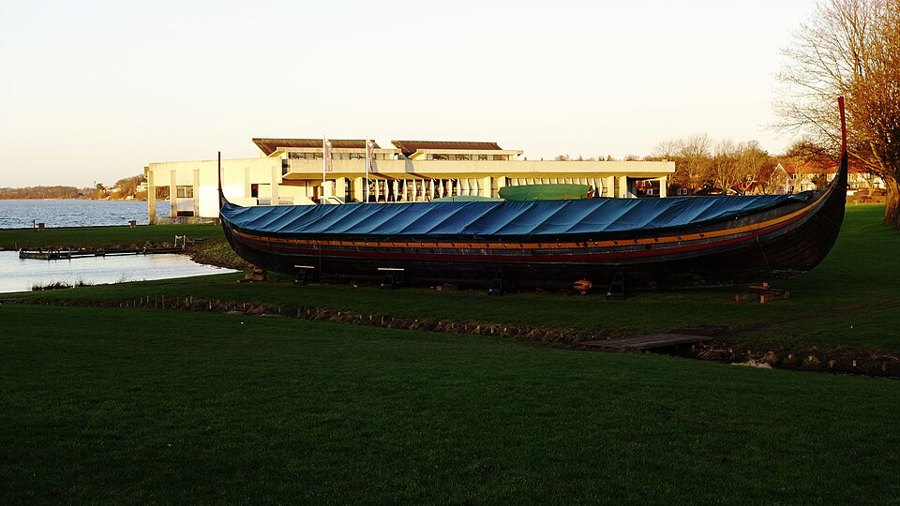
One museum report describes short Sea Stallion trials with the mast lowered. Rowing on all sixty oars and rowing on alternate oars produced almost the same distance over ten minutes against the reported wind. The crew attributed the limited gain to restricted working space when every position was occupied.
This result concerns those trials, not all longships. It nevertheless challenges a tempting assumption: doubling the number of active oars need not double useful power delivered to the water. Additional people may shorten one another’s strokes or complicate coordination. The experimental value lies in comparing configurations on the same vessel, rather than reasoning from the number of oar holes alone. A complete interpretation would also need repetition, similar conditions, and a clear account of crew experience.
Sources for this section: 2

The raised rig created a cost
The same report found reduced progress when the mast and rig remained raised during rowing into the wind. A separate August 2007 log similarly compared rowing with the mast up and down, while also recording the time required to lower and raise it. The rig’s state therefore affected both rowing performance and the transition between operating modes.
The choice cannot be made from rowing speed alone. If lowering the mast takes time, a short difficult passage may end before the gain repays the interruption. On a longer stretch, the balance may change. This is an operational calculation, not evidence that ancient crews always chose one arrangement. The reports show the variables that must enter the question: distance, weather, crew work, and the cost of changing the vessel’s configuration.
Sources for this section: 2, 3
Short bursts and endurance answer different questions
The August log distinguishes limited trials from longer rowing and notes uncertainty caused by current. Crew members considered alternate-oar rowing more practical for sustained effort. The museum’s educational exercise likewise asks how long high speed can be maintained, rather than treating a brief maximum as a normal cruising pace.
That is a crucial distinction for historical scenarios. A short approach to a landing, a maneuver in confined water, and hours of travel are different tasks. A burst that is physically possible may be costly to repeat. The resulting fatigue can also affect later work, including sail handling or unloading. These are consequences to consider, not quantified ancient endurance limits. Without comparable observations, a dramatic image of vigorous rowing cannot supply a reliable daily distance.
Sources for this section: 3, 4
Progress depends on what is measured
The museum’s rowing exercise uses navigation data and asks researchers to examine wind direction, wind speed, crew numbers, and mast position. These variables explain why a statement such as the ship rowed at three knots is incomplete. Was that speed over the ground or through the water? Was it maintained, and in what direction relative to wind and current?
A simple thought experiment shows the issue. A vessel making two knots through still water would have a different ground speed if carried by a one-knot current in the same direction than if opposed by it. The arithmetic does not tell us what happened on a Viking voyage; it shows why environmental context is necessary. Comparing unqualified figures from different trips can create an apparent technological difference that actually came from the water.
Sources for this section: 4
A crew is part of the propulsion system
The trials suggest that rowing arrangements should be understood as an interaction among hull, oars, people, and conditions. Counting benches gives only the beginning of that system. It also matters whether the available people must simultaneously steer, watch the route, or prepare other equipment. A crew total is not necessarily the number able to pull effectively at the same moment. Coordination, room for movement, and the decision to alternate workers affect what can be sustained.
The archaeological and experimental evidence also have different limits. Oar fittings can establish positions and constrain an arrangement; a modern crew can test whether a proposed configuration works. Neither alone gives the full organization of an ancient crew. The strongest account connects them without merging them. It describes the physical arrangement, reports what a specified reconstruction did, and reserves claims about historical practice for evidence that actually supports them. This makes rowing a subject of measurable decisions rather than a generic symbol of Viking strength.
Sources for this section: 1, 2, 3, 4
The Evidence
The sources below support this article. Interpretations and limits are explained in the text; this is not an exhaustive research review.