
Journeys & Encounters · Deep dive
Fresh Water and Provisions: The Limits of a Voyage Estimate
In Brief
Crew size and consumption connected sailing time to storage space. Sea Stallion’s records make the calculation concrete while also showing why modern supplies are not a Viking menu.
On this page
People turn time into a material requirementA simple calculation is useful if its assumptions remain visibleThe expedition replenished through modern networksCooking arrangements were deliberately modernDifferent planning documents use different inputsSupplies also affected access and handlingSourcesPeople turn time into a material requirement
The museum’s account of Sea Stallion’s 2007 departure reports 942.5 liters of water for a crew of sixty-one. It discusses drinking and cooking demand as a major limit on how long the vessel could remain away from replenishment. These are observations and planning figures from a modern expedition.
Their significance is the relationship between people, time, and storage. Every additional person can contribute labor, but also consumes provisions. Every extra day caused by unfavorable conditions extends that demand. A route estimate that considers only the distance a hull can sail therefore leaves out a central constraint. The ship’s theoretical range is not a fixed property independent of its crew and the way it is supplied.
Sources for this section: 1
A simple calculation is useful if its assumptions remain visible
Using the report’s illustrative rate of three liters per person per day, sixty-one people require 183 liters daily. Dividing the reported starting quantity by that rate gives a little over five days before allowing for reserves, losses, or variation. This arithmetic explains the approximate scale of the museum’s discussion; it is not advice about water needs or an established Viking ration.
A model becomes more useful when the assumptions can change. Increasing the crew or the expected delay shortens the margin unless storage also increases. Reducing the assumed rate makes the arithmetic look easier without proving that the lower value is adequate. The calculation should therefore be presented as a scenario with explicit inputs. A precise decimal answer does not remove uncertainty in those inputs. For comparison, twenty hypothetical people supplied for five days at the same assumed rate would require three hundred liters, while sixty people would require nine hundred. The difference comes from crew size alone. It shows why a small cargo crew and a heavily crewed longship cannot be assigned the same endurance simply because their hull lengths are similar.
Sources for this section: 1
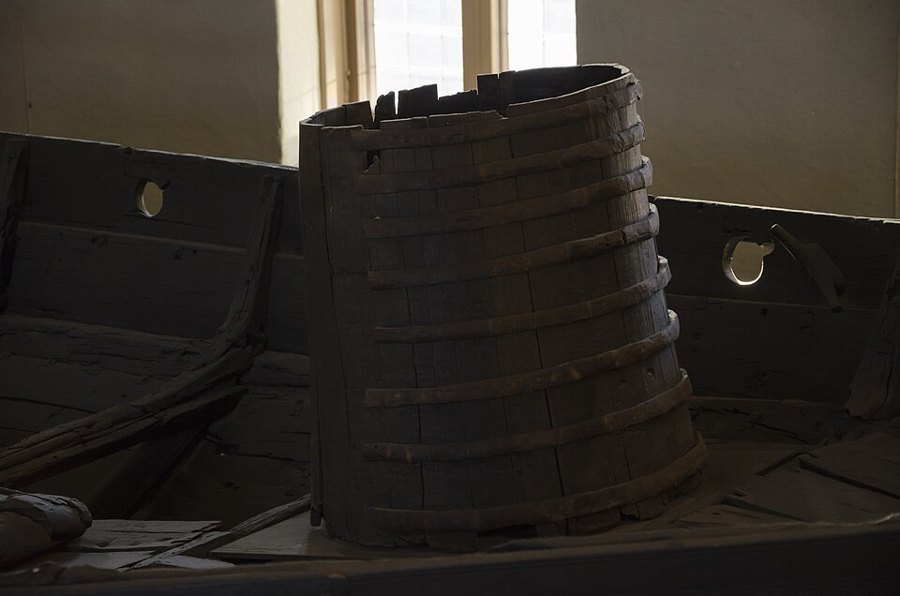

The expedition replenished through modern networks
The cook’s July 2007 diary records supermarket shopping, access to a vehicle, and reserve supplies aboard the escort vessel Cable One. It describes the substantial work of registering, distributing, and stowing food for the different sections aboard Sea Stallion. These details are part of the experiment’s context, not inconvenient information to omit.
They limit what a successful voyage demonstrates about historical self-sufficiency. Modern resupply can help a crew continue while leaving questions about Viking provisioning unanswered. At the same time, the diary offers direct evidence about the physical work of managing stores in a crowded hull. The appropriate conclusion separates those two points: the expedition tested a reconstructed vessel and produced useful logistical observations, but it did not reproduce an isolated medieval supply chain.
Sources for this section: 2
Cooking arrangements were deliberately modern
The museum’s description of Sea Stallion’s cooks includes gas burners, packaged foods, and equipment selected for the expedition. It also explains how rough conditions could restrict meal preparation. These records must not be converted into a Viking cookbook merely because the meals were eaten aboard a reconstructed longship.
The historical value lies in the problem revealed by the modern arrangement. Food has to remain accessible, preparation requires working space, and movement can make ordinary tasks difficult. A proposed ancient menu would need separate evidence for ingredients, containers, fuel, and cooking practice. It would also have to distinguish food prepared ashore from food handled while underway. The reconstruction’s galley makes the operational questions visible while providing only limited answers about the past.
Sources for this section: 3
Different planning documents use different inputs
The expedition’s project description gives another water-consumption figure within its planning discussion, alongside estimates for crew, food, and space. Such numbers should be retained in their original contexts rather than silently merged into one supposedly definitive rate. Planning estimates and observations from a particular voyage are not identical categories of evidence.
The proper response is to show sensitivity. A model can be recalculated under several plausible assumptions and identify which ones most strongly change its outcome. If a claimed route is possible only under the smallest consumption estimate and without delays, that dependence should be stated. This is a logical assessment of the model, not a claim that we know the correct daily requirement for every Viking crew in every season.
Sources for this section: 4
Supplies also affected access and handling
Sea Stallion’s cook describes stowage as a demanding operation in which existing supplies sometimes had to be moved to reach and arrange other items. Storage capacity was therefore not simply empty volume waiting to be filled. The location of items influenced the work needed to use them.
This leads to a fuller account of range. A ship needs enough provisions, but it also needs a usable arrangement and a realistic plan for delay or replenishment. More stores can occupy space needed for people and equipment; fewer stores can make the voyage dependent on frequent stops. Historical interpretation should examine that tradeoff for the particular vessel and route. The strongest estimate is transparent about its assumptions and limits, rather than claiming a single exact number of days that all Viking ships could remain at sea.
Sources for this section: 2, 3, 4
The Evidence
The sources below support this article. Interpretations and limits are explained in the text; this is not an exhaustive research review.