
Journeys & Encounters · Deep dive
Ballast and Cargo: Why Loading Changed the Ship
In Brief
A vessel’s weight and its distribution affected draft, balance, steering, and access for repairs. The cargo was therefore part of the operating system, not just something placed inside it.
On this page
Displacement is more than the empty hullBallast created a compromiseWhere the weight sat matteredPeople and provisions changed the load over timeBallast could conceal a repair problemA cargo ship also had a changing biographySourcesDisplacement is more than the empty hull
The Viking Ship Museum’s Sea Stallion ballast account lists the hull and rig, stone ballast, equipment, and crew as separate contributions to the vessel’s displacement. Its reported total of twenty-five tons concerns that modern loading arrangement. It must not be presented as a directly measured weight of the original Skuldelev 2 at sea.
The distinction helps clarify a common ambiguity in ship descriptions. An empty hull, a fitted vessel, and a loaded vessel are different things. A quoted tonnage is meaningful only when its definition is stated. Cargo capacity introduces another distinction: it is not identical to total displacement. The ship must support itself, its people, and its equipment as well as any goods it carries. A historical transport estimate that ignores these categories can overstate what was available for trade.
Sources for this section: 1
Ballast created a compromise
The museum explains that Sea Stallion needed sufficient weight for the hull and sail to work together, while excess weight could make rowing more demanding. Ballast also helped the crew adjust trim. The aim was therefore not simply to maximize or minimize weight, but to find a useful balance for the intended operation.
This is an engineering tradeoff with historical implications. A vessel prepared for sustained sailing might not be in the most convenient configuration for a shallow landing or a long rowing passage. Changing the load could help one task while making another harder. That does not mean the design was defective. It means performance depended on use. Any proposed carrying capacity or draft should be read alongside the assumptions about how the ship was loaded and what its crew intended to do.
Sources for this section: 1
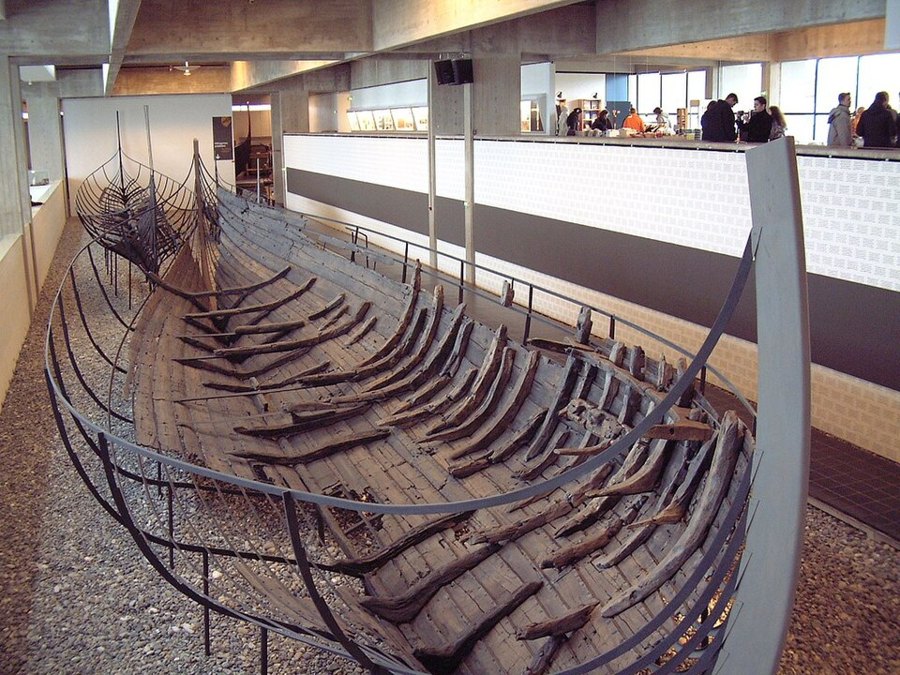

Where the weight sat mattered
The museum’s stowage report describes placing heavy equipment and provisions with care around the middle of Sea Stallion rather than concentrating them at the ends. It connects the loading arrangement to steering behavior and the vessel’s motion in waves. The modern crew developed a stowage plan through repeated experience.
The practical point is that two ships with the same total weight can behave differently if that weight is distributed differently. Moving a load changes relationships within the vessel even though no timber has been altered. It also changes access: a frequently needed object buried beneath heavy cargo is effectively less available. A useful reconstruction of transport must therefore consider placement and handling, not only whether a theoretical volume fits within the hull’s outline.
Sources for this section: 2
People and provisions changed the load over time
The Sea Stallion reports treat the crew as movable weight and describe provisions and water as substantial parts of the stowed load. These are modern operational observations, but they identify a general problem. The configuration at departure is not necessarily the configuration several days later.
Food and water are consumed; people move to perform tasks; equipment may be brought on deck or secured elsewhere. The inference is that loading is an ongoing activity rather than a single calculation completed before sailing. A hypothetical voyage model should distinguish a departure condition from later conditions and explain whether the crew adjusts the distribution. This does not recover an ancient stowage manual. It prevents a modern estimate from pretending that the vessel’s internal arrangement remains unchanged throughout the journey.
Sources for this section: 1, 2
Ballast could conceal a repair problem
Ottar’s planned 2019 voyage to western Norway ended early after a leak was located beneath a large mass of ballast. The museum reported that sixteen tons of stones were removed after the vessel returned to Roskilde so that the affected area could be examined. The incident belongs to the modern reconstruction’s history.
Its value is the connection between operational loading and maintenance access. A problem may be straightforward to understand yet difficult to reach while the ship is loaded. Continuing toward a destination is therefore not determined only by whether the leak can temporarily be managed. The crew must also consider where inspection and repair are practicable. An account of maritime range based only on speed and provisions misses this category of constraint: the ability to keep the vessel functioning en route.
Sources for this section: 3
A cargo ship also had a changing biography
The museum’s Skuldelev 1 teaching sheet identifies western Norwegian construction and evidence of repairs associated with other areas. Those observations show that a ship could acquire new material during its working life. They do not provide a list of the goods it carried on every voyage.
For cargo reconstruction, this distinction is essential. Hull form can support an interpretation of transport capability, while timber repairs can trace aspects of movement and maintenance. Neither supplies a complete commercial itinerary. The most useful account combines these limited clues with explicitly stated loading assumptions. It asks what could be carried safely and accessibly under a particular reconstruction, and keeps that answer separate from what is known to have been carried historically. Ballast and cargo belong to the ship’s history, but their precise arrangement is often one of its least visible parts.
Sources for this section: 4
The Evidence
The sources below support this article. Interpretations and limits are explained in the text; this is not an exhaustive research review.