
Journeys & Encounters · Deep dive
Skuldelev 1: Cargo Capacity Meets the Realities of an Open-Sea Voyage
In Brief
Skuldelev 1 represents a substantial cargo vessel. Modern voyages with its reconstruction Ottar show why carrying capacity, sailing speed, delays, and maintenance must be considered together.
On this page
A working cargo vessel, not a floating warehouseTesting a reconstruction in more than pleasant weatherWhy the fastest passage is not the whole journeyA rudder problem changes the available routeAccess to a leak depends on what is above itWhat ocean-going means in this caseSourcesA working cargo vessel, not a floating warehouse
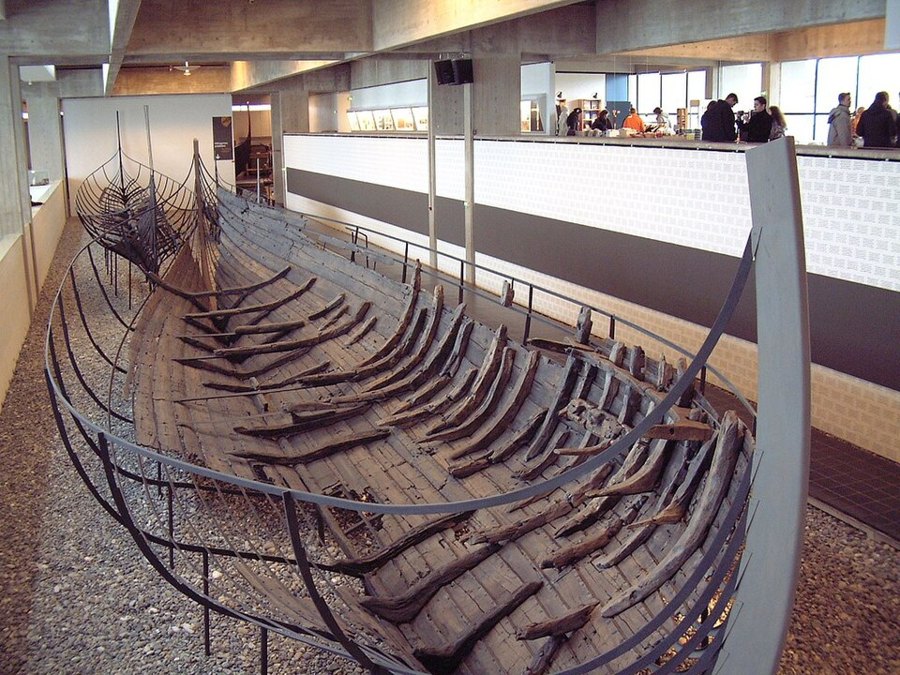
Skuldelev 1 was a broad cargo ship built in western Norway around 1030, with pine construction and later repairs. Its surviving form supports an interpretation centered on transporting substantial loads across exposed water. The reconstruction Ottar allows that interpretation to be investigated through practical use rather than through hull dimensions alone.
Cargo capacity does not describe an entire transport operation. Goods must be brought aboard, stowed so that the vessel remains manageable, protected as necessary, and removed at the destination. Crew space and access to essential equipment remain necessary even when the hold is valuable commercial space. A full ship is therefore a coordinated arrangement of people, material, and working clearances. The archaeological hull gives the investigation a physical starting point; it does not preserve a loading plan for every voyage or identify the precise cargoes that once passed through it.
Sources for this section: 1
Testing a reconstruction in more than pleasant weather
The museum records standardized trials with Ottar in the southern Kattegat in autumn 2003, using Hundested as a base. The week included both strong winds requiring reduced sail and much lighter conditions. Such variation matters because a cargo vessel must be understood across a range of conditions rather than through one successful run.
A meaningful comparison holds some factors stable while recording others. The loading state, sail arrangement, course relative to the wind, and sea conditions influence the result together. If all change without documentation, an apparent improvement cannot confidently be assigned to one cause. The museum's trial framework therefore calls for repeated observations and recording of changing conditions. Applied to Skuldelev 1, this approach turns the broad question of whether it was seaworthy into more specific questions about how a particular reconstructed hull behaves under an identified combination of load, weather, and handling.
Sources for this section: 2

Why the fastest passage is not the whole journey
Ottar's 2003 voyage toward eastern Norway illustrates the difference between moving speed and total travel time. The museum records a 147-nautical-mile section from Anholt to Lyngør averaging 4.5 knots over the ground. Yet the full journey from northern Zealand took seven travel days because strong headwinds required shelter at Anholt.
Those figures describe different things and are not contradictory. A calculation using only a favorable sailing segment answers how quickly the vessel moved during that segment. A calculation including waiting answers how long a traveler or cargo owner needed to reach the destination. For historical transport, the second question is often the more consequential one. A merchant could not deliver goods during a pause in harbor simply because the ship had previously sailed well. This documented modern example demonstrates the distinction without establishing a fixed timetable for the ancient vessel.
Sources for this section: 3
A rudder problem changes the available route
During Ottar's return voyage in 2005, strong winds and waves placed heavy demands on the attachment holding the steering oar. The museum describes wear in the withy and a response that changed the vessel's course: the sail was arranged so that the steering oar was pressed toward the hull, and the ship headed to Norway for a replacement birch withy.
The episode shows how a relatively small component can constrain a large transport system. The hull may remain afloat and the sail may still provide power, while the available safe courses narrow because steering cannot be trusted under every load. Repairs are therefore not an incidental interruption outside maritime history. They are part of the conditions under which journeys occur. The incident documents the modern reconstruction and its equipment; it should not be converted into a universal service interval for every Viking Age steering attachment.
Sources for this section: 4
Access to a leak depends on what is above it
A 2019 voyage offered a different problem. Ottar's crew hoped to reach Sognefjord, but unfavorable winds delayed departure and a leak later led to a decision to return from the Swedish coast. The museum's account locates the troublesome area beneath sixteen tons of ballast behind the mast. Back in Roskilde, unloading the ballast allowed the crew to expose the area for investigation.
The practical relationship is clear: material added for the ship's operating condition can make access to the hull more difficult. A loading plan therefore affects more than balance and capacity. It can determine which areas remain inspectable and how easily a problem can be addressed away from a workshop. The episode does not prove that the original ship carried sixteen tons of stones. It demonstrates a maintenance consequence of this documented modern loading arrangement, which researchers can use to formulate better questions about cargo handling and access.
Sources for this section: 5
What ocean-going means in this case
Taken together, the hull interpretation and the recorded voyages support a view of Skuldelev 1 as a vessel whose usefulness depended on a whole operating system. Carrying a load across exposed water required adequate hull behavior, effective steering, suitable weather decisions, and the ability to respond when equipment deteriorated. None of these can be reduced to a single maximum speed.
The modern evidence also has boundaries. Ottar sails with modern people, recorded interventions, and circumstances that differ from those of an eleventh-century crew. Its successes establish possibilities for that reconstruction; its difficulties identify vulnerabilities and practical questions. Neither automatically supplies the ancient ship's route list or commercial history. The strongest lesson is methodological and concrete: evaluate a cargo voyage from loading through arrival, including stops and repairs. Skuldelev 1 becomes more historically useful when its impressive carrying role is connected to those ordinary operational demands.
Sources for this section: 3, 4, 5
For the introductory context, read The Skuldelev Ships: Traders, Warships, and a Fishing Boat.
The Evidence
The sources below support this article. Interpretations and limits are explained in the text; this is not an exhaustive research review.