
Journeys & Encounters · Deep dive
Weather and Departure: Why Waiting Was Part of the Voyage
In Brief
A sailing route was a series of decisions under changing conditions. Modern longship voyages show how favorable wind, endurance, supplies, and the choice of departure point interacted.
On this page
Distance alone does not make an itineraryThe 2007 crew faced several plausible choicesA forecast could change which harbor was usefulHeadwinds connected speed to human enduranceA research voyage has modern advantages and constraintsSeasonality is more than choosing summerSourcesDistance alone does not make an itinerary
The Viking Ship Museum’s Sea Stallion voyages repeatedly distinguish time underway from time spent waiting. Its 2026 summer account describes a trip in Roskilde Fjord and Isefjord shaped by strong winds, thunderstorms, and days in harbor. Fast passages occurred within a journey that also included delays and training.
This is a modern voyage with modern forecasts, not a direct reenactment of Viking risk. It nevertheless illustrates a basic transport problem: a ship’s speed when moving does not determine the elapsed time of the trip. An itinerary based on distance divided by favorable speed can be badly misleading if it omits waiting. The relevant historical question is how often acceptable conditions occurred along a route and what travelers could do while they waited.
Sources for this section: 1
The 2007 crew faced several plausible choices
A July 2007 Sea Stallion report describes debate after an expected favorable wind failed to arrive. The alternatives included attempting a difficult crossing, continuing to wait, or moving along the Norwegian coast to shorten a later passage. The account makes the decision visible rather than presenting the route as inevitable.
Each option exchanges one cost for another. Waiting consumes time and provisions but may reduce exposure. Moving to another departure point adds a coastal leg while changing the geometry of the crossing. Sailing immediately may advance the schedule but prolong effort if the wind is unfavorable. These are analytical consequences of the alternatives, not proof of one standard Viking policy. The experiment reveals a decision structure that historical travelers also had to confront, although their information and obligations differed.
Sources for this section: 2
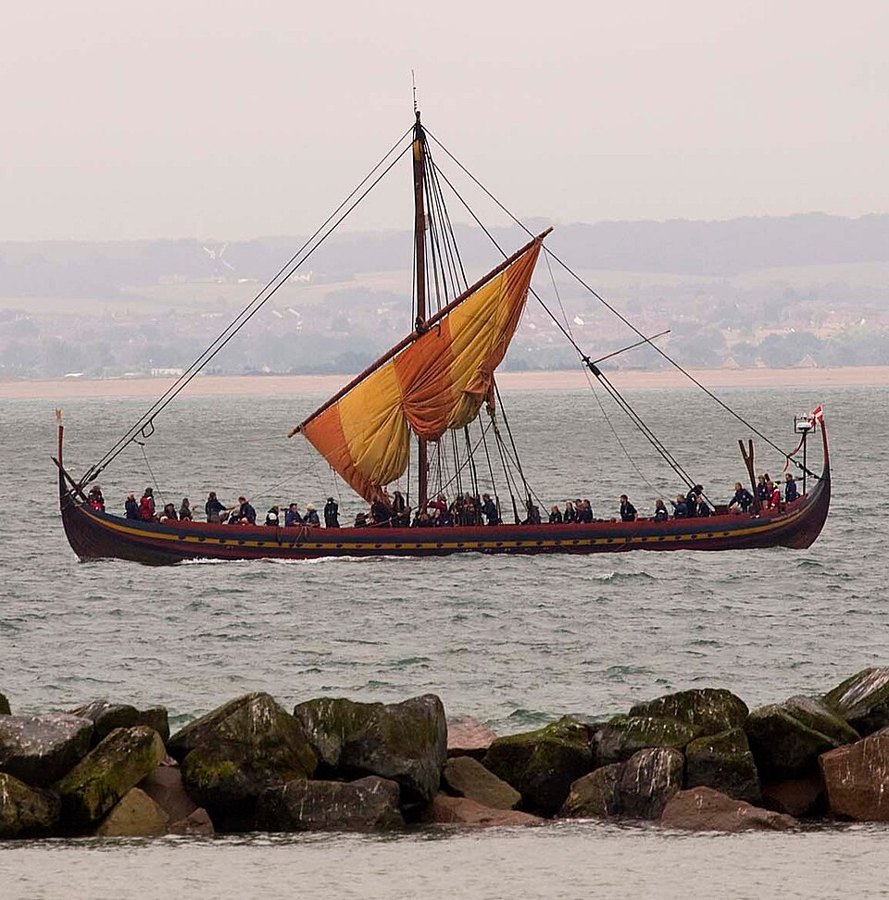

A forecast could change which harbor was useful
The Lowestoft log of July 21, 2008 considers a move toward the Netherlands before a predicted wind shift. The crew compared the time needed to reach that position with the risk that the favorable interval would close first. It also considered remaining where it was until a better crossing became possible.
The calculation shows why a harbor’s value depends partly on the next leg. A place that is secure today may be poorly positioned for tomorrow’s wind. This does not make harbor choice irrational; it makes it conditional. For historical interpretation, a map of straight lines between ports is therefore incomplete. The practical route could include staging movements whose purpose was to improve the start of a later passage, rather than simply to minimize total nautical miles.
Sources for this section: 3
Headwinds connected speed to human endurance
The same Lowestoft discussion contrasted a relatively direct passage in favorable conditions with a much longer upwind crossing. The crew rejected the latter because of the strain and the space required for sufficient supplies. The record therefore connects sailing performance to the people and stores aboard, rather than treating the ship as an isolated machine.
A longer route has compounding costs. More time means more consumption, while additional provisions themselves require space and add weight. Fatigue can also reduce the ability to handle changing conditions. These relationships help explain why a technically possible passage may still be an unattractive choice. The log is evidence for one modern decision, but its transparent reasoning supplies a better comparison than assuming that historical sailors always pressed onward whenever the hull could survive.
Sources for this section: 3
A research voyage has modern advantages and constraints
The museum’s research program explicitly included crew organization, food, water, sleep, and logistics alongside the ship’s sailing and rowing performance. Diaries, logs, and other records were intended to capture those dimensions. This broader design recognizes that movement depends on a functioning crew as well as a capable hull.
Modern participants also bring differences that must remain visible: forecasts, safety planning, communications, scheduled commitments, and the purposes of an experiment. These can alter decisions in either direction. A research team may postpone a leg that an ancient traveler under pressure attempted, or attempt a test that a merchant seeking predictable delivery avoided. Comparisons become more useful when these incentives are named rather than hidden beneath the claim that the conditions were exactly the same.
Sources for this section: 4
Seasonality is more than choosing summer
The 2026 summer voyage demonstrates that summer itself does not guarantee a succession of easy sailing days. A seasonal description is therefore too coarse to determine a particular departure. Two journeys in the same month may meet very different conditions, and a favorable outward passage does not establish an equally favorable return. Any reconstruction of a round trip must consider both legs rather than doubling the best outward time. Route, exposure, daylight, crew condition, and the changing weather all need separate consideration.
The surviving evidence does not provide a universal Viking departure calendar. A defensible reconstruction can instead identify the decisions a proposed journey requires and test them against dated accounts, environmental context, and experimental constraints. It should distinguish a best-case travel time from a plausible range including delays. Waiting then becomes part of maritime skill rather than an embarrassing interruption to a story of relentless movement. The achievement was not simply making a vessel go quickly, but choosing when and where useful progress was possible.
Sources for this section: 1, 2, 4
The Evidence
The sources below support this article. Interpretations and limits are explained in the text; this is not an exhaustive research review.