
Journeys & Encounters · Deep dive
Side Rudders: Steering, Attachment, and a Difficult Experimental Problem
In Brief
A steering surface was only useful while its connection to the ship remained reliable. Trials with reconstructed vessels show why the attachment deserves as much attention as the blade.
On this page
The rudder belonged beside the sternA hidden problem on the 2007 voyageFlexible wood offered another approachA successful connection still needed replacementSteering loads belong to the whole vesselWhat the experiments establishSourcesThe rudder belonged beside the stern
The Viking Ship Museum describes the side rudder as a characteristic steering arrangement of Viking Age ships. Gokstad and Oseberg preserve especially useful evidence because rudders survived in association with their hulls. The early medieval Gislinge boat did not preserve its rudder, leaving the modern team to choose a comparison for that missing element.
The contrast matters because a reconstructed rudder can be based on direct evidence in one project and analogy in another. Both may be historically useful, but the degree of constraint differs. Shape, position, and attachment should therefore be examined separately. A blade resembling an archaeological find does not guarantee that the complete installation matches the original. The attachment must permit steering movement while transmitting the loads into a suitable part of the hull.
Sources for this section: 1
A hidden problem on the 2007 voyage
Sea Stallion’s July 2007 diary describes removing the rudder connection for inspection. Its outer covering looked satisfactory, but opening that covering revealed broken yarns inside. An attempted repair did not provide a lasting solution, and the crew changed to an emergency modern strap arrangement. Later in the same account, another rudder strap failed while the vessel was underway.
This is evidence about the reconstruction and its selected materials. It should not become a story in which Viking steering systems are declared inherently defective. The useful finding is narrower: an installation that seemed serviceable from outside had developed internal damage under real operating conditions. Surface appearance was not a reliable guide to remaining strength. The incident exposed a research problem that a calm-water demonstration might never have revealed.
Sources for this section: 2
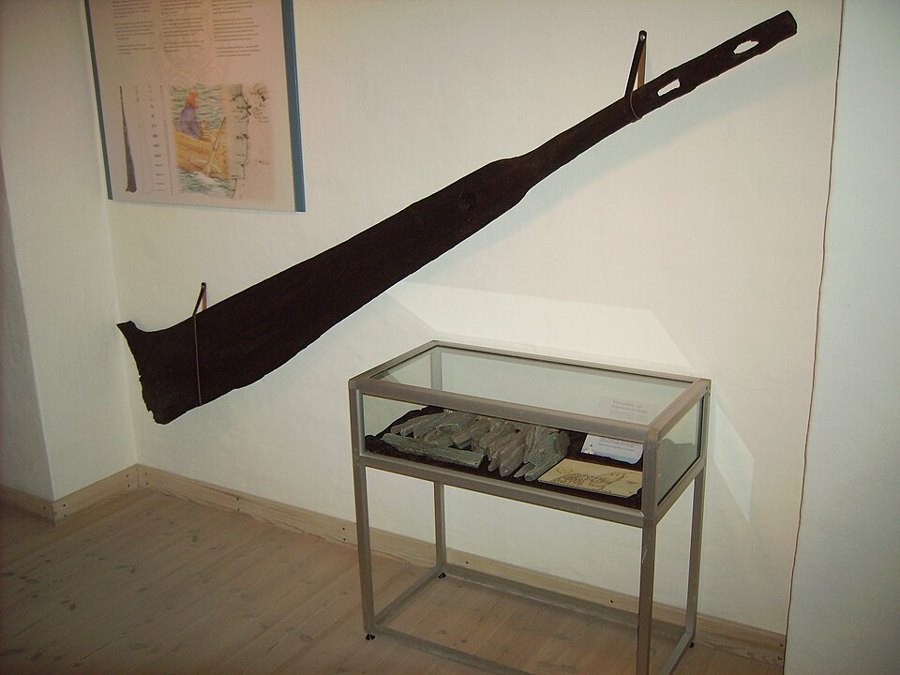

Flexible wood offered another approach
The museum describes producing rudder withies from young birch. Twisting separates the longitudinal fibers sufficiently to make the trunk flexible, while a portion of the root can act as a stop outside the rudder. The prepared piece passes through the steering arrangement and into the ship, where it is secured.
This is a different technological idea from treating wood only as rigid timber. The material is deliberately transformed so that its fibers can work in a flexible connection. Its suitability depends on preparation and placement, not simply on the species name. The museum’s demonstration should also be understood as craft documentation rather than a universal historical specification: a particular diameter or length chosen for one reconstruction cannot define the equipment of every ancient ship.
Sources for this section: 3
A successful connection still needed replacement
A 2008 report records a birch connection that had endured several days and roughly four hundred nautical miles before replacement. Wear affected both the withy and the rudder wood. The crew planned an additional protective covering to reduce direct wood-on-wood abrasion. This is a specific observation from a particular voyage, not a standard service interval for Viking equipment.
The report shows why success and maintenance are not opposites. A component may perform its task while gradually approaching the point at which replacement is sensible. Carrying or obtaining another one can be part of a workable system. For historical interpretation, the important questions extend beyond whether an attachment broke: how was deterioration recognized, what materials were needed for renewal, and how did its condition affect sailing decisions?
Sources for this section: 4
Steering loads belong to the whole vessel
A rudder cannot be understood independently of the hull’s movement and the forces applied by the sail. The museum’s Gislinge discussion notes that reconstructing and sailing larger vessels exposed attachment problems less obvious in small boats. Scaling the installation upward is therefore not merely a matter of making an identical piece longer.
As an engineering inference, a larger or more heavily loaded steering surface can impose greater demands on its supports. Repeated motion can also concentrate wear where materials touch. The response may involve changing attachment material, protecting contact surfaces, adjusting the rig, or changing how the ship is handled. Each choice changes the tested system. To determine which intervention helped, a research record must describe the original configuration and the sequence of modifications.
Sources for this section: 1, 2, 4
What the experiments establish
The voyage accounts document a genuine process of discovery: inspection uncovered damage, an emergency solution allowed the crew to continue, and later trials explored a historically plausible alternative. The temporary modern safety equipment belongs in that account. Omitting it would make the voyage look like a more complete demonstration of reconstructed technology than it actually was.
The evidence supports the feasibility of particular side-rudder arrangements and identifies their maintenance demands. It does not establish one final Viking solution or explain every later change in steering design. The historical significance lies in the connected problem: blade, attachment, hull support, material preparation, and crew response all mattered. A connection also has to be accessible enough to inspect and renew. Where dismantling requires several people, the labor and available working space become part of the maintenance problem. That practical requirement deserves attention alongside the strength of the material. A side rudder was a working mechanism embedded in the vessel, not an isolated wooden paddle whose shape alone reveals how the ship was controlled.
Sources for this section: 1, 2, 3, 4
The Evidence
The sources below support this article. Interpretations and limits are explained in the text; this is not an exhaustive research review.