
Journeys & Encounters · Deep dive
Ropes and Cordage: Choosing a Material for the Job
In Brief
Viking ships did not depend on a single universal rope. Plant fibers, hair, hide, and flexible wood offered different possibilities, while the surviving evidence remains uneven.
On this page
Rope is a family of materialsStanding and running rigging impose different demandsWritten vocabulary can conceal a distinctionA rudder connection tested the material choiceOttar’s rig is a record of experimental choicesWhat to record when testing cordageSourcesRope is a family of materials
The Viking Ship Museum’s ropemaker overview lists evidence for plant-based cordage, animal hair, wool, and hide. It gives lime bast a prominent place and cautions that definitive evidence for Viking Age hemp-rope production is lacking. Hemp’s presence on a modern reconstruction must therefore not be treated as proof of its original use on that vessel.
The broader lesson is to ask what a rope is made from before discussing its strength or historical authenticity. Thickness alone is inadequate. Two lines with similar diameters can differ in construction, elasticity, abrasion behavior, and response to water. A rig contains different tasks, so there is no reason to assume that one material was optimal everywhere. The appropriate question concerns a specific rope, in a specific position, doing a specific job.
Sources for this section: 1
Standing and running rigging impose different demands
A line supporting a mast may remain loaded for long periods, while a working line must move through hands or fittings. The museum’s craft account explains that material choice depends on such functional differences. It also describes limitations: bast can tolerate friction yet suffer when repeatedly knotted, while other materials offer different combinations of elasticity and durability.
These observations invite a practical analysis rather than a ranking from best to worst. A more elastic line may cushion a changing load but allow an unwanted change in rig geometry. A rough line may be durable yet awkward to handle repeatedly. A knot that is secure in one construction may behave differently in another. The historical problem is consequently not solved by naming the strongest available fiber. The whole connection and its operating conditions have to be considered.
Sources for this section: 1

Written vocabulary can conceal a distinction
The museum’s rope discussion warns that terms translated simply as rope can distinguish plant-based cordage from animal-based material. It recommends returning to the original wording when using sagas or laws. It also notes that medieval Norwegian legal requirements include hide and hair in equipment descriptions.
This is a reminder that translation affects technical history. An English reader may picture a familiar twisted plant rope where the source allowed something structurally different. Conversely, a modern distinction between rope, strap, and thong may not map neatly onto every historical category. The legal evidence also has its own date and purpose. A medieval equipment requirement cannot be applied without argument to every earlier Viking ship, and a rule does not prove that every crew complied with it.
Sources for this section: 2
A rudder connection tested the material choice
Sea Stallion’s 2008 rudder-tackle report describes problems with its earlier hemp connection and the decision to test flexible wooden alternatives. The report discusses relevant archaeological examples using different plant materials and makes clear that the reconstruction team was working through a problem rather than copying a complete, certain solution.
This case is particularly useful because the cordage sits within a demanding moving connection. Failure cannot be explained solely by comparing dry fibers in isolation. Water exposure, repeated tightening, rubbing, and the motion of the rudder all enter the problem. A material that seems adequate ashore may behave differently after hours of sailing. The experiment therefore provides evidence about a particular assembly under use, not simply a verdict that one species of fiber was good or bad.
Sources for this section: 3
Ottar’s rig is a record of experimental choices
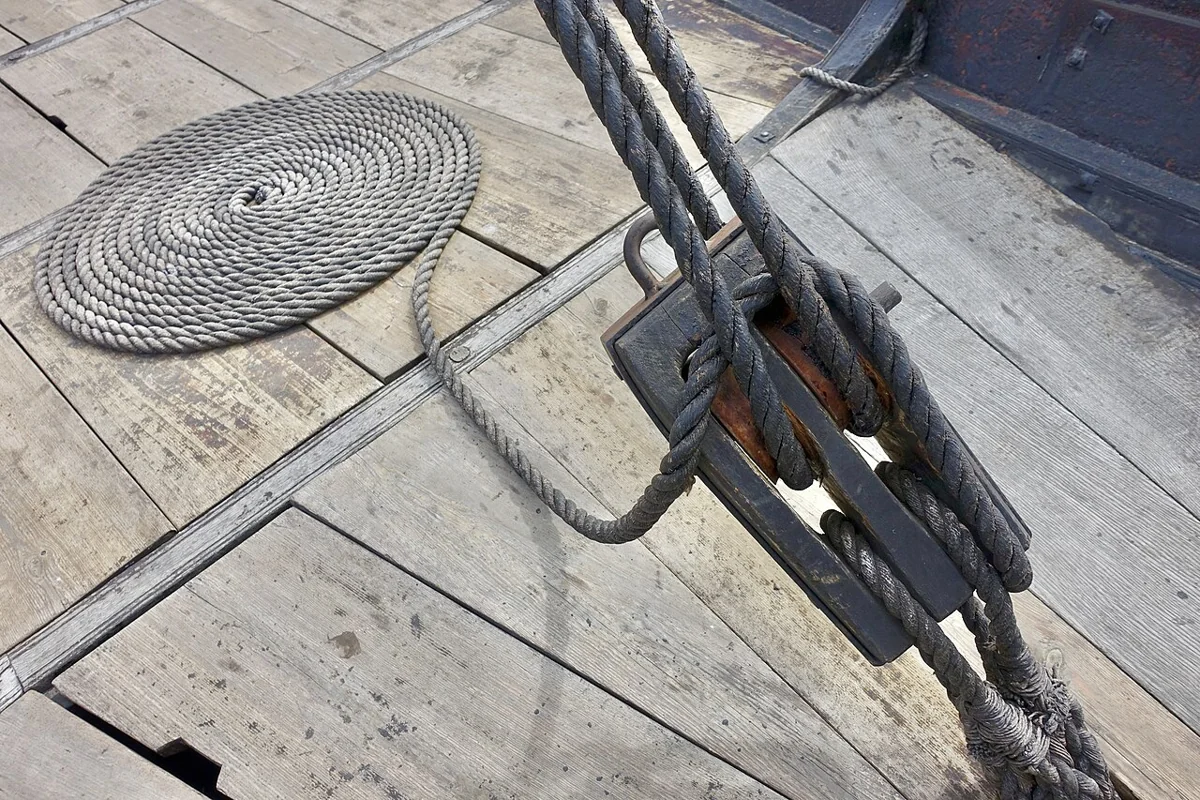
The museum’s Ottar description includes different materials in different parts of its rigging, including horsehair and experimental lime-bast applications. This modern combination illustrates the practical interest in matching material to function. It is not a recovered list of the ropes aboard the original Skuldelev 1.
That distinction becomes especially important when a museum ship is described as authentic. The useful question is authentic in which respect: material availability, construction method, outward form, or demonstrated association with the original find? These are related but different standards. A reconstruction can be historically informative while incorporating substitutions or uncertain choices. It becomes stronger evidence when the choices are recorded, because another team can test an alternative rather than inheriting the first arrangement as unquestionable fact.
Sources for this section: 4
What to record when testing cordage
A meaningful trial should identify the fiber, construction, diameter, attachment, and location of the line. Its record should also distinguish new material from a repaired or weathered rope. Observing where damage begins can be more informative than noting only the final break: wear near a fitting suggests a different problem from deterioration distributed along the whole line.
This proposed method follows the practical questions raised by the museum’s work. It also explains why isolated archaeological fragments are both valuable and limited. They may identify a material and construction without preserving the complete length, location, or service history. Cordage belongs at the center of maritime interpretation because it connected people, sail, steering, and hull. Its poor visibility in many displays reflects preservation and presentation, not a minor role in making a vessel work.
Sources for this section: 1, 2, 3, 4
The Evidence
The sources below support this article. Interpretations and limits are explained in the text; this is not an exhaustive research review.