
Journeys & Encounters · Deep dive
Beach Landings and Harbor Access: The Last Part of a Voyage
In Brief
Reaching a coast did not complete the journey. Water depth, unloading, shore conditions, and the ability to depart again shaped what a vessel could actually accomplish.
On this page
Shallow draft creates opportunities, not unlimited accessExperimental military landings tested a specific operationPeople and cargo make different demands ashorePortage was a complete change of operating modeA harbor preserves more than wrecksArrival and departure must be considered togetherSourcesShallow draft creates opportunities, not unlimited access
The museum’s Skuldelev 3 account presents a small coastal cargo vessel with a reconstructed draft below one meter. Such dimensions help explain interest in shallow-water access, but a draft figure always belongs to a loading assumption. A lightly fitted vessel and one carrying a substantial cargo do not necessarily reach the same places.
The practical inference is that access must be considered at the time and condition of arrival. Enough water beneath the hull is necessary but not sufficient. The crew also needs room to maneuver, a manageable approach, and a way to secure or unload the ship. A coastline on a map is not automatically a usable landing place. This is why transport capability cannot be reduced to the distance a vessel can cover offshore.
Sources for this section: 1
Experimental military landings tested a specific operation
The Viking Ship Museum reports landing and formation trials conducted in 2016 and 2017. In the described exercise, participants left the vessel and formed on shore rapidly. The report presents the result as evidence that a prepared operation could be swift, rather than providing an observed timetable for an actual Viking attack.
The conditions are essential to the interpretation. A practiced group on a selected shore is testing feasibility under those circumstances. Opposition, unfamiliar terrain, damaged equipment, or an awkward landing angle could change the outcome. The result therefore cannot become a universal countdown from sighting a ship to combat. Its value is that it replaces a purely imagined transition with an operation that can be timed, described, repeated, and compared with other conditions.
Sources for this section: 2
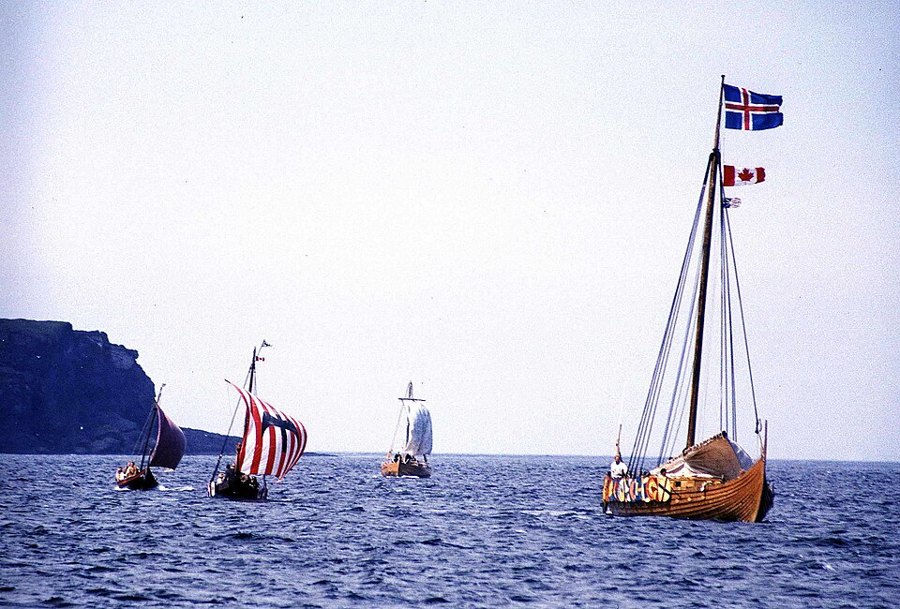

People and cargo make different demands ashore
The landing trials concern an armed group leaving a vessel and organizing itself. A merchant unloading heavy goods faces a different task. A person can step or jump ashore; a fragile or bulky load may require a more controlled transfer. A successful military exercise does not measure commercial unloading efficiency.
This comparison follows from the different tasks rather than from an excavated Viking loading manual. It suggests useful questions: can the cargo be carried by individuals, does it need a boat-to-shore transfer, and can the vessel remain stable while weight is removed? The ship’s design and the landing infrastructure must be considered together. Calling both operations a landing can conceal their different labor, timing, and space requirements.
Sources for this section: 1, 2
Portage was a complete change of operating mode
The museum documents a 1996 experiment moving the reconstructed small warship Helge Ask over a narrow strip of land. Preparation included removing ballast, lowering the mast, and arranging a lubricated track and hauling equipment. The published account compares human hauling with assistance from horses and contrasts the land route with a much longer passage around the headland.
The important insight is not a universal hauling speed. It is the scale of preparation surrounding the movement itself. The time spent pulling is only one part of a portage. Unloading, organizing equipment, and refloating also belong in a fair comparison. A map showing a short land connection does not prove that crossing it was cheaper or easier for every vessel. Hull size, load, terrain, and available help all affect that choice.
Sources for this section: 3
A harbor preserves more than wrecks
Excavation of the longship in Hedeby harbor also allowed investigation of jetties and accumulated seabed layers. The museum’s account describes this wider opportunity created by the cofferdam used around the wreck. The ship find therefore belongs within evidence for a working waterfront rather than existing as a detached example of naval architecture.
This combination changes the questions researchers can ask. A vessel’s dimensions can be considered against structures used for access and handling. Deposits may reflect activity repeated over time, while a single wreck records a particular ending. The two scales are complementary. Neither should be forced into a simple story in which the wreck necessarily used every nearby structure in its final form. Dating and stratigraphic relationships are needed to connect them.
Sources for this section: 4
Arrival and departure must be considered together
A landing place useful in one set of conditions may be difficult to leave in another. Even without assigning an exact historical practice, a transport model must account for the return from shore to water: securing the vessel, reloading it, restoring equipment removed for landing, and gaining enough room to maneuver. Ignoring these stages can make an apparently efficient route misleading.
The evidence from Skuldelev 3, Helge Ask, the landing trials, and Hedeby points toward a shared conclusion with several limits. Shallow and versatile vessels offered valuable options, but each option required work and suitable circumstances. For example, comparing two proposed approaches would require a consistent load and an explicit account of whether the vessel remained afloat, grounded deliberately, or transferred people through smaller boats. These alternatives should be tested separately rather than treated as equivalent ways of reaching the same point on a map. The archaeological remains show vessels and infrastructure; experiments test particular actions. Combining them carefully produces a history of access and handling, rather than the unsupported claim that a Viking ship could simply land anywhere.
Sources for this section: 1, 2, 3, 4
The Evidence
The sources below support this article. Interpretations and limits are explained in the text; this is not an exhaustive research review.