
Research & Sources · Deep dive
Inside a Viking Blade: What Metallography Can Reveal
In Brief
A sword’s surface can conceal welded components, different steels, and traces of heat treatment. Reading that evidence requires more than recognizing a famous inscription.
On this page
Begin with a manufacturing questionA small section is a located observationRead structures, not just ingredientsA blade may be a compositeLater knives provide a controlled comparisonNeutrons offer another route insidePreservation belongs in the argumentTechnology does not identify an ownerSourcesBegin with a manufacturing question
Two swords can share a hilt style while their blades differ substantially. Alan Williams’s study examined material from forty-four swords carrying Ulfberht or related inscriptions, alongside other Viking Age examples. That comparison makes a useful starting point: an inscription defines a group worth investigating, rather than guaranteeing an identical recipe. The historical question should be specific. Was the cutting edge a separate component? Was the blade hardened? Do apparently similar weapons have different internal structures? Asking whether a sword is simply “advanced” compresses several independent properties into a ranking that an attractive inscription cannot settle. Manufacturing comparisons become useful when the measured property is named.
Sources for this section: 1
A small section is a located observation
Metallography generally requires a specimen that can be mounted, polished flat, and examined microscopically; etching helps expose the metal’s structure. Before sampling, investigators must identify exactly where the specimen will come from and what the cut may destroy. A fragment from the tang cannot automatically represent the cutting edge. Imagine a blade whose central body and edges were assembled separately: a sample through only one component would answer a narrower question than a complete cross section. The published drawing should therefore locate the sample relative to the surviving object. Without that relationship, a technically excellent micrograph can remain archaeologically ambiguous.
Sources for this section: 2
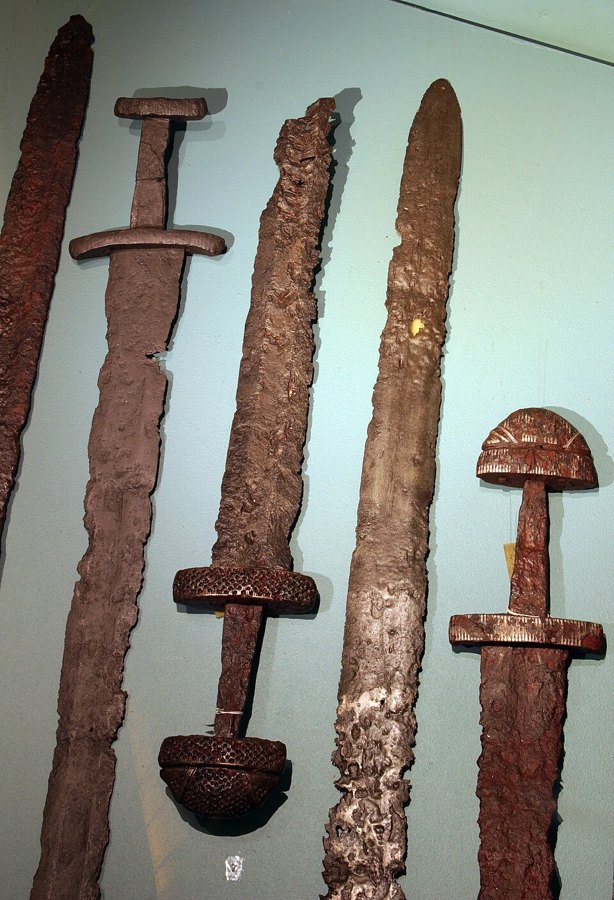

Read structures, not just ingredients
Iron and steel are not interchangeable labels for a single material. Williams explains that ferrite is essentially iron, while pearlite contains alternating iron and iron carbide; martensite can develop when suitable steel is quenched. These microscopic structures help connect composition with cooling history. Carbon content alone does not describe everything a smith did. For an illustrative comparison, two pieces containing similar carbon could have undergone different thermal treatments and consequently display different structures. Conversely, the identification of a hard constituent in one small area does not establish uniform hardening throughout a sword. A convincing interpretation combines the observed structures, their distribution, and appropriate measurements.
Sources for this section: 1
A blade may be a composite
Historic England’s archaeometallurgical guidance describes the joining of different iron alloys in edged tools and weapons. It also notes an Anglo-Scandinavian preference in some knives for steel enclosed between lower-carbon sides. That observation offers a practical way to think about a section: follow boundaries and ask how components meet, rather than treating every change as accidental impurity. A diagram should distinguish observed junctions from reconstructed ones. The number and arrangement of pieces may be clear in a particular cut while their full length remains unknown. A reconstruction drawing that extends every boundary along the entire blade makes an additional inference and should say so.
Sources for this section: 2
Later knives provide a controlled comparison
David Starley’s investigation of seven York knives found composite construction and skilled heat treatment, with differences in composition both between objects and between components. These specimens date from the twelfth through sixteenth centuries, so they are later comparisons, not direct measurements of Viking Age practice. Their value here is methodological: a blade can contain deliberate material contrasts, and a town’s archaeological collection need not represent one uniform workshop tradition. The study allowed either raw materials or finished blades to explain participation in wider exchange. Keeping both possibilities open prevents chemical variation from turning prematurely into a map of traveling smiths or a list of exporting towns.
Sources for this section: 3
Neutrons offer another route inside
A 2017 study examined three Viking Age swords in the National Museum of Denmark using neutron diffraction. The method investigated composition and manufacturing evidence without cutting out metallographic sections. The researchers also emphasized that earlier conservation could assist or obstruct interpretation. This is a different observation strategy, not simply a superior version of microscopy: each technique measures particular properties at a particular scale. A museum considering a new investigation should compare the actual question with the proposed method’s capabilities. If a claim concerns a tiny junction, a broad measurement may need complementary evidence; if preservation prevents sampling, a penetrating technique can open otherwise unavailable possibilities.
Sources for this section: 4
Preservation belongs in the argument
The same neutron study dealt with blades whose preservation and earlier cleaning histories differed. Those differences matter when comparing the surviving evidence. Suppose two blades appear unlike one another: the contrast might involve manufacture, preservation, treatment, or several of these together. Record those possibilities before explaining the difference through regional craftsmanship. This reasoning also applies to a fragment selected because it is already broken. The convenient sampling location may be unusually damaged and therefore unrepresentative. Reports should retain observations about corrosion and past intervention alongside the attractive reconstruction of the original blade. They explain which parts of that reconstruction can be checked and which cannot.
Sources for this section: 4
Technology does not identify an owner
A metallurgical result can support an account of construction without identifying the person who wielded the weapon. Starley’s later York comparison illustrates the distinction between evidence for varied supply and certainty about where an object was completed. Applied cautiously to Viking material, the same distinction discourages a leap from unusual metal to a foreign warrior. Consider the separate questions: where did material originate, where was it worked, how did the finished weapon circulate, and where was it eventually buried? A blade section directly addresses only some of them. The strongest account pairs manufacturing evidence with context while leaving unsupported steps visibly unresolved.
Sources for this section: 3
For the introductory context, read Ironworking: From Bog Ore to Everyday Tools.
For the introductory context, read Viking-Age Swords: Craft, Status, and Survival.
The Evidence
The sources below support this article. Interpretations and limits are explained in the text; this is not an exhaustive research review.