
Research & Sources · Deep dive
Seeing Beneath Corrosion: X-rays, CT, and Hidden Construction
In Brief
A scan can reveal inlay, joins, fragile contents, or modern repairs. Interpreting the image requires separating the original object from everything that happened afterward.
On this page
An investigation before a cleaning decisionCumwhitton’s concealed decorationSeveral images can answer different questionsGalloway: looking without unwrappingThe hidden detail may be modernDamage also has an internal geographyA model should retain its evidential statusJoin scientific observation to object historySourcesAn investigation before a cleaning decision
A corroded archaeological object presents a practical dilemma: removing material to identify it may also remove evidence. Historic England’s radiography guidance describes imaging as a way to investigate obscured form and structure while creating a record of present condition. For Viking material, this changes the order of work. Identification can begin before a conservator decides which surfaces to expose. Imagine a small iron lump from a grave: its external silhouette may not show whether it contains a fitting, a folded element, or several joined parts. An informative image can help define the next question without requiring every corrosion layer to be stripped away first.
Sources for this section: 1
Cumwhitton’s concealed decoration
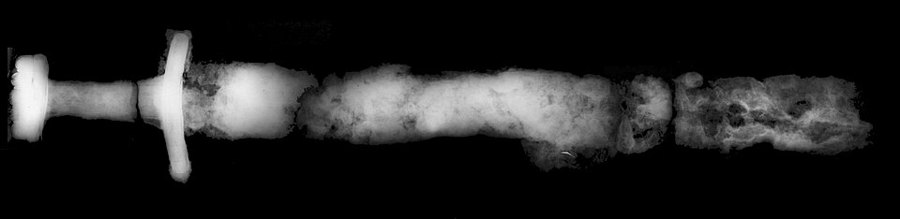
An iron sword from the Viking cemetery at Townfoot Farm, Cumwhitton, provides a concrete example. Historic England illustrates the pommel beside its radiograph, which reveals surviving intricate inlaid decoration. The discovery is not simply that the object looks better under another kind of illumination. It makes decoration available for study where the present surface alone is insufficient. An analyst can compare the arrangement of the inlay with other objects while recording precisely which lines are visible. A completed drawing should preserve gaps instead of quietly extending an incomplete motif into a symmetrical design. What survives and what is reconstructed are different kinds of information.
Sources for this section: 2

Several images can answer different questions
The radiography guidance discusses multiple exposures and the need to obtain informative views, rather than treating a single image as a complete examination. The useful settings and orientation depend on what the investigator needs to distinguish. Think of a hypothetical composite fitting with both thick and thin parts: one exposure may make one component clearer than the other. Accordingly, an image caption should explain which view is presented and why it matters. A reader should be able to connect a feature in the radiograph with its position on the object. Without that connection, technical visual detail can be impressive yet difficult to evaluate archaeologically.
Sources for this section: 1
Galloway: looking without unwrapping
The Galloway Hoard vessel retained fragile textile wrappings, making investigation of its metal surface a conservation problem as well as an interpretive opportunity. National Museums Scotland describes the use of CT and X-radiography to examine the vessel and its contents without disturbing those wrappings. The scans provided a three-dimensional view where direct access would have required intervention. The important achievement is the relationship between two forms of evidence: the container and the material surrounding it. Preserving their association allows questions about packing and deposition to remain available. A beautifully cleaned vessel separated from its wrapping would present a different and less complete archaeological record.
Sources for this section: 3
The hidden detail may be modern
Oseberg research demonstrates why an internal feature cannot automatically be assigned to a Viking craftsperson. Radiographs of reconstructed wooden objects revealed extensive screws, pins, and other metal components used in their modern reassembly. The Fourth sled is an especially clear published example. These details belong to the object’s museum history, even though they are physically embedded in the surviving artifact. When interpreting a scan, investigators must therefore compare it with treatment records and older photographs. A fastener may help explain present stability without explaining original manufacture. The discovery of a concealed component is the beginning of a chronological question, not the answer to it.
Sources for this section: 4
Damage also has an internal geography
The Oseberg conservation study uses radiography and tomography to investigate cracks, voids, and the uneven distribution of treatment materials. Some important damage was not apparent from surface photographs. This shows why visual completeness is an unreliable measure of internal integrity. For a hypothetical display mount, the practical consequence is straightforward: an apparently substantial part may be a poor place to apply support or pressure if internal evidence shows weakness. Imaging therefore contributes to preservation decisions as well as historical interpretation. A scan that changes where an object can safely be supported may be as consequential as one that reveals a previously unknown decorative feature.
Sources for this section: 4
A model should retain its evidential status
The Galloway investigation produced a digital view of material concealed beneath wrapping. When such results are shown to visitors, a caption should make clear whether they are viewing the original object, an image derived from scans, or a reconstruction based on those images. Those forms serve different purposes. A model can make hidden surfaces intelligible without becoming a substitute for the scan record or the physical vessel. Consider a feature that is indistinct in the underlying data: an exhibition image may need a clear visual treatment, but that choice should not silently turn uncertainty into a crisp archaeological observation. Presentation decisions remain part of interpretation.
Sources for this section: 3
Join scientific observation to object history
Historic England describes investigative conservation as research into an object’s creation, use, modification, and burial, undertaken alongside preservation. Cumwhitton’s inlay is one example of that broader purpose. The best account of an imaging result should identify the object, explain the concealed feature, and state what claim the feature actually supports. It should also preserve the route back to the evidence: image identifiers, object records, and the comparison that made the interpretation persuasive. A headline about a secret inside a Viking artifact may attract attention, but a useful explanation shows why the observed detail belongs to manufacture, later use, burial, or modern treatment.
Sources for this section: 2
For the introductory context, read Conservation Is Research: Oseberg and the Galloway Vessel.
The Evidence
The sources below support this article. Interpretations and limits are explained in the text; this is not an exhaustive research review.
- Historic England, Guidelines on the X-radiography of archaeological metalwork ↗
- Historic England, Archaeological conservation and the Cumwhitton sword ↗
- National Museums Scotland, Conserving the Galloway Hoard vessel ↗
- Braovac and colleagues, Navigating conservation strategies for Oseberg wood (2018) ↗