
Journeys & Encounters · Deep dive
Repton: Burials, Diet, and the Date of the Great Army
In Brief
The apparent conflict between coins and radiocarbon dates became a test of how human remains should be analyzed.
On this page
A place with a history before the armySeeing the early structure within later workThe charnel beneath the moundReconciling the chronologyExcavating the ground around the monumentThe landscape extends beyond the enclosureHeath Wood adds movement and animalsA case built from independent questionsSourcesA place with a history before the army
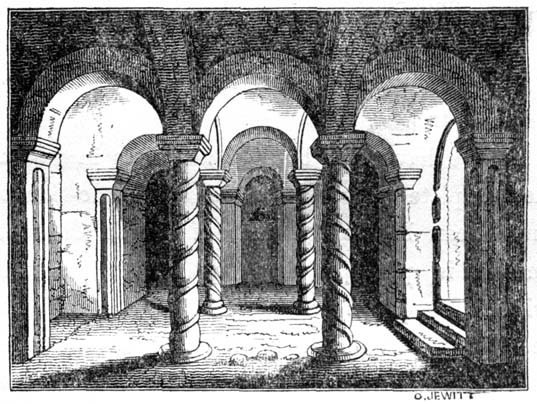
Repton’s significance did not begin with a Scandinavian force. The surviving church of St Wystan contains an Anglo-Saxon crypt within a building that also includes much later work. Historic England describes a small vaulted space divided into nine bays, with columns, decorated pilasters, and wall recesses that may have held tombs. This architectural setting matters because the army entered an established religious landscape. Burials near a church and the reuse of earlier structures have to be understood within that history. The present building is not a complete ninth-century survival, but its early fabric anchors the discussion in a place of existing importance.
Sources for this section: 1
Seeing the early structure within later work
The church listing distinguishes ninth-century elements from thirteenth-, fourteenth-, and fifteenth-century additions and later restoration. Two staircases reach the crypt, whose walls contain shallow recesses and whose vaulting rests on columns and wall supports. Reading these details makes the building a sequence rather than a single artifact. The early room provides a spatial reference for graves outside it, while later alterations explain why the modern exterior cannot simply be projected backward. A visitor can therefore use the standing church to orient the archaeology without assuming that its present plan and appearance belonged to the army’s winter.
Sources for this section: 1

The charnel beneath the mound
Excavations in the 1970s and 1980s recovered a deposit of commingled human remains beneath a low mound. The University of Bristol’s account reports at least 264 people in one room of an earlier building that had been altered for burial use. Most were assessed as adult males, but women were also represented. Weapons and coins strengthened the proposed association with the army recorded at Repton in 873–874. A charnel is not simply a row of intact individual graves: bones have been collected and placed together. That difference affects how researchers reconstruct individuals, mortality, and the relationship between death and final deposition.
Sources for this section: 2
Reconciling the chronology
A 2018 study showed that marine food had made some Repton radiocarbon dates appear too early. Dietary corrections made the tested charnel bones compatible with a late ninth-century event. Coins in another grave independently required burial after 873. The revised results removed an apparent chronological obstacle to the Great Army interpretation. They did not identify a military unit or prove that everyone died together. The distinction is between dating evidence compatible with a proposed event and a complete biography of each person represented in the deposit.
Sources for this section: 3
Excavating the ground around the monument
Archaeologist Tom Horne’s account of the renewed investigations describes work beyond the original enclosure and the return to Trench 70 in 2023. Earlier seasons found gaming pieces, an axe fragment, an arrow, ship-type nails, and a path associated with the charnel entrance. The later work sought to reach undisturbed natural deposits and investigate a line of grave or pit features. Eight grave cuts were examined, several with poorly preserved human remains. This is a different task from locating a spectacular object. It establishes sequences: what was cut into what, which surfaces connected features, and which activities preceded the army. The surviving ground can preserve relationships even when bones and other organic materials have deteriorated.
Sources for this section: 6
The landscape extends beyond the enclosure
Cat Jarman’s report on later work discusses finds at Foremark, a few miles from Repton, including weights and gaming pieces. Terrain analysis suggested a relationship with an earlier river course, while trial excavation tested the possibility of wider occupation. This moved the research question beyond the compact enclosure traditionally associated with the camp. It also linked investigation to nearby Heath Wood, where Scandinavian cremation mounds had long been known. The proposal is not that every point between the sites was continuously occupied. It is that a camp’s activities, burial places, and access to the river may form a wider landscape than one defensive boundary suggests.
Sources for this section: 4
Heath Wood adds movement and animals
A separate study of cremated remains from Heath Wood analyzed strontium in three humans and three animals. One adult and the sampled animals had signatures inconsistent with the local setting; the authors favored origins in the Baltic Shield region. The other sampled adult and non-adult were compatible with local values, which does not prove local birth. The small sample includes animals among the travelers. This adds a practical question to the camp landscape: which living resources accompanied people, and which were obtained after arrival? The answer requires evidence beyond a list of weapons or buildings.
Sources for this section: 5
A case built from independent questions
Repton’s strongest lesson is the need to keep different questions distinct while allowing evidence to interact. Architecture establishes an inherited setting. Coins constrain chronology. Diet affects radiocarbon calibration. Skeletal study addresses bodies and injuries. Regional survey tests the scale of occupation, while neighboring burial grounds extend the comparison. These methods do not all produce the same kind of answer. Together they explain why the Great Army interpretation remains persuasive and why the site still warrants research. The historical notice supplies a candidate event; archaeology tests its relationship with a complicated material record rather than merely illustrating it.
Sources for this section: 1, 2, 3, 4, 5, 6
For the introductory context, read The Great Army: Looking Beyond the Battlefield.
The Evidence
The sources below support this article. Interpretations and limits are explained in the text; this is not an exhaustive research review.