
Journeys & Encounters · Deep dive
Torksey: The Economy Inside a Winter Camp
In Brief
Thousands of objects turn a brief chronicle entry into evidence for exchange, manufacture, and a mobile population.
On this page
Locating the campAn assemblage that kept growingWeighing metal rather than trusting one coinageGames, work, and the people behind a military nameFollowing pottery production beyond the campThe town was a later developmentComparing different kinds of evidenceWhat the mobile economy changesSourcesLocating the camp
The Anglo-Saxon Chronicle places the Great Army at Torksey in the winter of 872–873. Archaeological work located the occupation north of the modern village, on the eastern side of the Trent. The published digital catalogue describes an area of approximately 55 hectares across six fields. That is an archaeological distribution, not a headcount. Its importance is that it expands the scale at which an army camp must be investigated. A search limited to a compact defensive enclosure would miss much of the activity. Collaboration with metal detector users was central to establishing the distribution and bringing material to scholarly attention.
Sources for this section: 1
An assemblage that kept growing
The catalogue reports roughly 3,585 objects, mostly unstratified metal-detected finds, with some material recovered in archaeological trial trenches. It includes coins from different monetary traditions, precious-metal fragments, weights, gaming pieces, and dress fittings. The earlier major report tabulated a smaller assemblage because research and reporting were still developing. Those totals should not be treated as contradictory estimates of the ancient camp. They are different stages of the modern evidence base. Nor does an unstratified object carry the same contextual information as one excavated from a documented feature. The database makes those differences part of the research rather than hiding them behind a single spectacular number.
Sources for this section: 1, 2

Weighing metal rather than trusting one coinage
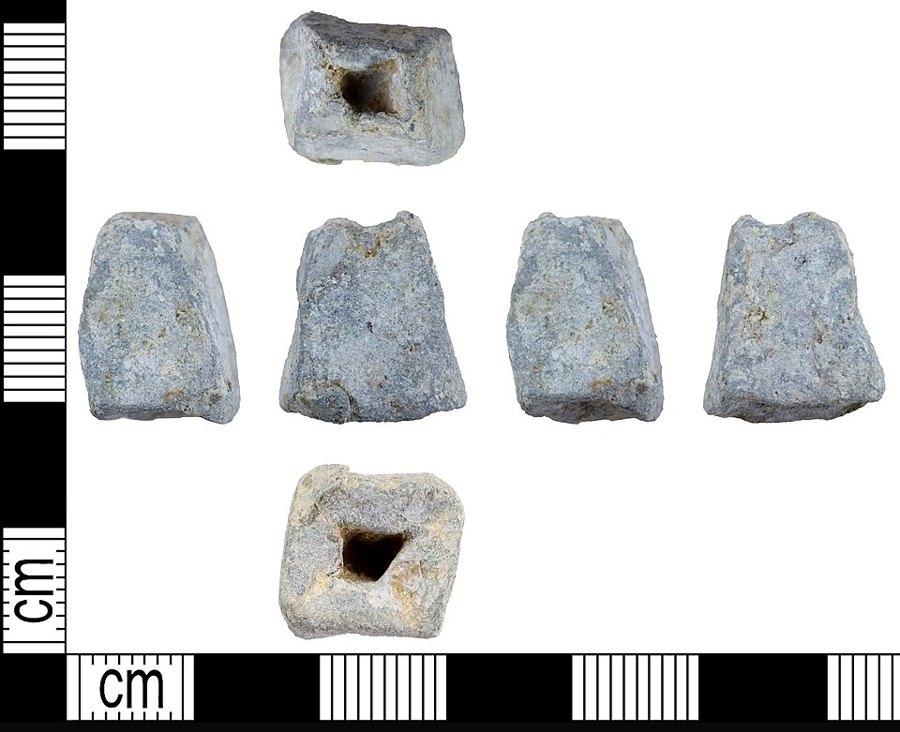
The major Torksey study recorded more than 350 weights. Its examples included copper-alloy forms and numerous lead weights, some inset with decorative metalwork. Weights matter because pieces of precious metal could be assessed by mass rather than accepted solely at a coin’s official face value. The researchers did not identify one consistent weight standard across the assemblage. That finding complicates the idea of a perfectly uniform army economy. People could share a practical commitment to weighing silver while bringing different equipment and habits. The camp becomes a meeting place of practices, not simply an overseas extension of one homogeneous monetary system.
Sources for this section: 2
Games, work, and the people behind a military name
A York public interpretation project reconstructed ships being repaired, metal being processed, trading, and gaming. The reconstruction drew attention to activities that disappear when the word army is imagined to mean only ranks of fighters. Yet a visual reconstruction is an interpretation of the finds, not a recovered photograph. It can show how several tasks might coexist, but the placement of a particular tent or worker requires decisions beyond the surviving evidence. Its strongest educational use is to make the camp’s practical demands visible: occupying a place through winter required maintenance, provisions, exchange, and ways of organizing time as well as preparing for conflict.
Sources for this section: 3
Following pottery production beyond the camp
Gareth Perry’s study of Torksey pottery approaches production as a sequence of decisions, from raw-material selection through forming and firing. It examines the adoption of wheel-thrown pottery and the wider changes associated with large-scale manufacture in ninth-century England. This approach asks more than when a new pot shape first appeared. It considers how skills were transmitted and how production choices fitted a changing society. The relevance to the army is a historical question about people and expertise moving together. A military presence could help create conditions for new manufacture without every pot being made by a soldier or every innovation arriving in one season.
Sources for this section: 4
The town was a later development
Research south of the modern village examined the early medieval town as a separate phase from the northern winter camp. The project’s archive describes an eleventh-century Torksey with a mint, cemeteries, and churches. It connects the investigation of urban growth with the pottery industry and with people following the army. This temporal separation is essential. A later church or workshop does not become evidence for the camp merely because it lies near Torksey. The more interesting question is how temporary occupation, incoming skills, existing communications, and subsequent investment interacted over generations. Urban development is a process to explain, not an automatic consequence of an army stopping for winter.
Sources for this section: 5
Comparing different kinds of evidence
Torksey works particularly well as a case study because its evidence operates at several scales. Coins help constrain chronology; weights illuminate exchange; manufacturing traces identify processes; the spatial distribution defines an extensive area of activity. The pottery research adds another dimension by following technical choices through a longer period. These strands can support one another without being identical. A coin’s date constrains when it could have been lost, while a pottery production sequence explains how an object was made. Combining them requires explicit questions about time and context rather than allowing one apparently precise date to govern every nearby find.
Sources for this section: 1, 2, 4, 5
What the mobile economy changes
The camp’s significance lies in the mismatch between a brief written label and a varied material world. The recovered objects support a community undertaking many kinds of activity, while the later town presents a separate problem of development. This makes Torksey more than an illustration of a chronicle entry. It supplies evidence that can change the questions asked of the army: how exchange worked, which skills traveled, how long activities continued, and which parts of a temporary gathering became durable. The answer is not a complete census. It is a better-founded model of campaigning as an economic and social undertaking that could reshape the places it occupied.
Sources for this section: 1, 2, 3, 4, 5
For the introductory context, read The Great Army: Looking Beyond the Battlefield.
The Evidence
The sources below support this article. Interpretations and limits are explained in the text; this is not an exhaustive research review.