
Journeys & Encounters · Deep dive
Aldwark: How an Army Camp Changed the Archaeological Model
In Brief
A riverine assemblage reveals exchange and metalworking, while its modern collection history shows why provenance matters.
On this page
From Ainsbrook to AldwarkThe chronology is broader than one winterThe alleged hoardRecovering a scattered modern recordWeights as evidence for practiceA wider archaeological signatureWhy the new catalogues matterA revised model, not a replacement stereotypeSourcesFrom Ainsbrook to Aldwark
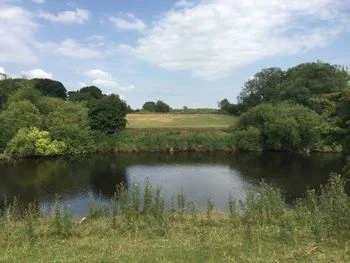
The site now called Aldwark was first reported in 2003 after metal detecting. It initially circulated under Ainsbrook, a name assembled from the finders’ surnames, and was later published as a riverine site near York. The digital catalogue locates it around 20 kilometers northwest of York, near the transition between the rivers Ouse and Ure. These changing labels refer to the history of discovery and publication, not successive medieval names. Establishing that identity matters when comparing old reports, sale descriptions, and museum records. Without it, material from one place can look like several unrelated assemblages.
Sources for this section: 1
The chronology is broader than one winter
Coin evidence supports occupation in the later ninth century, including the period when Scandinavian armies operated in and around York. The catalogue also notes limited evidence for later activity. This makes Aldwark different from a site confidently assigned to one recorded winter. Coins, metalworking debris, weights, and precious-metal fragments support an interpretation of organized activity, but the duration and sequence require care. The camp hypothesis rests on the assemblage as a whole and comparison with other sites. It should not be reduced to finding one foreign coin near a river and declaring that a named commander camped there on a particular date.
Sources for this section: 1
The alleged hoard
The digital catalogue explains that the earlier report separated 121 closely grouped finds as a possible hoard. Its compilers subsequently merged them into the wider assemblage because excavation did not establish a distinct deposit at the reported location. That is a consequential interpretive decision. A deliberately buried hoard could suggest concealment, savings, or a particular collection event. Dispersed camp material instead raises questions about losses, processing, and repeated activity. The objects do not change, but their relationship changes the history they can support. Recording the reason for reclassification allows later researchers to evaluate it rather than inheriting the label uncritically.
Sources for this section: 2
Recovering a scattered modern record
The catalogue combines records from archaeological organizations, museums, the Portable Antiquities Scheme, and willing collectors. Some finds had been sold before adequate recording. Its compilers also warn that the well-known Ainsbrook name was sometimes attached to objects of uncertain origin to increase their appeal. They therefore accepted material only where collection history supported association with Aldwark. This is more than a technical housekeeping issue. A false provenance can enlarge a camp, alter its apparent date range, or introduce a craft that never occurred there. Provenance research is part of reconstructing the medieval site, not merely documenting modern ownership.
Sources for this section: 2
Weights as evidence for practice
Research on inset lead weights places Aldwark alongside British and Irish sites where fragments of decorative metalwork were embedded in weighing equipment. Such objects connected reused ornament with a practical task. The relevant study discusses bullion exchange while allowing for other contexts such as distribution, payments, and social transfers. A weight therefore identifies a capability more securely than one exact transaction. It indicates that measuring metal mattered to the people using it. It cannot tell us whether the silver on a particular occasion represented trade, division of proceeds, or an obligation. The distinction helps turn a striking artifact into evidence for a range of economic behavior.
Sources for this section: 3
A wider archaeological signature
A York research summary from 2018 described the use of Torksey and Aldwark to identify a recurring combination of objects at more than 30 additional locations. Many lay along rivers, old roads, or other strategic routes, sometimes near established estate centers and major churches. Later research expanded that comparative program. The method does not require every site to possess an identical inventory. Instead, it asks whether several characteristic categories occur together in a meaningful setting. This provides a way to investigate movement beyond the few places named in chronicles, while still demanding alternatives such as trade, later settlement, or redeposition.
Sources for this section: 4
Why the new catalogues matter
The Archaeology Data Service’s account of the later project emphasizes publishing the underlying catalogues alongside the interpretive book. Searchable records and downloadable data allow others to inspect classifications and compare sites. This changes the status of an argument: readers need not rely only on a selection of attractive objects or a final narrative. They can investigate what was included and how the assemblages differ. The project also broadens the questions from military location to supply, metalworking, and interaction with surrounding populations. Such questions are particularly appropriate for a mobile force whose survival depended on resources beyond its own fighting equipment.
Sources for this section: 5
A revised model, not a replacement stereotype
Aldwark helped undermine the assumption that a Viking army camp must resemble one compact defended enclosure. Its river setting and varied assemblage support a more extensive picture of temporary or recurrent gathering. But replacing a small-camp stereotype with an equally rigid giant-market stereotype would repeat the problem. The useful model is comparative and testable: identify the assemblage, establish its chronology, examine its landscape, and assess the reliability of its recovery. Aldwark is especially valuable because the published record makes those steps visible. It teaches us about medieval activity and about the modern decisions through which that activity becomes historical evidence.
Sources for this section: 1, 2, 3, 4, 5
The Evidence
The sources below support this article. Interpretations and limits are explained in the text; this is not an exhaustive research review.