
Beliefs & Stories · Deep dive
Giants, Kinship, and the Boundaries of the Divine World
In Brief
The beings translated as giants can be enemies, ancestors, hosts, and possessors of knowledge. Their relationships with the gods reveal a world organized through contested boundaries.
On this page
What does the word giant conceal?Knowledge older than the gods’ present orderA hostile host can also be familyThor’s defense of violence is a speech in a contestHalls turn cosmic conflict into social conflictNarrative importance is not proof of worshipSourcesWhat does the word giant conceal?
English translations commonly use giant for several Old Norse words, including jötunn and risi. That convenience can encourage a misleading picture: one species of enormous, uniformly hostile creatures facing a separate species of gods. Tom Grant's study of saga vocabulary argues that risi and jötunn carry significant differences, including social and physical associations. Medieval writers could contrast the terms rather than use them as interchangeable labels.
This matters before any family tree is drawn. An English category can erase distinctions that help a medieval scene work. Grant's evidence includes etymology, translated literature, and saga usage; his conclusion is an argument about language in particular bodies of writing, not a recovered native classification chart. Readers can retain giant as a practical shorthand while asking which word the underlying passage uses. A translation should open the question of a character's relationships and role, rather than settle those questions by importing the familiar giant of a modern fairy tale.
Sources for this section: 1
Knowledge older than the gods’ present order
In Vafþrúðnismál, preserved in medieval Eddic transmission, Odin enters the hall of a formidable giant to test knowledge. Vafthrudnir is dangerous precisely because he knows so much. The exchange places him within the earliest history of the world: he explains the making of earth from Ymir's flesh, mountains from bones, the sky from a skull, and the sea from blood. The landscape itself therefore bears the material presence of a primordial giant.
The poem also gives giant ancestry a strange generative history, including offspring arising beneath an ancestor's arm and from the meeting of his feet. Such details resist an ordinary human genealogy. Yet the contest takes place through recognizable social actions: entering a hall, receiving a seat, and wagering one's head. Odin wins with a question about what he privately whispered to his dead son. That ending defeats an exceptionally knowledgeable opponent through inaccessible personal knowledge; it does not make giants intellectually inferior.
Sources for this section: 2

A hostile host can also be family
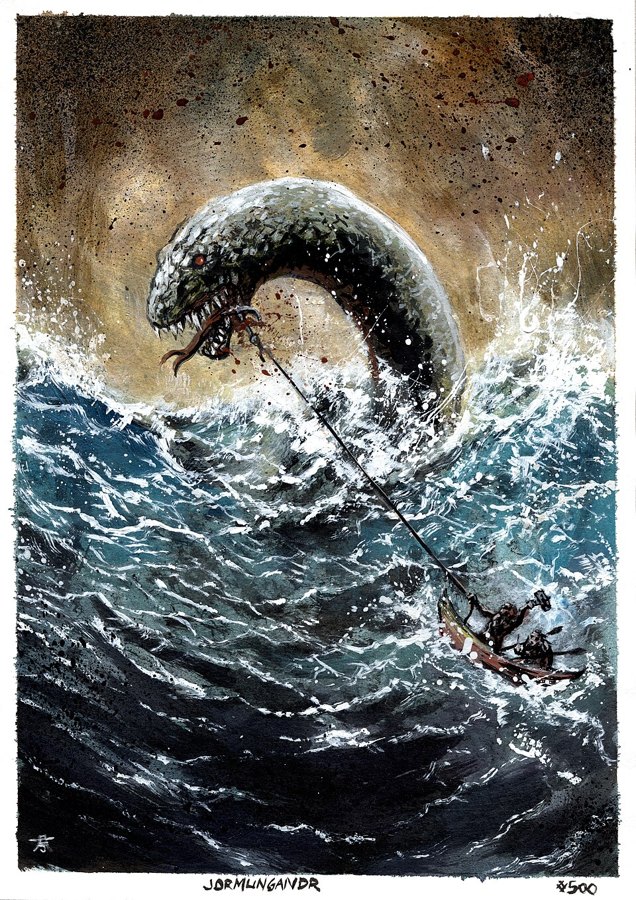
Hymiskviða makes a simple opposition between gods and giants especially difficult. Tyr directs Thor toward a great cauldron owned by Hymir, whom Tyr identifies as his father. On arrival, Tyr encounters both a terrifying many-headed grandmother and a welcoming woman who receives her son. Within this one household, kinship, hospitality, and menace coexist. The visitor's relationship to the host cannot be reduced to an encounter between unrelated enemies.
The welcome is also precarious. Tyr's mother hides the visitors because Hymir is hostile to guests, and the host's glance destroys the structure behind which they shelter. Thor's reputation as an enemy of giants remains active even inside a scene built around family connections. The poem does not pause to reconcile this ancestry with every other account of Tyr. Its narrative instead makes the dangerous household useful: the gods need something it possesses. Reading the scene on its own terms preserves the tension between dependence, family access, and force.
Sources for this section: 3
Thor’s defense of violence is a speech in a contest
In Hárbarðsljóð, Thor argues with a ferryman who refuses him passage. The exchange presents competing claims to importance rather than an impartial lecture about the universe. Thor boasts of killing giants and giant women; one defense of his actions is that their uncontrolled increase would threaten human life in Midgard. Within his own account, violence protects an inhabited world from overwhelming outsiders.
The ferryman repeatedly challenges Thor's prestige, however, and boasts of manipulation, sexual exploits, and warfare. At another point Thor criticizes the ferryman's failure to repay a gift properly. The poem thus sets heroic force beside questions of cunning, reciprocity, and social rank. Thor's statements are valuable evidence for how a poet could justify his giant-killing role, but the argumentative setting matters. They do not cancel the family relationships found elsewhere. A character can describe an opponent as a collective threat in one performance while other poems explore particular giants as hosts, ancestors, or relatives.
Sources for this section: 4
Halls turn cosmic conflict into social conflict
Tommy Kuusela's 2017 doctoral thesis approaches these encounters through the culture of halls. Its research abstract identifies hospitality, protected peace, generosity, hostile guests, knowledge, and destruction of a hall as central themes. The comparison treats giant hall-owners as figures whose dealings can illuminate the rivalry and obligations of powerful human households. A hall is therefore more than scenery behind a monster fight.
Kuusela distinguishes Odin's frequent use of disguise and cunning from Thor's emphasis on strength, honor, and courage. The contrast helps explain why a visitor's conduct matters as much as the host's identity. Winning knowledge or valuables can involve manipulation; defending honor can end in the destruction of another household. This interpretation does not require treating a myth as a transcript of an actual aristocratic dispute. It asks how an audience familiar with hospitality and rivalry might understand divine conduct. The boundary between the groups remains consequential, but its expression changes with the relationship and occasion.
Sources for this section: 5
Narrative importance is not proof of worship
Were giants ever recipients of ritual? Gro Steinsland posed that question explicitly in a 1986 study. She challenged the habit of rejecting possible evidence simply because an established model defined giants as beings who could not receive cult. Her discussion considers difficult literary expressions, marriage relationships, and proposed ritual implications. The argument is valuable because it exposes a circular method: a classification cannot both decide in advance what evidence is possible and then claim confirmation from its absence.
That criticism does not turn every literary giant into an attested object of worship. A sacred place associated with a named figure, an ambiguous word in a late narrative, and a proposed identification of an image carry different evidential weights. Steinsland's proposals remain arguments to assess individually. The strongest general conclusion is narrower: giants occupy indispensable positions within surviving stories, supplying ancestry, knowledge, relationships, and resources. Whether a particular community addressed a particular being ritually requires evidence beyond the being's importance in a poem.
Sources for this section: 6
The Evidence
The sources below support this article. Interpretations and limits are explained in the text; this is not an exhaustive research review.
- Tom Grant, A Problem of Giant Proportions (2019) ↗
- Vafþrúðnismál, Old Norse text edited by Guðni Jónsson ↗
- Hymiskviða, Henry Adams Bellows translation (1923) ↗
- Hárbarðsljóð, Henry Adams Bellows translation (1923) ↗
- Tommy Kuusela, War and Peace between Gods and Giants in Old Norse Halls (2017), research abstract ↗
- Gro Steinsland, Giants as Recipients of Cult in the Viking Age? (1986) ↗