
Beliefs & Stories · Deep dive
Hel and the Many Ways of Imagining Death
In Brief
A destination, a person, a poetic expression, and a road through remembered lives: Hel becomes more intelligible when its different witnesses are allowed to disagree.
On this page
A name does several kinds of workA rule already troubled by its famous exceptionBrynhild speaks on the roadDeath waiting at the headlandSaxo sends a king beneath the groundSacred ground belongs to a communitySourcesA name does several kinds of work
Christopher Abram's study of medieval Scandinavian afterlife literature starts with a problem easily hidden by a modern mythology dictionary. Hel can appear as a place, a personal figure, or an expression for death itself. Combining those uses into a single biography and geographical description produces a tidier system than the surviving texts necessarily support. A poet who says that someone has entered Hel may be describing a death without specifying a detailed underground kingdom.
Abram identifies different emphases in skaldic and eddic verse and argues that Snorri Sturluson's account brings those traditions into a more organized structure. His subject is how medieval authors use inherited material, not a census of what every Scandinavian believed. This distinction is productive because it lets readers ask what a particular passage requires. A personified death can address grief; a destination permits a journey; a conventional expression can complete a verse. Those functions may overlap without being identical.
Sources for this section: 1
A rule already troubled by its famous exception
The Swedish History Museum notes a contradiction in familiar descriptions of Hel. Some accounts associate it with people who die through sickness or old age, yet Baldr goes there after being killed. That example makes it difficult to treat manner of death as an automatic sorting mechanism. A system built around a clean contrast between battlefield death and natural death cannot accommodate even this prominent divine narrative without qualification.
The museum also presents Hel as both a realm and its ruler. These descriptions are useful introductions, provided that they remain attached to the literary traditions that preserve them. Baldr's presence demonstrates why a simplified museum label or modern diagram should be a starting point for reading, not the last word. Rather than inventing a special exception for each difficult character, readers can recognize that authors drew on overlapping accounts. The tension tells us something about the evidence itself: the surviving stories do not all serve the same classificatory purpose.
Sources for this section: 2
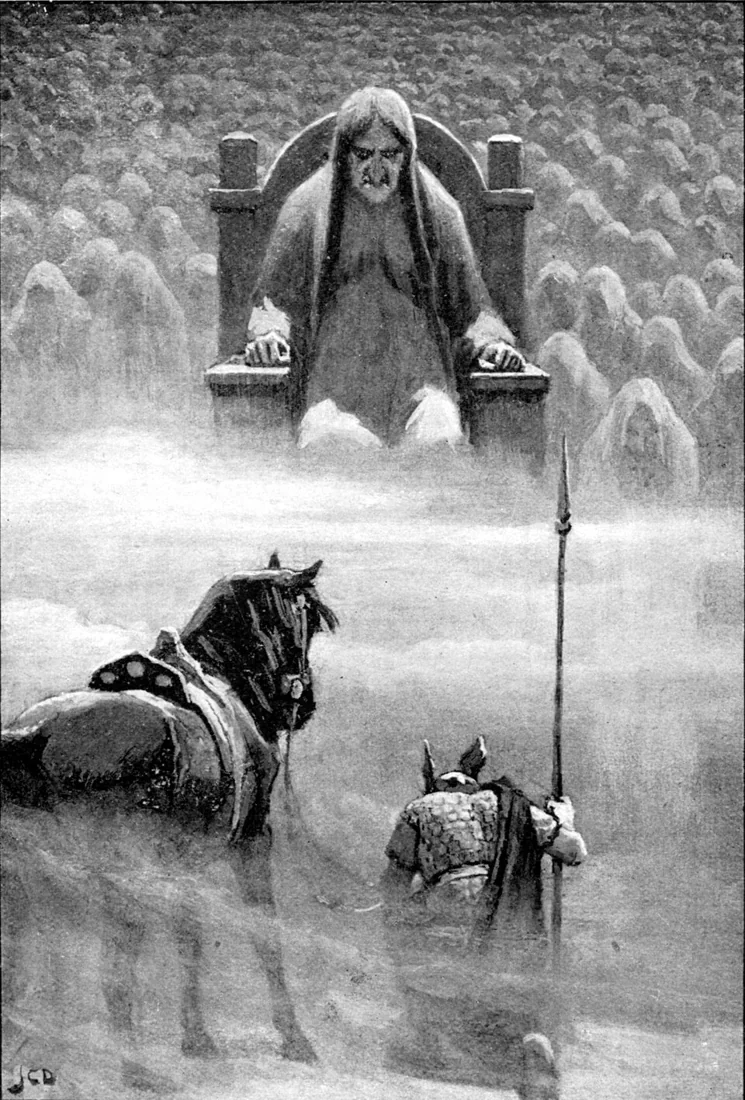

Brynhild speaks on the road
Helreið Brynhildar places Brynhild in a wagon on a journey after her death. A giantess challenges her passage and accuses her of responsibility for disaster. Brynhild answers by recounting events from her life, including her relationship with Sigurd and the deceptions surrounding it. The road becomes a setting in which her reputation is contested and her own version can be heard.
The poem does not pause to describe a complete realm of the dead. Its energy lies in accusation, defense, and the hope of continued companionship. Brynhild's final insistence that she and Sigurd will be together is especially significant because the journey gives her a voice after the catastrophe of the heroic story. The text therefore rewards a different question from where exactly the wagon is going: what does posthumous speech allow her to claim? Here, an afterlife setting permits unfinished conflict and loyalty to continue beyond bodily death, without resolving every theological question that a modern map might raise.
Sources for this section: 3
Death waiting at the headland
Sonatorrek, attributed to Egill Skallagrímsson, approaches death through bereavement rather than a guided tour. The speaker's family has been damaged by losses that he cannot repair. Sea imagery gives his grief a physical force: the waves have broken an opening in the enclosure of kinship. His relations with divine powers become strained because poetic ability and devastating loss belong to the same lived predicament.
In the final stanza, the figure commonly understood as Hel stands at a headland, and the speaker declares his readiness to await death. The poem does not describe her palace or subjects. A visible boundary in a familiar landscape makes an approaching end imaginable. This closing posture is best read beside the struggle to speak at the poem's opening: language becomes possible again even though the losses remain. It would flatten that movement to turn the stanza into evidence only for Hel's address. Personification is part of the poem's handling of grief and endurance.
Sources for this section: 4
Saxo sends a king beneath the ground
In Book One of Saxo Grammaticus's Latin history, composed around the turn of the thirteenth century, a woman appears to Hadding with fresh plants in winter. She takes him underground. Their route includes mist, richly dressed people, a fertile region, a river bearing weapons, and armies repeating their former fighting. A wall finally blocks the travelers. When the woman throws a decapitated bird across it, its crowing signals renewed life on the other side.
This is another landscape of death, but calling each feature part of a standard map of Hel would overstate what the narrative says. The unnamed guide and inaccessible region create mystery rather than exhaustive explanation. The succession of scenes also complicates any description of the entire underworld as uniformly barren or inactive. Saxo's account offers fertility, continued combat, and an astonishing boundary between death and life. Hadding can witness these things without obtaining complete access or a comprehensive account of how they fit together.
Sources for this section: 5
Sacred ground belongs to a community
A different perspective emerges from the treatment of Helgafell in Eyrbyggja saga. Carl Phelpstead's close reading emphasizes how a mountain becomes a place of exceptional meaning through prohibitions, family attachment, and communal activity. The saga's Thorolf requires respectful conduct toward it; killing and bodily pollution are restricted. Later conflict spills blood on sacred ground, forcing a reassessment of where an assembly can properly meet.
These episodes make the supernatural significant within the inhabited landscape, rather than only in a distant destination reached after death. The community must negotiate boundaries between ordinary ground and a place treated differently. Phelpstead reads that process as an interaction between environment and culture. For an account of afterlife traditions, its importance is comparative: remembered relations with extraordinary places could shape everyday conduct and social institutions. Such evidence broadens the discussion beyond choosing between two named halls. Medieval narratives preserve several ways of connecting mortality, inherited places, and the obligations of the living.
Sources for this section: 6
The Evidence
The sources below support this article. Interpretations and limits are explained in the text; this is not an exhaustive research review.
- Christopher Abram, Representations of the Pagan Afterlife in Medieval Scandinavian Literature (2003) ↗
- Swedish History Museum, The Path to Hel ↗
- Helreið Brynhildar, Henry Adams Bellows translation (1923) ↗
- Sonatorrek, Finnur Jónsson edition and Danish translation (1912–1915) ↗
- Saxo Grammaticus, Danish History, Book One, Oliver Elton translation ↗
- Carl Phelpstead, Ecocriticism and Eyrbyggja Saga (2014) ↗