
Beliefs & Stories · Deep dive
Norns, Fate, and the Limits of One System
In Brief
The sources connect norns with birth, judgment, threads, and troubled lives. Reading their actions closely reveals a wider range of possibilities than three women weaving a universal future.
On this page
Three named figures beside the treeBirth brings a different classificationThreads stretch around a future rulerAn angry prediction and an extinguished candleJudgment can explain an unbearable outcomeA metaphor can allow both limits and choicesSourcesThree named figures beside the tree
Völuspá 19–20 places a green ash beside Urdr's well and introduces three knowledgeable maidens. Their names are Urdr, Verdandi, and Skuld. The stanza then describes actions: they mark wood, establish laws, and determine lives and destinies. This combination matters. The passage does not merely identify characters; it imagines authoritative decisions being made and given durable form.
The often-repeated picture of three women at a loom is not what these particular lines describe. Nor does naming three figures here demonstrate that every reference to norns elsewhere must concern exactly the same trio. Within this poem, the scene belongs to a sweeping account of the world's ordering and impending destruction. The allocation of human lives sits within that larger temporal perspective. A useful close reading begins with the verbs and setting the stanza actually supplies, then asks how they relate to other witnesses. Starting with a complete modern diagram risks making those distinctive details disappear.
Sources for this section: 1
Birth brings a different classification
In Fáfnismál, Sigurd questions the dying Fafnir about norns associated with childbirth. The answer in stanza 13 distinguishes origins: some belong with gods, others with elves, and others are daughters of Dvalin. Whatever relationship readers propose between these groups and the three figures in Völuspá, the poem itself presents variety. It does not simply repeat the familiar names beside the well.
The exchange occurs inside a scene of lethal combat. Sigurd has wounded the dragon, who warns him about the destructive consequences of the treasure he seeks. Questions about the beginnings of life therefore interrupt a conversation shaped by approaching death. The juxtaposition gives the norns a wider relevance than a decorative appearance at a cradle. Their association with life's conditions can matter at both ends of an existence. It also illustrates the hazards of extracting a single stanza as a taxonomy: the speakers are pursuing knowledge under pressure, not delivering a neutral handbook of supernatural species.
Sources for this section: 2

Threads stretch around a future ruler
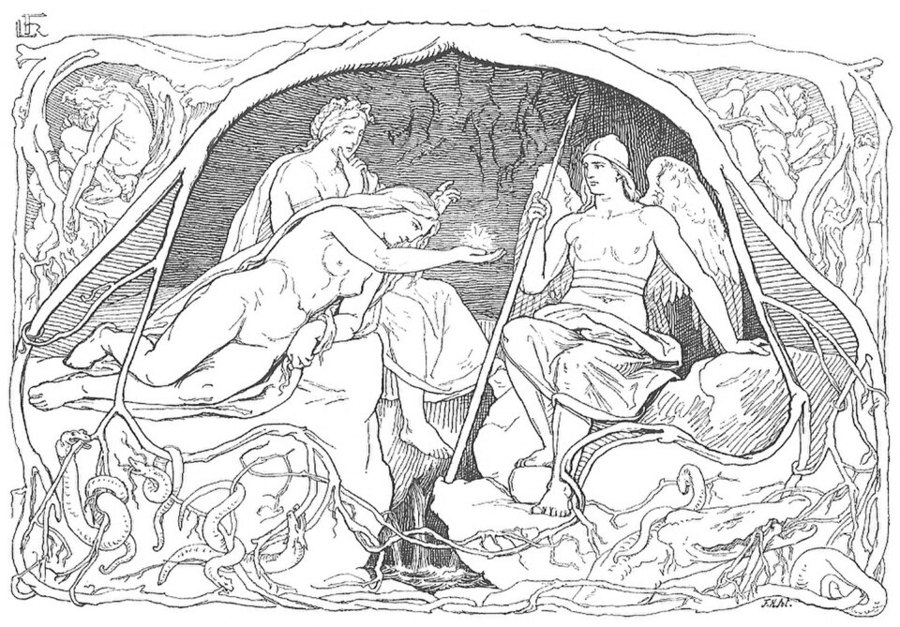
The opening of Helgakviða Hundingsbana I celebrates Helgi's birth through cosmic disturbance and the arrival of norns. They determine an exceptional future for him. Golden strands are extended and fastened across a vast setting, linking the newborn child's prospects with space beyond the household. The imagery makes the future ruler's significance feel expansive before his deeds have begun.
Translations can make the passage sound like an ordinary act of weaving, but the described actions deserve attention in their own right: drawing out, fastening, and establishing connections. What the scene clearly emphasizes is the making of a durable destiny. This is praise organized around the promise of future achievement, not an account of everyone's birth. Its grandeur gives the hero's life a special frame. Reading it beside the quieter classification in Fáfnismál shows how the same category of beings can serve different poetic needs: one passage answers a question, while the other magnifies a heroic entrance into the world.
Sources for this section: 3
An angry prediction and an extinguished candle
Norna-Gests þáttr, preserved in later medieval manuscripts including Flateyjarbók, tells a strikingly different story. Gest recalls female visitors who predicted his future while he lay in a cradle. Two promise distinction, but the youngest becomes angry after being neglected and pushed from her seat. She declares that he will live only while a nearby candle continues burning. The eldest immediately puts it out.
That action does not cancel the pronouncement. It changes the circumstances under which the stated limit will be reached. Gest keeps the candle through an extraordinarily long life and eventually lights it after becoming Christian at King Olaf's court. His death coincides with its end. The narrative combines competing declarations, intervention, memory, and conversion. It cannot be treated as an unmediated report of a Viking birth ceremony. Yet its logic is precise: the deadly condition remains effective while resourceful action postpones its fulfillment, making fate and human response parts of one continuing story.
Sources for this section: 4
Judgment can explain an unbearable outcome
Karen Bek-Pedersen's research draws attention to the legal vocabulary surrounding norns. In a stanza associated with Hervarar saga, Angantyr laments having killed his brother and describes the norns' judgment as evil. The expression comes after conflict over inheritance has become lethal. Fate gives language to a result that the survivor recognizes as devastating and irreversible.
Calling the outcome a judgment does not erase the choices that led toward it. Instead, it locates the personal disaster within an order experienced as larger than the individual. Bek-Pedersen also identifies the textual limitation of this particular example: the stanza belongs to a later manuscript witness and is absent from earlier ones. That matters when dating the evidence. It still illuminates medieval and later literary uses of the norns, but cannot independently establish the exact language of Viking ritual. The comparison directs attention toward declarations and decisions as well as material images of thread.
Sources for this section: 5
A metaphor can allow both limits and choices
In a separate study of fate and weaving, Bek-Pedersen proposes that the interaction of warp and weft offers a useful way to understand necessity alongside possibility. The warp establishes a structure; the crossing thread works within that structure to produce the cloth. This is a modern interpretation of why a textile metaphor can be effective, not proof that every Old Norse author held one philosophical doctrine.
The comparison helps explain why recognizing fate need not make every action meaningless. A fixed condition can coexist with different responses, just as a story can announce an eventual loss while remaining interested in courage, decisions, and consequences along the way. It also cautions against reducing all textile references to one visual scene. Spinning, fastening strands, weaving, and cutting are different operations. The strongest account of the norns leaves room for those differences and for other metaphors, including judgment. Their literary force emerges from what they do in each passage, not only from what modern summaries call them.
Sources for this section: 6
For the introductory context, read Yggdrasil: A Living World, Not a Fixed Map.
The Evidence
The sources below support this article. Interpretations and limits are explained in the text; this is not an exhaustive research review.
- Völuspá, Old Norse text, stanzas 19–20 ↗
- Fáfnismál, Henry Adams Bellows translation (1923) ↗
- Helgakviða Hundingsbana I, Henry Adams Bellows translation (1923) ↗
- Norna-Gests þáttr, Nora Kershaw translation (1921), chapters 11–12 ↗
- Karen Bek-Pedersen, Nornir in Old Norse Mythology (2008), discussion of legal vocabulary ↗
- Karen Bek-Pedersen, Fate and Weaving: Justification of a Metaphor (2009), abstract ↗