
Life & Society · Deep dive
Honey, Beeswax, and the Evidence for Keeping Bees
In Brief
Bee remains and dated wax reveal how sweetness, craft materials, and the management of insects intersected.
On this page
Honey gathering and keeping beesThe Coppergate hive that was never confirmedBee products in a northern landscapeGotland wax belongs to a workshop economyMead and the allocation of sweetnessWhat bee remains can add to a food historyReading a household economy across different findsSourcesHoney gathering and keeping bees
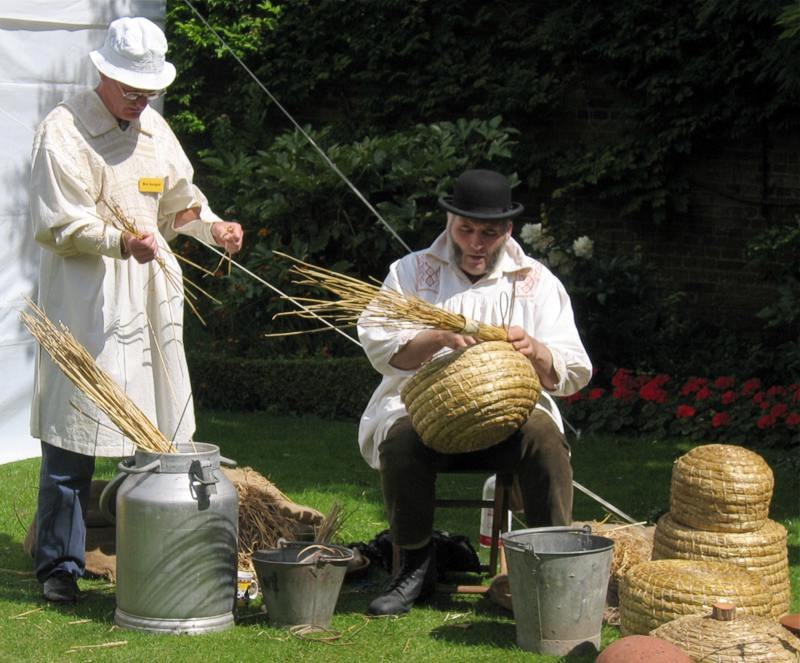
Honey could reach a household without that household owning a hive. Gene Kritsky's historical review distinguishes collecting honey from wild nests from beekeeping that supplies bees with an artificial cavity. Medieval European practice included tree, log, box, and basketlike hives; the variety matters because a hive need not resemble the familiar domed straw skep. These alternatives connect honey production to different kinds of work: finding colonies, controlling access to a tree, constructing containers, and managing a colony near a settlement. They also leave different archaeological traces. A hole in a tree is unlikely to enter a domestic excavation intact. The practical question is therefore how people obtained bee products, rather than simply whether a settlement has produced a recognizable beehive.
Sources for this section: 1
The Coppergate hive that was never confirmed
At Coppergate in York, bundles of apparently twisted plant stems occurred alongside abundant honeybee remains. Harry Kenward suggested a possible skep, but his published reassessment explained how that provisional idea hardened into an alleged discovery. The object was subsequently missing, preventing examination of its construction. Plant material remaining in the sample included dyer's greenweed, common elsewhere at Coppergate. The hive identification remained unproved. Bees themselves were securely identified, and their repeated occurrence across numerous samples led Kenward to favor beekeeping on or near the site. This distinction makes Coppergate unusually instructive: the case for local bee management rests on the distribution of insects, while the attractive picture of one particular basket hive lacks confirmation.
Sources for this section: 2

Bee products in a northern landscape
NordGen's account of the Nordic brown bee emphasizes how little is known about beekeeping before Christianity, while recognizing the older practice of gathering wild honey in Denmark and Sweden. Its Norwegian comparison comes from Oslo, where excavated bees dated to 1175–1225 were identified as brown bees. That is medieval evidence, later than the conventional Viking Age, and NordGen explicitly leaves local beekeeping an open question. The comparison helps separate three propositions that are often collapsed: bees existed in a region, people obtained honey there, and people kept colonies in constructed hives. Those propositions require different evidence. It also discourages treating a relatively rich English urban assemblage as a complete description of farms throughout Scandinavia.
Sources for this section: 3
Gotland wax belongs to a workshop economy
Ny Björn Gustafsson's study of two substantial Gotland beeswax finds placed them in the Viking Period through radiocarbon dating. One came from Starrar fen in Halla parish; the other had a less certain location associated with Mästermyr. The reported calibrated range was 890–1030 CE. The study interprets wax particularly through nonferrous metalworking, where a modeled wax form could be removed from a mold before metal was poured. Hollow cast objects made wax especially useful, although simpler objects could be made through other methods. The geographical origin of these wax supplies remains uncertain. Consequently, finding wax on Gotland neither locates a local apiary nor measures the amount of honey eaten there. It does reveal demand for an animal product within skilled manufacturing, linking bees to ornaments as well as to food.
Sources for this section: 4
Mead and the allocation of sweetness
The National Museum of Denmark describes mead as a fermented mixture of honey and water, potentially flavored with herbs. It distinguishes mead from barley beer and suggests that the effort of obtaining substantial honey supplies made mead more suitable for special occasions. That interpretation concerns availability and effort, not a fixed rule that every household followed. A useful economic implication is that honey used for a drink could not simultaneously sweeten another food. Producing a batch for guests concentrated a resource that might otherwise be divided into smaller portions. Archaeology seldom preserves the decisions behind that allocation, but distinguishing honey fermentation from grain brewing prevents every drinking vessel from becoming evidence of abundant mead.
Sources for this section: 5
What bee remains can add to a food history
Richard Cole's study of bees in Old Norse sources brings archaeological evidence into the discussion, including bees from Viborg around 1000–1025. It notes bee remains in latrine deposits at Viborg and York and discusses accidental ingestion, perhaps associated with mead production, as an explanation. This is a hypothesis about how insects entered a deposit, rather than a recovered drink recipe. Its value is that it follows a small find through a possible sequence of activities: obtaining a bee product, processing or consuming it, and disposing of bodily waste. Cole also distinguishes the later literary symbolism of industrious bees from actual northern insect populations. A medieval author could employ a familiar moral image without reporting a local beekeeper at work.
Sources for this section: 6
Reading a household economy across different finds
Taken together, these cases reveal several separate routes through which bees entered human affairs. York supplies a repeated insect signal within an urban environment. Gotland supplies dated wax associated in interpretation with manufacturing. Viborg contributes evidence relevant to consumption, while later Oslo provides a comparison for the northern distribution of bees. The strongest reconstruction keeps those activities connected without making them identical. A metalworker's wax supply could depend on exchange; a household could obtain honey without keeping a colony; a feast could consume honey in a drink while leaving no identifiable hive. This is why a history of sweeteners benefits from following materials between producers, traders, craftspeople, and diners. Each stage answers a different question about access, labor, and use.
Sources for this section: 2, 3, 4, 6
The Evidence
The sources below support this article. Interpretations and limits are explained in the text; this is not an exhaustive research review.
- Kritsky, Beekeeping from Antiquity Through the Middle Ages ↗
- Kenward, A skeptical view of the Coppergate beehive ↗
- NordGen, The Nordic brown bee ↗
- Gustafsson, Beeswax in metalworking in Viking Period Gotland ↗
- National Museum of Denmark, Beer and mead ↗
- Cole, The Political Symbolism of Ants and Bees in Old Norse Sources ↗