
Life & Society · Deep dive
Brewing, Drinking Vessels, and the Work of Hospitality
In Brief
The feast began before the first cup was offered, in spaces used for processing, storing, and serving.
On this page
Brewing required a sequence of spacesThe disputed brewhouses of the northern islandsServing created a social orderTwo Birka beakers and two supply networksA silver service within a hoardFood and political gatherings at HofstaðirWhat a feast cost the householdSourcesBrewing required a sequence of spaces
A drink served in a hall began as a series of operations elsewhere. Graham and Merryn Dineley's experimental study separates heating crushed malt in water, drawing off the resulting liquid, fermentation, and storage. Each stage needed containers and movement of liquid, while spilled material and equipment cleaning created demands for water and drainage. Their argument is particularly useful for thinking about buildings as working spaces. A hearth alone is a poor indicator of brewing because many activities require heat. A combination of heating facilities, suitable floors, vessels, and drains offers a more persuasive functional possibility. The important contribution of experiments is to identify these practical requirements; experiments do not, by themselves, prove what a particular excavated room was used for.
Sources for this section: 1
The disputed brewhouses of the northern islands
The Dineleys proposed that some buildings previously identified as baths or saunas at Birsay and Jarlshof could have served brewing. At Birsay they pointed to hearths, drains, stone surfaces, and fire-cracked stones; at Jarlshof they examined structures beside a large hall. These are proposed reinterpretations, not universally established identifications. Their discussion also includes twelfth-century Cubbie Roo's Castle, which belongs to the later Norse world rather than the Viking Age proper. The comparison suggests questions for future excavation: where could liquid be heated, how could a heavy vessel be supported, and where would waste water go? It does not justify assigning every drained room to a brewery or assuming every farm had a dedicated brewing building.
Sources for this section: 1

Serving created a social order
The Swedish History Museum's account of meaningful drinking connects hospitality with rank and household authority. It interprets the offering and filling of cups as an activity through which a host's household could acknowledge a guest's standing. This makes serving equipment part of social performance rather than merely a container for alcohol. The museum also draws on later Old Norse literature, including poetic language associating women with drink and vessels. Such texts help explain how medieval writers imagined these relationships, although they do not identify the individual brewer behind an excavated cup. Hávamál's advice about moderation is equally important: drinking culture included expectations about controlled speech and behavior, not simply approval of unlimited intoxication.
Sources for this section: 2
Two Birka beakers and two supply networks
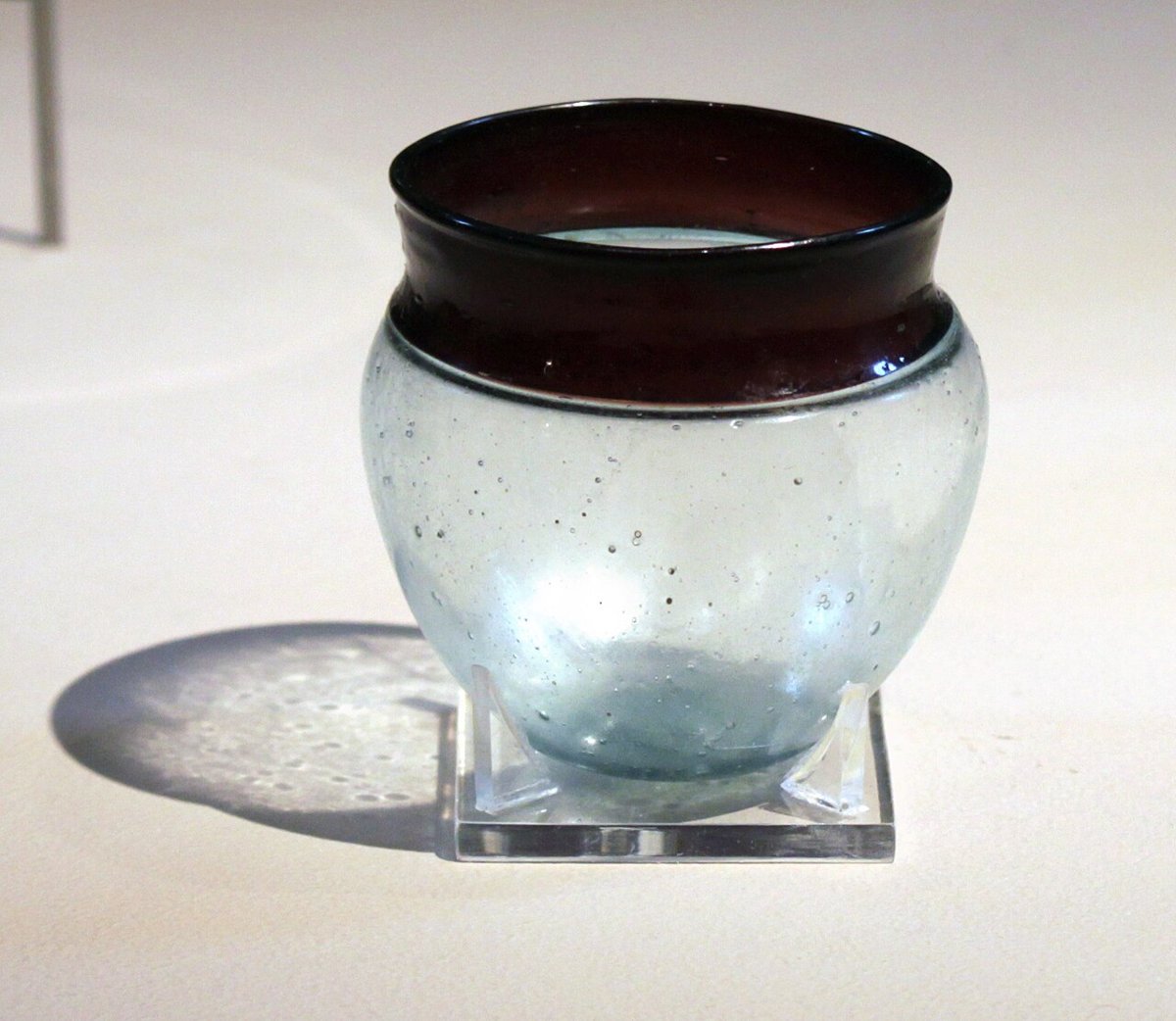
A yellow-green funnel beaker from Birka grave Bj 850 belongs to a type imported from continental Europe, where such glass vessels were produced in quantity. Another beaker, from Bj 542, is thick, colorless glass with ground designs that include birds, plant motifs, and a tree. The Swedish History Museum places its probable manufacture in ninth-century Iran or Iraq. These objects reveal contrasting sources of finished vessels within one trading settlement. They also show why a single generic Viking drinking cup is misleading. Form, color, decoration, and manufacturing tradition could distinguish one vessel from another. Their burial contexts preserve unusually complete objects, but do not tell us what drink each last held or how frequently it was used at a table.
Sources for this section: 3, 4
A silver service within a hoard
The Terslev hoard in Zealand adds another kind of drinking equipment. Among its silver were four Nordic cups and a large embossed bowl that the National Museum of Denmark suggests may have come from Persia. The hoard also contained coins, jewelry, and other objects; its latest coin dates to 944, and the museum places deposition in the second half of the tenth century. Drinking vessels therefore belonged to an assemblage of portable wealth as well as to the furnishing of hospitality. A cup could be valued for its material, workmanship, and associations, then removed from circulation through burial in the ground. The hoard preserves a gathering of objects, not a photograph of one feast, so the relationship between its pieces requires interpretation.
Sources for this section: 5
Food and political gatherings at Hofstaðir
Hospitality is visible through animal remains as well as vessels. Gavin Lucas and Thomas McGovern examined an unusual group of cattle skulls from the monumental Viking Age hall at Hofstaðir in Iceland. Their osteological analysis supported decapitation and display, and they interpreted the practices as seasonal sacrifice associated with feasting and political gatherings. In their reading, meetings could help manage social tensions while enhancing a host's standing. This is an argument grounded in the treatment of animal bodies and the setting of the hall; it does not identify the beverage consumed at those gatherings. Placing the case beside imported cups makes a useful comparison: conspicuous hospitality could mobilize both local livestock and objects obtained through distant networks.
Sources for this section: 6
What a feast cost the household
These examples allow hospitality to be approached as coordinated work. Brewing required processing and handling liquids; serving required vessels and people to distribute their contents; feeding a gathering drew on animals and other provisions. The cases do not supply a universal guest list, standard drink strength, or fixed expenditure per visitor. They instead reveal distinct investments that a host might combine. A prestigious imported vessel could remain useful across many occasions, while a slaughtered animal or consumed batch of drink represented a one-time allocation. That contrast helps explain why halls, workshops, storerooms, and farms belong in the same history. The public moment of drinking depended on labor and resources assembled before guests arrived, and on decisions about who would be included.
Sources for this section: 1, 2, 5, 6
The Evidence
The sources below support this article. Interpretations and limits are explained in the text; this is not an exhaustive research review.
- Dineley and Dineley, Where Were the Viking Brew Houses? ↗
- Swedish History Museum, Meaningful drinking ↗
- Swedish History Museum, Birka Bj 850 cone beaker ↗
- Swedish History Museum, Birka Bj 542 glass beaker ↗
- National Museum of Denmark, The silver hoard from Terslev ↗
- Lucas and McGovern, Bloody slaughter at Hofstaðir ↗