
Life & Society · Deep dive
Hunting, Trapping, and the Northern Fur Trade
In Brief
Paw bones, protein analyses, and proposed winter routes connect northern hunting communities with workshops and elite dress.
On this page
A trade built on perishable goodsPaw bones in a trading townBeaver fur in Danish elite dressSmall animals and large pitfallsA proposed winter route into Sámi countryRings, rivers, and gathering placesWhat a fur network connectedSourcesA trade built on perishable goods
Fur was an important commodity in northern exchange, but its archaeological visibility differs sharply from that of silver. A coin can survive where an entire garment has disappeared. The National Museum of Denmark identifies wild-animal furs, including sable, ermine, fox, marten, and beaver, among Viking export goods exchanged for materials such as silver, gold, beads, and silk. This trade connected the work of obtaining and preparing skins with distant consumers. “Viking fur trade” is therefore a convenient geographical and chronological label, not a claim that Scandinavians performed every stage. Hunters, processors, intermediaries, and buyers could belong to different communities. Understanding their connections requires more than tracing the journeys of the metal objects received in exchange.
Sources for this section: 1
Paw bones in a trading town
Bengt Wigh’s study of Birka’s animal remains identifies numerous bones from fur-bearing animals, particularly fox, squirrel, and marten. Many came from paws left attached to pelts until final processing in the town. Once removed, they entered urban refuse. This anatomical pattern differs from what would be expected if complete animals were simply arriving for meals. It points to a particular stage in a production chain. The carcass and skin could follow separate paths, leaving different evidence at the hunting place and trading settlement. Wigh finds fur processing important through Birka’s history. Even when the skins themselves vanished, the small bones discarded during preparation preserved evidence for a perishable commodity moving through the town.
Sources for this section: 2
Beaver fur in Danish elite dress
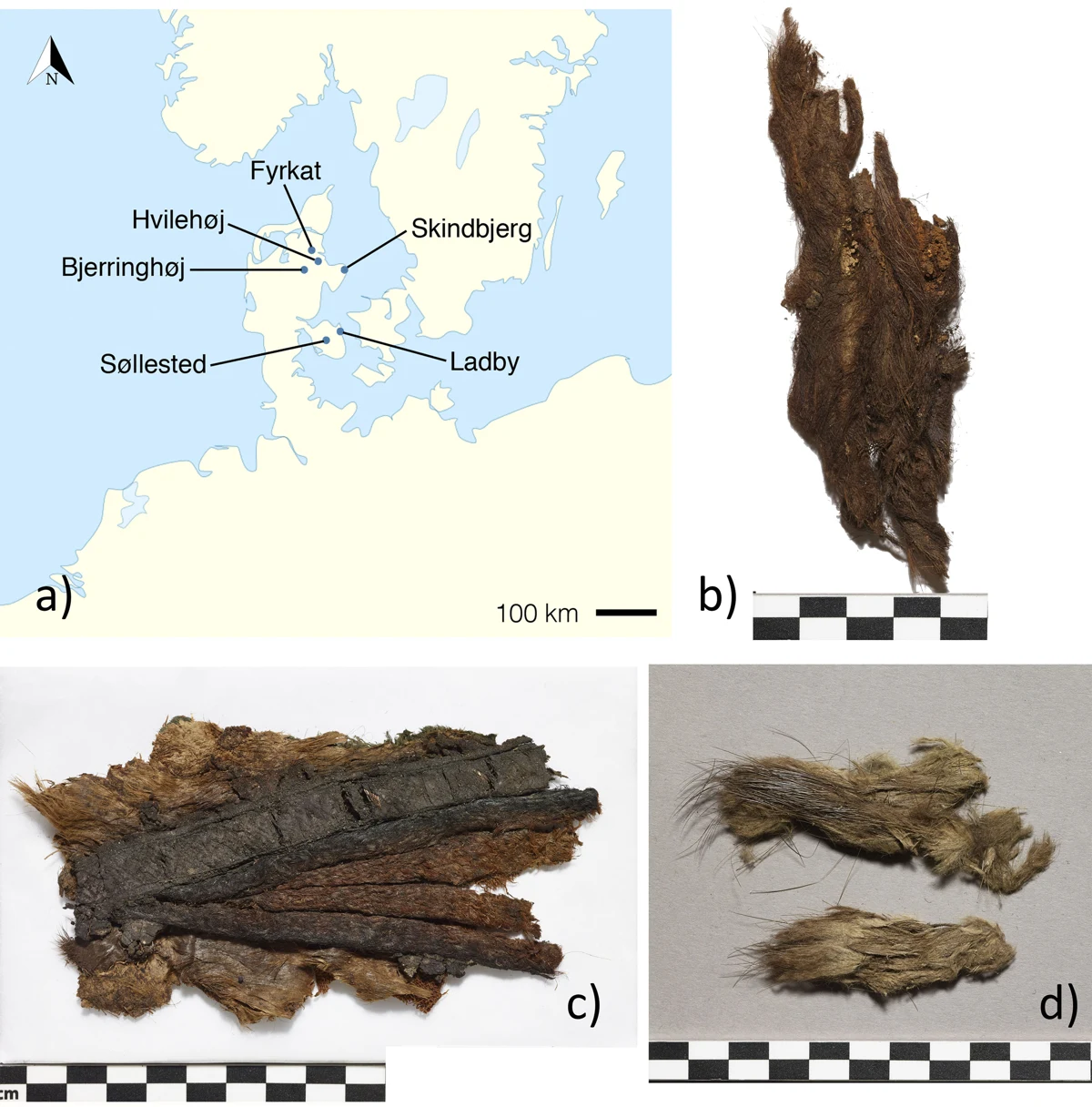
A protein study of fur from six high-status Danish Viking Age graves identified wild species including beaver, squirrel, and a mustelid, alongside domestic-animal material. The garments and associated objects could combine several species rather than use one skin throughout. Beaver was especially significant because the researchers argued that Danish supplies could not explain the material and that import was the strongest explanation. Their discussion acknowledges a rare later beaver bone and the uncertainty of reconstructing local animal populations. The finding does not locate the exact trapping ground. It does show that finished clothing could bring together locally available hides and more distant fur, with differences in texture and appearance forming part of how luxury was displayed.
Sources for this section: 3
Small animals and large pitfalls
The spectacular trapping pits of northern Sweden must not be treated as direct evidence for catching every animal involved in the fur trade. Andreas Hennius’s revised chronology concerns pits used for elk and reindeer. Foxes, martens, and squirrels were most likely obtained by other methods. His analysis also challenges the assumption that pitfall activity simply rose with Viking towns: the dated sequence includes substantial earlier activity, a reduction at the beginning of the Viking Age, and renewed early medieval intensity. Hunting landscapes had histories of their own. The point is not that forests were disconnected from towns, but that a specific class of monument needs a specific explanation. Large pits cannot substitute for missing evidence about small-animal trapping techniques.
Sources for this section: 4
A proposed winter route into Sámi country
Survey in the mountains between Norway and Sweden identified a trail marked by upright stones high enough to remain visible above snow. Bergman and colleagues combined lichen measurements with other evidence to argue for a route established around the ninth century, possibly by a Norse chieftain seeking access to Sámi fur traders. The proposed date and purpose are interpretations; the stones do not carry labels naming their users. Even so, the study directs attention toward the infrastructure of exchange in winter conditions. Reaching a trading partner could require recognizable routes through difficult terrain. It also puts Sámi participants within the historical relationship as trading communities, rather than treating northern resources as goods that appeared without the knowledge and work of local people.
Sources for this section: 5
Rings, rivers, and gathering places
Research presented through Lund University links Perm-type silver rings with early Viking Age contacts between the Volga region and the Baltic. The author proposes a model in which small groups obtained furs and brought them to river centers, where products could be gathered for exchange on a larger scale. Weight-adjusted rings may have served as substantial units of payment rather than ornaments alone. This is a reconstruction from distributions and material characteristics, not a preserved ledger of transactions. Its value lies in separating the collection of individual skins from the concentration of a commercially useful supply. A network could connect numerous dispersed producers with distant markets without requiring one traveler to organize every stage personally.
Sources for this section: 6
What a fur network connected
The examples reveal several distinct kinds of evidence: Birka’s processing debris, Danish garment fragments, mountain route markers, and eastern silver forms. They should not be compressed into one identical itinerary. Each documents or suggests a different part of acquisition, movement, manufacture, and consumption. Their combination nevertheless makes the economic relationship more tangible. The demand visible in elite clothing depended on skilled preparation, while the waste of preparation could accumulate far from the animal’s original habitat. Regional hunting chronologies also warn that northern communities were not merely responding to a single Viking-era boom. Fur exchange joined existing landscapes and livelihoods to new opportunities, with effects that varied according to species, route, and the particular relationships between communities.
Sources for this section: 2, 3, 4, 5, 6
The Evidence
The sources below support this article. Interpretations and limits are explained in the text; this is not an exhaustive research review.