
Life & Society · Deep dive
Soapstone Vessels and the Networks That Supplied Them
In Brief
Quarry scars, stone chemistry, and cooking pots connect household needs with specialized production and long-distance movement.
On this page
Stone that could become cookwareCatpund preserves the missing vesselsHollowing was a vulnerable stageA pot with an iron handleMatching Hordaland vessels with quarriesSettlement across the North AtlanticCookware within changing supply systemsSourcesStone that could become cookware
Soapstone, also called steatite, offered northern households a material that could be carved into useful vessels. Its high talc content makes it relatively soft, and its thermal properties suited repeated heating. Geopark Shetland describes a much wider range of products than cooking pots alone: oil lamps, fishing weights, spindle whorls, loom weights, and bake plates were also made from it. These uses connected quarrying with cooking, lighting, textile work, and fishing. A suitable deposit was therefore a resource for several activities within a household economy. Yet the existence of local rock did not ensure that every object was locally made. To understand supply, archaeologists must connect particular products with extraction sites rather than assume that proximity proves origin.
Sources for this section: 1
Catpund preserves the missing vessels
At Catpund in Shetland, quarry surfaces retain chisel marks and hollows where vessels were shaped and removed. The empty spaces are evidence for objects that have traveled elsewhere or disappeared. Spoil heaps and unfinished pieces preserve a different part of the same industry. Together, these remains allow a quarry to be read as a production site rather than simply a geological outcrop. The extraction scars show repeated work across the hillside, while abandoned pieces reveal points where the process stopped. A kitchen vessel may give evidence of use but little indication of how it was detached from bedrock. At the quarry, those priorities reverse: the maker’s access to the stone and the consequences of cutting become the main surviving evidence.
Sources for this section: 1

Hollowing was a vulnerable stage
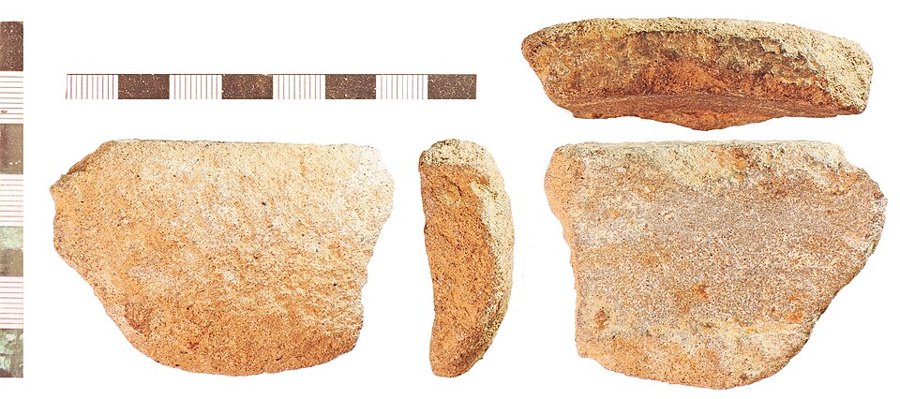
Archaeology Shetland’s account of the Catpund excavations distinguishes blocks, rough blanks, and vessels at different stages of completion. Many abandoned pieces came from the rough hollowing stage, when breakage posed a particular problem. This is important for understanding labor. A broken blank represented work already invested without a usable vessel to show for it. Differences among tool marks have prompted competing explanations: uneven skill among workers, or skilled adaptation to variable stone and impurities. The surviving variation cannot settle that question by itself. A uniform method may be unsuitable when the material is inconsistent. The quarry thus illustrates how craft knowledge included judging the rock and adjusting work, not merely repeating an ideal sequence of identical blows.
Sources for this section: 2
A pot with an iron handle
A vessel from Birka grave Bj 879 combines a rounded soapstone body with an iron handle and attachment. The Swedish History Museum notes that the displayed pot is partly reconstructed. This is a useful reminder that a familiar complete silhouette may include modern restoration, while the surviving components establish a specific combination of materials. The stone vessel and its iron fittings brought different kinds of craft into one object. Soapstone is naturally available in northern Bohuslän and Jämtland, both exploited in the Viking Age, but those regional facts do not assign this particular pot to a quarry. Its presence at Birka documents a vessel in use or ownership there, followed by its selection for burial.
Sources for this section: 3
Matching Hordaland vessels with quarries
A joint archaeological and geological investigation in western Norway compared the chemical composition of vessels with sampled quarry stone. The researchers examined 51 vessels from Viking Age rural contexts, 95 from eleventh- and twelfth-century Bergen, and samples from 38 Hordaland quarries. Major, trace, and rare earth elements supplied a chemical fingerprint, which was then evaluated alongside archaeological information. The study found that few Viking Age vessels came from outside the region, while the later urban sample had a substantially larger external component. It also distinguished quarry districts supplying different groups of consumers. The result is more specific than a generic story of expanding trade: the places supplying cookware changed as the settlement and consumption pattern changed.
Sources for this section: 4
Settlement across the North Atlantic
Amanda Forster and Richard Jones’s Homeland to Home research combines vessel forms with scientific analysis of soapstone composition. Their work includes quarries in Shetland and southeastern Norway and artifacts from places including Orkney, York, Kaupang, and the Faroes. The purpose is to examine connections between arriving communities, imported objects, and the eventual use of local resources. A pot carried into a new settlement and a later pot made from nearby stone can represent different phases of establishment. However, the origin of a vessel should not be equated automatically with the birthplace of its user. Supplies can travel through exchange. Provenance makes it possible to test migration and distribution hypotheses, provided that objects and people remain distinct kinds of evidence.
Sources for this section: 5
Cookware within changing supply systems
Research on medieval Borgund provides a later comparison. Its excavated assemblage includes both imported pottery and soapstone vessels, and researchers examine origin, wear, soot, and food deposits to investigate trade and use. This does not mean that Borgund’s medieval proportions describe every Viking household. It instead shows how stone cookware could remain useful while other vessel supplies developed around it. The Hordaland study likewise demonstrates that regional production and wider exchange were alternatives operating at different scales, rather than successive stages that neatly replaced one another. Soapstone’s history includes quarry labor, transport, iron attachments, cooking, and eventual discard or burial. Following those connected activities makes an ordinary vessel evidence for economic relationships as well as household practice.
Sources for this section: 6, 4
The Evidence
The sources below support this article. Interpretations and limits are explained in the text; this is not an exhaustive research review.
- Geopark Shetland: Catpund soapstone quarry ↗
- Archaeology Shetland: Steatite in Shetland ↗
- Swedish History Museum: soapstone pot from Bj 879 ↗
- Hansen, Jansen and Heldal: provenancing Hordaland vessels ↗
- Forster and Jones: Investigating the Origins of Steatite Vessels ↗
- University of Bergen: pottery and soapstone from Borgund ↗