

Life & Society · Focused study
Mammen’s Embroidery: Reassembling a Garment We Cannot Fully Name
In Brief
The embroidered wool from the Mammen burial is among the most evocative textiles of the Viking Age. Its surviving patterns are clearer than the complete garment to which they belonged, and that difference deserves attention.
On this page
Patterns survive where an outfit does notTwo records, different materialsLook closely before assigning meaningSourcesPatterns survive where an outfit does not
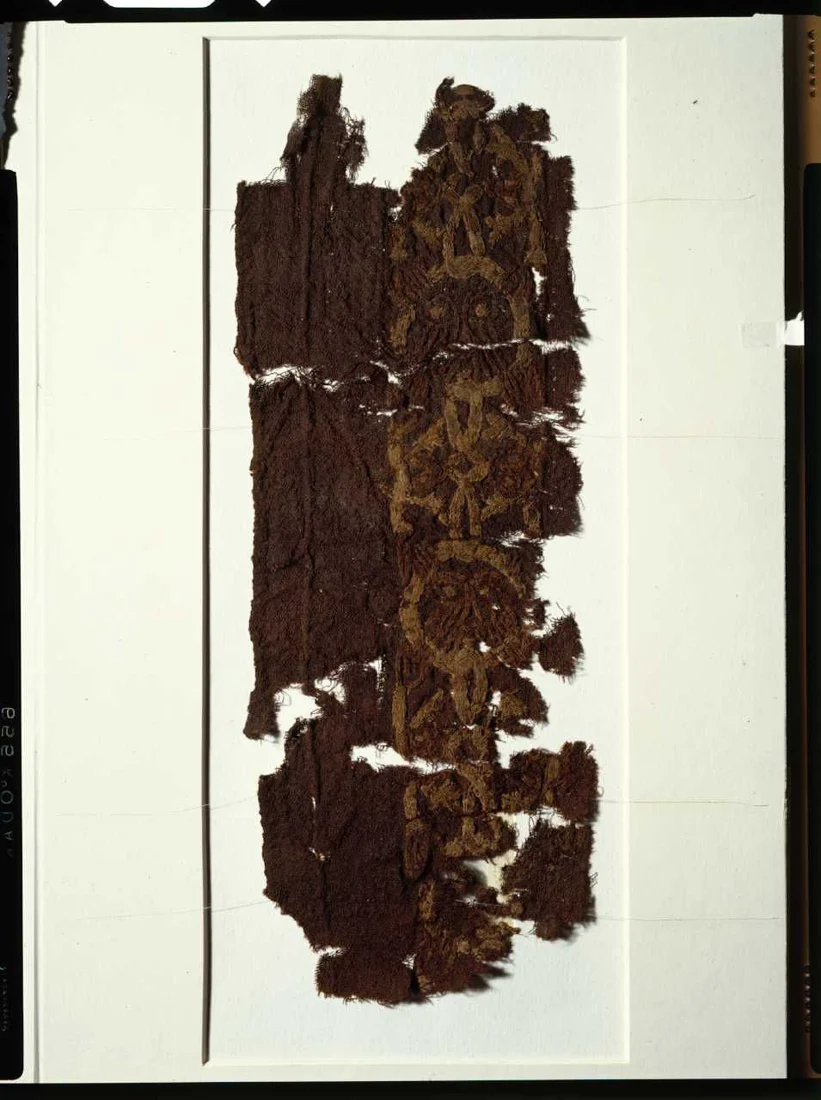
The National Museum of Denmark describes the Mammen clothing as costly and elaborate, while explaining how poor documentation during the nineteenth-century discovery complicates interpretation. Embroidery survives on wool fragments, with plant and animal ornament among the motifs. Other pieces include bands and material associated with bedding or furnishings. These are not automatically parts of one tunic. An attractive modern reconstruction can hide this problem by stitching every fragment into a coherent costume. The original evidence instead asks researchers to determine which pieces belonged together and where they were positioned.
Sources for this section: 1
Two records, different materials
The museum’s collection record identifies the embroidered wool separately as C135a. That identity provides a practical starting point for examining the assemblage. Embroidered wool should not be merged into a single imagined surface with every other textile just because all belonged to the burial. Looking at the object individually also helps distinguish the textile’s material from the appearance of a photograph. An image of one surviving piece is evidence for that piece; it is not a complete pattern for the deceased’s wardrobe. The catalog’s precise attribution is more useful here than an unsupported complete costume.
Sources for this section: 2
Look closely before assigning meaning
An embroidery motif may be identifiable as a plant-like form or an animal without revealing its maker’s complete symbolic intention. A visitor can appreciate the organization of the stitches and repeated shapes while leaving their significance open. Similarly, valuable materials support an interpretation of conspicuous resources without supplying the deceased’s precise rank. The museum’s presentation retains uncertainty over the textiles’ placement, which provides a good model for displaying replicas: label reconstructed areas and distinguish clothing from other furnished textiles. Mammen then becomes more interesting than a single spectacular outfit. It exposes the work of interpretation itself, showing how an archaeological assemblage is assembled intellectually as well as physically. A useful close-up image should therefore concentrate on the surviving embroidered wool, with a separate diagram for a proposed arrangement, rather than passing a fully dressed modern figure off as direct evidence.
Sources for this section: 1, 2
The Evidence
The sources below support this article. Interpretations and limits are explained in the text; this is not an exhaustive research review.