
Life & Society · Deep dive
Age, Disability, and Care in Burial Evidence
In Brief
Healed injuries and long-term bodily changes reveal survival and adaptation, while careful interpretation distinguishes evidence of care from assumptions.
On this page
From a changed bone to an experienceA healed arm at CnipLiving with damaged joints at FjälkingeOseberg and the difficulty of estimating ageWhy a cemetery is not a health surveyThe limits of the abandonment storyCare without reducing people to dependenceSourcesFrom a changed bone to an experience
A healed injury is evidence that someone lived after being hurt. It is not, by itself, a full account of their treatment or social position. The bioarchaeology of care approach developed by Lorna Tilley and Tony Cameron asks researchers to move explicitly from skeletal observations to functional consequences and then to possible assistance. That sequence matters in Viking Age households, where a person's ability to contribute depended on particular tasks and surroundings. Limited movement in one joint need not imply an inability to perform every kind of work. Conversely, survival through a difficult recovery could require substantial support. The historical question is therefore specific: what could this individual probably do, what would have been difficult, and what archaeological evidence supports an inference that others helped?
Sources for this section: 1
A healed arm at Cnip
The osteological report for the Viking Age cemetery at Cnip on Lewis describes an adult man in burial C with a well-healed fracture near the lower end of the left upper-arm bone. The injury had united without deformity or evidence of muscle wasting. The analyst considered immobilization during recovery likely. This is a useful example because the interpretation identifies the observation and the proposed response separately. The healed shape is visible in the bone; the use of immobilization is an inference from the outcome. No surviving splint establishes the equipment, and the fracture does not identify a particular healer. The man also had dental changes, but the report did not establish a cause of death. His skeleton preserves episodes within a life, not a complete medical record.
Sources for this section: 2

Living with damaged joints at Fjälkinge
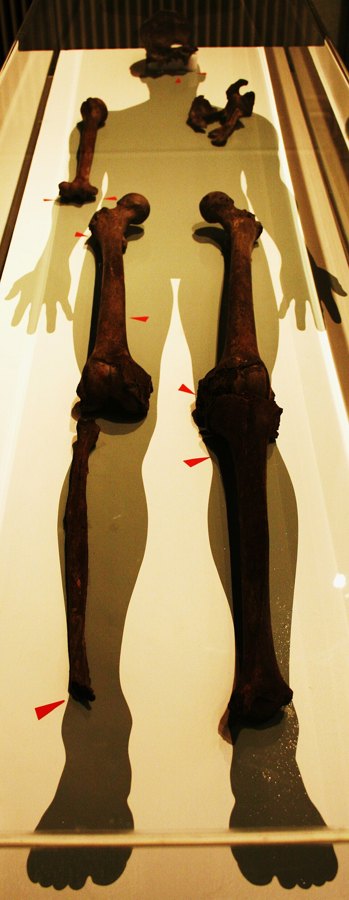
At Fjälkinge in southern Sweden, a cemetery dated approximately 900–1050 preserved individuals who had lived with long-standing physical changes. Bertil Helgesson and Caroline Arcini reported healed fractures, including some that had united out of alignment, and persistent shoulder dislocations in two women. An older woman in grave 65b had injuries involving her arm and pelvis. These cases make bodily adaptation part of the community's history rather than an exceptional interruption to it. The same study identified people with skeletal evidence interpreted as leprosy buried among others in the cemetery. That spatial observation challenges an automatic assumption of separate burial. It cannot prove the absence of stigma during life, but it supplies concrete evidence against reconstructing exclusion solely from a modern expectation about disease.
Sources for this section: 3
Oseberg and the difficulty of estimating age
Per Holck's reexamination of skeletal material from Oseberg illustrates how an apparently familiar individual can change under closer analysis. The older woman's surviving vertebrae showed fusion, inflammatory changes, and a compression fracture. For the younger woman, slight tooth wear had helped support an earlier youthful age estimate, but analysis of tooth-root translucency suggested a substantially older adult. Holck emphasized that dental wear also reflects diet, making it an imperfect clock. The contrast matters beyond the numerical estimate: a burial popularly imagined as an elderly woman accompanied by a young attendant could be interpreted differently when the second woman's age changed. Neither age nor skeletal condition identifies either woman by name. Their remains demand attention as evidence in their own right, not merely as accessories to a royal identification.
Sources for this section: 4
Why a cemetery is not a health survey
Modern research on the osteological paradox explains why counts of skeletal changes cannot straightforwardly measure the health of a living community. People differed in susceptibility to disease and death, and a cemetery contains those who died at particular ages rather than a random sample of everyone alive. Population change through migration, births, and deaths adds another complication. A visible lesion can therefore be difficult to interpret without considering how long someone survived and how the sample formed. This is especially relevant when an excavated area represents only part of a burial ground. The appropriate response is to investigate context and compare plausible explanations, not to assign a single life expectancy or health profile to all Viking Age people from one group of skeletons.
Sources for this section: 5
The limits of the abandonment story
The Swedish History Museum explicitly rejects the familiar claim that elderly people and those with reduced physical capacity were routinely thrown from a precipice. Its display instead emphasizes grave evidence for people who survived with injuries and dependence on others. This does not require replacing a story of universal cruelty with one of universal kindness. The material supports a more varied social history. Some conditions that affected daily life left little or no skeletal trace; others are strikingly visible after burial. A history built only around the most dramatic bones would miss much of that variation. The task is to explain supported cases of survival and accommodation while recognizing that the emotional quality of a relationship is seldom recoverable from skeletal remains.
Sources for this section: 6
Care without reducing people to dependence
Across these examples, assistance should be considered alongside participation. The Cnip fracture raises a question about support during recovery; the Fjälkinge dislocations raise questions about enduring adjustments; Oseberg shows how age and physical condition intersected with an elaborate burial. None of these people can be reduced to a diagnosis. They also occupied households, possessed relationships, and were treated in particular ways at death. Those dimensions become clearer when observations are kept at the scale the evidence permits. A healed fracture supports survival; an anatomical outcome may support a treatment hypothesis; burial position can establish inclusion in a cemetery. Combining these observations cautiously produces a history of living with bodily difference, without pretending that archaeology can recover every caregiver, remedy, or personal feeling involved.
Sources for this section: 1, 2, 3, 4
For the introductory context, read Health and Healing: What the Bones Can Tell Us.
The Evidence
The sources below support this article. Interpretations and limits are explained in the text; this is not an exhaustive research review.