
Journeys & Encounters · Introduction
Oseberg: A Ship, Two Women, and an Extraordinary Burial

In Brief
The Oseberg burial brings together seafaring, skilled craftsmanship, and elite power. Its treasures also remind us how much of Viking Age life normally disappears from the archaeological record.
Oseberg, Vestfold, Norway · Burial dated to 834 CE
On this page
A working ship becomes a graveHistory preserved in threadA discovery that required reconstructionSourcesA working ship becomes a grave
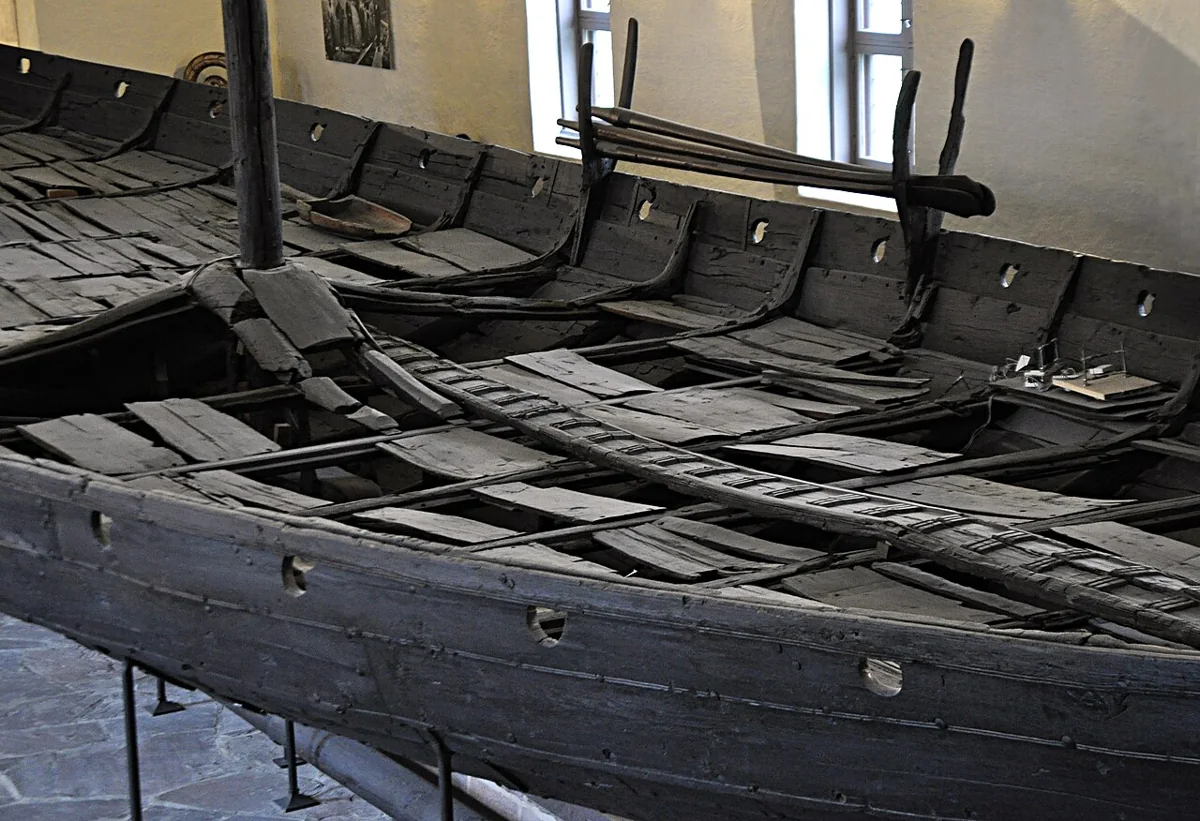
Built in southwestern Norway in the early ninth century, the oak Oseberg ship could travel under sail or oars. It is about 21.5 meters long, with fifteen oar openings along each side. In 834, it became the burial vessel for two women near present-day Tønsberg. Their names are unknown. The scale of the burial suggests exceptional standing, but cannot establish a particular royal identity.
The grave contained a wagon, sledges, carved animal heads, household equipment, and textiles. These objects connect the funeral to both ceremonial display and the practical activities of a wealthy household. They should not be treated as an inventory of an ordinary farm.
History preserved in thread
The textile finds include silk, embroidery, tablet-woven bands, and tapestry fragments. Imported silk points to connections reaching far beyond Scandinavia. Spinning and weaving equipment also survived, showing the importance of textile production alongside the finished luxury goods.
Figures on the tapestries include people, animals, and vehicles. Some appear to form processions. Whether particular scenes represent ritual, mythology, or remembered events remains uncertain. Modern drawings with complete designs and vivid colors help readers imagine the fragments, but their reconstructed details are not all directly preserved.
A discovery that required reconstruction
The burial came to archaeological attention in 1903 and was excavated in 1904. Recovery was only the beginning: conservation and reconstruction of the ship and much of its equipment took many years. About ninety percent of the restored ship's timber is original.
That survival is exceptional. Wood and cloth are easily lost, so Oseberg gives unusually rich evidence for crafts that can seem scarce at less favorable sites. It is valuable precisely because it preserves materials that archaeology often misses, while representing a highly unusual funeral.
The Evidence
The sources below support this article. Interpretations and limits are explained in the text; this is not an exhaustive research review.