
Beliefs & Stories · Deep dive
The Oseberg Tapestries: Reading Scenes Without Captions
In Brief
The woven images from Oseberg preserve a rare Viking Age visual world. Their figures can be described more securely than their stories can be named.
On this page
The images survive as a damaged collectionA procession is a description before it is an explanationViolence belongs to the visual vocabularyThe number of original textiles is itself a questionBorders provide a different kind of evidenceMaking a version tests craft choices rather than a storyA plausible reconstruction should expose its decisionsKeep narrative proposals separate from fragment matchingSourcesThe images survive as a damaged collection
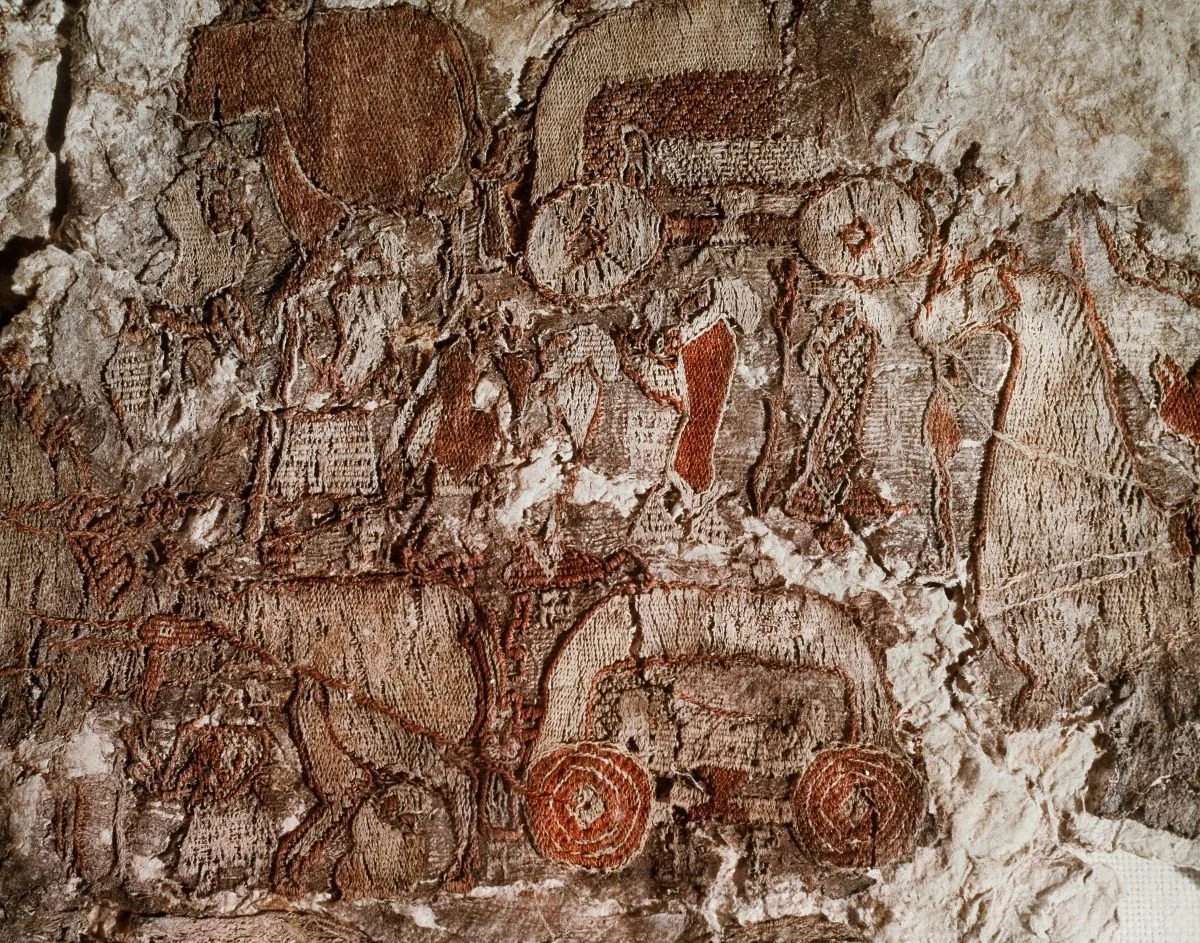
The Museum of the Viking Age describes Oseberg’s tapestries as fragments within a much larger collection of textiles from the ship burial. Among the visible subjects are people, animals, ships, wagons, buildings, and geometric ornament. This variety does not supply a complete illustrated narrative. The surviving pieces have lost material and color, and the original arrangement is difficult to recover. Before asking which myth appears, it is necessary to establish what is actually visible. A human figure beside a wagon is an observation; identifying that figure as a particular god or historical participant requires additional evidence that the image may not provide.
Sources for this section: 1
A procession is a description before it is an explanation
The two largest fragments show people and animals moving in succession, with riders, carried objects, and wagons. The museum compares the arrangement with a procession or cortege while leaving open whether the imagery represents ritual, myth, or an event. That distinction allows useful discussion without prematurely naming the scene. A repeated direction of movement can support the description of a procession, but it does not identify its destination, occasion, or participants. Nor does deposition in a burial prove that the textile originally illustrated that burial. An object’s final archaeological setting and the subject of its imagery are related questions rather than identical ones.
Sources for this section: 1

Violence belongs to the visual vocabulary
In a research presentation on the Oseberg tapestries, Marianne Vedeler draws attention to battle imagery, armed figures, and weapons appearing between figures in the narratives. Her discussion places weaving and representations of violence within a wider interpretive frame involving medieval Norse ideas about power, magic, and craft. The visual observations and the literary comparison should remain distinguishable. A spear represented in a scene can be identified without proving that the whole composition illustrates one surviving poem. Conversely, treating every weapon simply as decoration risks ignoring its possible narrative role. The challenge is to compare possibilities while keeping the evidence for each one visible.
Sources for this section: 2
The number of original textiles is itself a question
Research on image clustering of the Oseberg fragments explores whether texture features can help recover their original grouping. The study used both conventional texture descriptors and deep-learning methods, then grouped the resulting image features. Two texture clusters emerged, but the authors explicitly caution that limitations prevent a simple conclusion about the number of original artworks. This is a useful reminder that computational output does not automatically identify historical objects. Similarity can guide inspection and suggest relationships; it still needs evaluation against weaving structure, preservation, and the physical fragments. A numerical grouping should not become a reconstructed tapestry count without that additional argument.
Sources for this section: 3
Borders provide a different kind of evidence
Bente Skogsaas’s study of tablet-woven band 13B2 examines a component of the Oseberg textile assemblage through photographs, earlier drawings, comparisons, and practical weaving. The study distinguishes well-preserved portions from unclear or destroyed areas and develops explicit criteria for reconstructing the latter. This work is relevant to tapestry interpretation without turning a band into a picture scene. Construction and pattern can constrain how a reconstruction is made, while the meaning of a depicted procession remains unresolved. The distinction helps readers appreciate the strongest available result: technical reconstruction can become more precise even when narrative identification does not.
Sources for this section: 4
Making a version tests craft choices rather than a story
Oseberg Viking Heritage reports a recent reconstruction of the wagon-procession fragments using practical weaving and a replica of a small weaving fork from the burial. The original section is only about nineteen by forty-five centimeters without its borders, yet the reconstruction required substantial intermittent work. This account makes the scale and concentration of the craft tangible. It does not provide a universal labor estimate for Viking weavers, whose training and working conditions differed. Nor does completing the picture establish what it meant. A modern reconstruction can explore how a proposed design is woven while leaving the historical interpretation of that design open.
Sources for this section: 5
A plausible reconstruction should expose its decisions
Skogsaas developed two versions of the band reconstruction and evaluated them against the stated criteria, finding that one satisfied all of them. This is more informative than presenting a single finished textile without explanation. Readers can see that alternatives were considered and why one was preferred. The same principle can guide public presentations of the pictorial fragments: show surviving evidence, distinguish restored outlines, and identify choices that depend on analogy. Passing a set of technical criteria does not prove that every lost thread has been recovered, but it makes the reconstruction a reasoned proposal that others can inspect, challenge, or improve.
Sources for this section: 4
Keep narrative proposals separate from fragment matching
The clustering study and Vedeler’s discussion address different problems. One explores relationships among images of damaged fragments; the other investigates the possible significance of figures and weapons. Better grouping may improve the basis for interpreting a scene, but it cannot supply missing names or captions. An effective account therefore proceeds in stages: describe the surviving forms, assess how fragments may relate, and only then compare possible stories or ritual contexts. Oseberg’s tapestries remain important even when the last stage stays uncertain. They reveal skilled visual composition and subjects worth representing, while reminding us that a Viking audience may have recognized references that modern viewers can no longer securely recover.
Sources for this section: 2, 3
For the introductory context, read Oseberg: A Ship, Two Women, and an Extraordinary Burial.
For the introductory context, read How to Read Viking Animal Ornament.
The Evidence
The sources below support this article. Interpretations and limits are explained in the text; this is not an exhaustive research review.
- Museum of the Viking Age: Oseberg textiles and uncertain motifs ↗
- Marianne Vedeler: Weaving War, research presentation abstract ↗
- Museum of Cultural History: Texture-based clustering of archaeological textile images, abstract ↗
- Bente Skogsaas: reconstruction of Oseberg band13B2 ↗
- Oseberg Viking Heritage: Two Crafts Hand in Hand,2026 ↗