
Beliefs & Stories · Deep dive
Gold Foil Figures: Small Images and Ritual Before the Viking Age
In Brief
Tiny stamped and cut figures illuminate the centuries leading into the Viking Age, but their manufacture, use, and religious identities remain separate questions.
On this page
Begin before the familiar Viking timelineSorte Muld shows variety within a familiar labelManufacture establishes a sequence of choicesSome figures were made wearable in a specific wayAdded gold can change an already finished imageA divine name is a proposal requiring supportSmall scale is part of the research questionOffering is a category, not a complete ritual scriptSourcesBegin before the familiar Viking timeline
Gold foil figures are often discussed beside Viking religion, yet much of the material belongs to the preceding centuries. A study of their miniature character places its late Scandinavian Iron Age corpus around AD550/600–800. This chronology matters whenever later Norse stories are used to explain the images. A resemblance to a medieval account can suggest a comparison, but it cannot erase the time between the foil’s production and the surviving text. The figures are valuable evidence for earlier visual and ritual practices in their own right. They should not be reduced to illustrations prepared in advance for stories recorded centuries later.
Sources for this section: 1
Sorte Muld shows variety within a familiar label
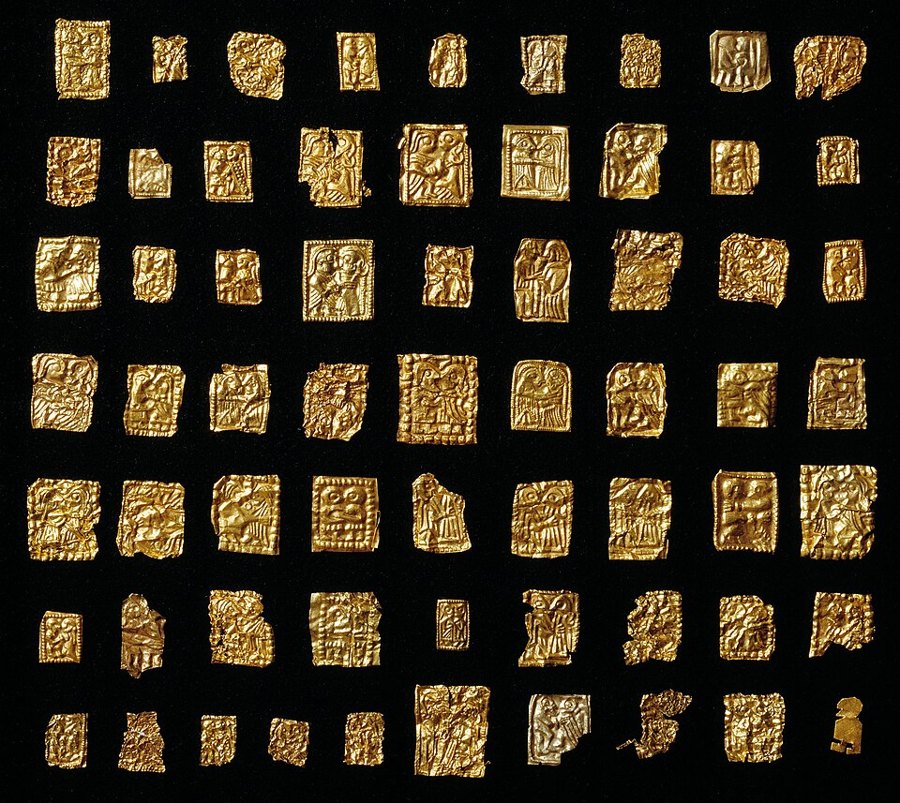
Bornholms Museum describes a large concentration of gold foil figures at Sorte Muld, including representations of men, women, and animals. Most carry impressed designs, while rarer examples are cut and worked individually. Clothing, hairstyles, jewelry, objects, and gestures form part of the visual vocabulary. The label guldgubber can therefore conceal significant differences. For interpretation, it is useful to record whether an image depicts one figure, a pair, or an animal before assigning a common function to the whole category. Shared material and small scale do not prove that every example represented the same being or participated in the same action.
Sources for this section: 2

Manufacture establishes a sequence of choices
Alexandra Pesch’s study distinguishes production from later changes to finished figures. Many foils were impressed from dies, while other forms were cut directly from sheet material. Comparing repeated impressions can identify relationships between objects without requiring a complete explanation of their religious meaning. If two examples share a die, that is evidence about their production connection; it does not automatically establish that they were used together or by the same person. This distinction is especially useful when discussing networks between important settlements. Manufacturing relationships provide one line of evidence, while distribution and archaeological context are needed to investigate movement and use.
Sources for this section: 3
Some figures were made wearable in a specific way
The Swedish History Museum describes two die-identical figures from a cremation burial at Bolmsö. Their gold edges were folded around a bronze backing with a hole that allowed suspension. This unusual construction gives a more concrete basis for discussing an amulet function than appearance alone would provide. It also warns against universal claims about the category. Evidence that these objects could be worn does not demonstrate that every thin gold figure was jewelry. Their backing and suspension arrangement are precisely the features that make the inference possible, and those features should remain central when the example is compared with unbacked or differently deposited foils.
Sources for this section: 4
Added gold can change an already finished image
Pesch draws attention to secondary strips apparently representing neck rings, including an example from Uppåkra. Such additions introduce a history after initial manufacture: the image was not necessarily complete, in its final form, when it left the die. Several interpretations remain possible. An addition might belong to customary use, alter an attribute, or adapt an object for a different purpose. Damage and punctures present further problems because their timing is not always clear. The analytical task is to establish the physical sequence before attaching a ritual explanation to it. An alteration is evidence of an action, but its motive may remain uncertain.
Sources for this section: 3
A divine name is a proposal requiring support
The Swedish History Museum suggests that the seated Bolmsö figure might represent Freyr, while presenting the identification as a possibility. That caution is essential. A seat, posture, or attribute can be compared with other images and texts, but identifying a particular deity requires more than choosing a familiar name that fits broadly. The first useful description should remain available even if the proposed identification changes: a small human figure, represented in a particular posture, constructed for suspension. This preserves the object’s evidential value without making its significance depend entirely on one uncertain interpretation of the person represented.
Sources for this section: 4
Small scale is part of the research question
The study For the Blind Eye Only? treats the figures’ smallness as significant rather than merely inconvenient. It proposes that their framed, miniature representations participated in transformations connected with cosmology and belief. This is a theoretical interpretation, not a label supplied by the objects themselves. Its value is to direct attention to how these images could be encountered: their detail rewards close inspection, yet their archaeological use may not have required public viewing. A cautious analysis can investigate size, visibility, and handling while keeping particular theological explanations open. Enlarged museum photographs are helpful, but they change the scale at which modern viewers meet the image.
Sources for this section: 1
Offering is a category, not a complete ritual script
Bornholms Museum presents temple offerings as a likely function while acknowledging that the figures’ exact purpose remains unknown. This is a useful level of conclusion. Even if an object was deliberately deposited in a religious setting, several questions would remain: who placed it, when, on whose behalf, and with what words or gestures? A concentration of finds can show repeated activity without preserving the complete ceremony. Gold foil figures consequently connect the earlier Iron Age with questions central to Viking religious history, but they do so through material evidence rather than a recovered instruction manual. Their unresolved details are part of the historical problem, not empty spaces to fill with certainty.
Sources for this section: 2
The Evidence
The sources below support this article. Interpretations and limits are explained in the text; this is not an exhaustive research review.