
Journeys & Encounters · Introduction
Gokstad: Reading a Seagoing Ship and Its Burial

In Brief
The Gokstad ship is evidence for both practical maritime engineering and an extravagant funeral. Separating those two parts of its history helps explain what the find can tell us.
Gokstad, Sandefjord, Norway · Ship built around 890 CE; burial around 900 CE
Built for more than one purpose
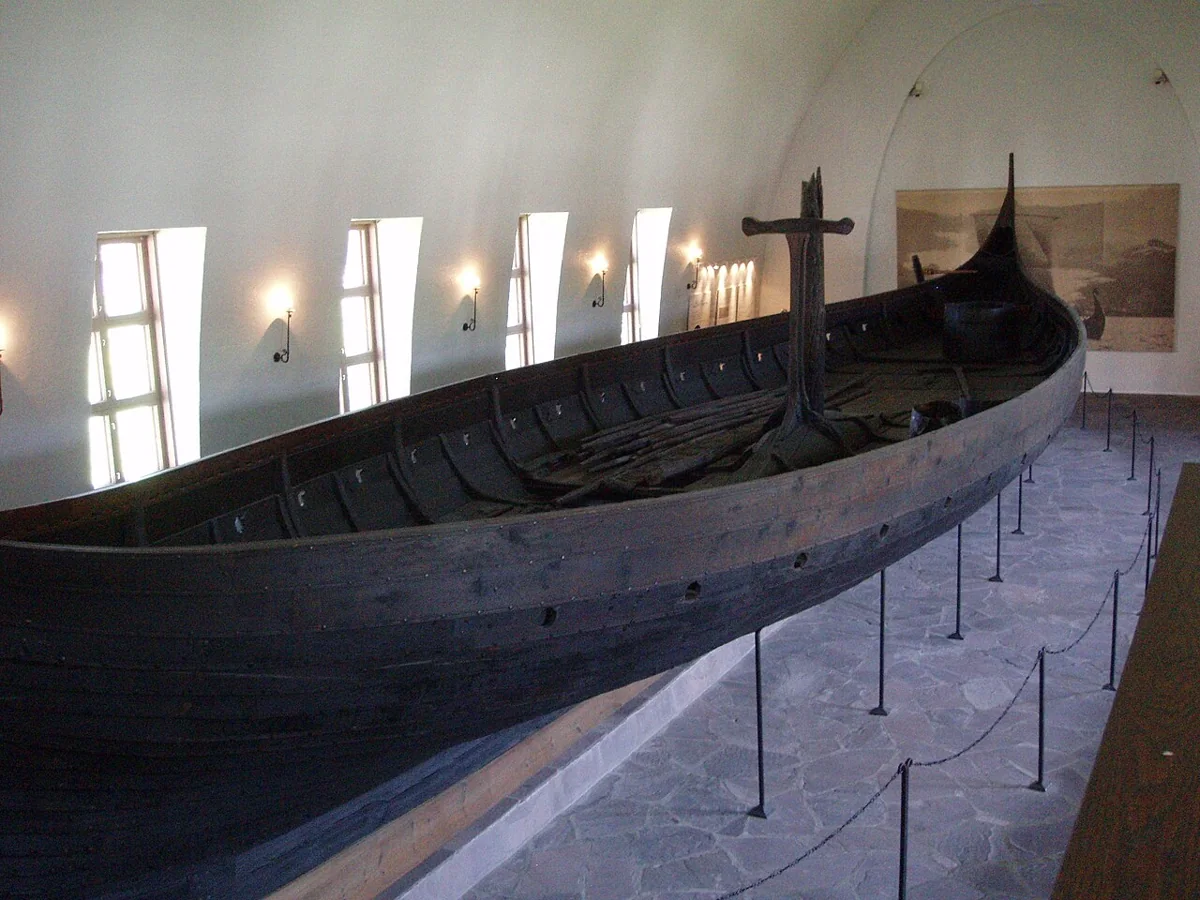
The ship was probably constructed around 890 in the Oslofjord region. Approximately 23 meters long and five meters wide, it has overlapping hull planks and sixteen oar openings on either side. Its form suited travel on open water, while sail and oars offered different ways to propel it.
A vessel with these capabilities could serve trade, travel, or warfare. That versatility does not prove which journeys this particular ship made. Nor should a modern estimate of sailing speed be read as a recorded Viking voyage. The surviving hull reveals design choices more directly than it reveals its owners' itinerary.
A ship beneath a mound
Around 900, the vessel was placed in a burial mound outside Sandefjord. Excavated in 1880, it contained the remains of a man whose rich burial places him within the social elite. His personal name and precise position remain unknown.
The mound itself was monumental: the museum describes an original footprint of roughly fifty by forty meters. Such a structure made the burial visible in the landscape. Its scale gives evidence for the resources devoted to commemoration, without identifying the occupant as a specific king.
Why missing objects matter
The excavator, Nicolay Nicolaysen, recognized that intruders had already entered the grave. Their damage extended through furniture and even the ship's bottom. This disturbance is essential context: the surviving contents are not an untouched arrangement left by the mourners.
A university research project records three smaller boats, equipment for riding and household tasks, and animal remains among the finds. Ancient looting may help explain missing weapons and personal possessions. Consequently, absence alone is a weak basis for deciding what the deceased owned or did. Gokstad is best read through the combination of hull, mound, surviving objects, and the history of damage to the burial.
The Evidence
The sources below support this article. Interpretations and limits are explained in the text; this is not an exhaustive research review.