
Journeys & Encounters · Deep dive
Keels and Stems: Building the Shape of a Hull
In Brief
The keel and the rising ends establish important relationships in a ship’s structure. Surviving pieces constrain a reconstruction, but missing stems can still allow more than one convincing solution.
On this page
Starting with connected componentsWhat a shaped stem doesThe Gislinge construction sequenceTwo stems for one archaeological boatRegion, material, and the choice of comparisonFrom a curved line to sailing behaviorSourcesStarting with connected components
The Viking Ship Museum describes keel and stems as the initial backbone of a clinker-built boat. Its Gislinge example uses a keel with a T-shaped section and shaped ends joined through scarf connections. The arrangement provides surfaces where the lowest planks meet the central structure. It is a system of fitted pieces rather than one enormous carved shell.
The early medieval Gislinge boat is an especially useful teaching example because the reconstruction process is documented step by step. It must nevertheless remain a comparison: a procedure demonstrated for this boat is not automatically the procedure for every Viking Age vessel. The broader historical question is which features recur across dated finds and which belong to a particular size, region, or period. A familiar silhouette can otherwise conceal considerable structural variety.
Sources for this section: 1
What a shaped stem does
A stepped stem can make the lines of the hull planks appear to continue upward into one carved element. The museum emphasizes this feature as both a construction problem and a recognizable aspect of the northern boatbuilding tradition. The outside appearance is produced by deliberate shaping, not by simply bending every plank until it reaches the highest point.
This makes the stem a meeting place between structure and appearance. The builder has to provide appropriate contact for the planks while shaping the visible end. Removing material changes both. It is therefore misleading to isolate an elegant profile from the three-dimensional piece that supports it. A photograph taken from the side can display the curve beautifully while hiding its thickness, its internal surfaces, and the exact positions of the joints.
Sources for this section: 1
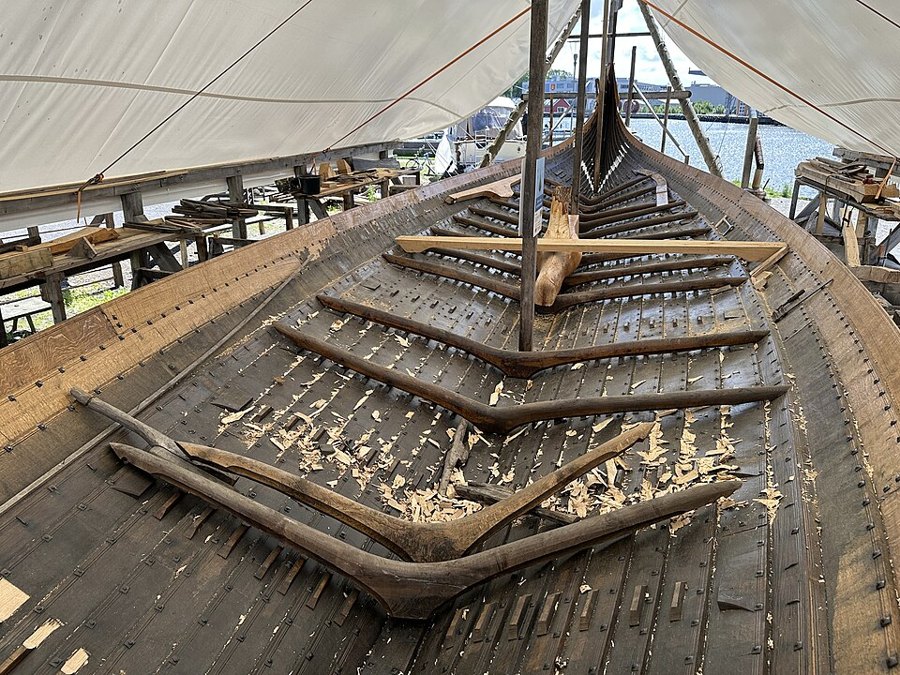

The Gislinge construction sequence
The museum’s construction diary describes shaping an oak keel, preparing the stems, and joining these pieces before beginning the planked shell. It records the use of axes and chisels, and the temporary protection of the finished keel while other work continued. Tarred wool was placed in the scarf connections when the pieces were assembled.
A sequence like this helps explain why boatbuilding cannot be reconstructed from a list of finished components alone. Some operations create the reference points for later operations. Others must wait until neighboring pieces exist and can be fitted. The diary is evidence for modern work undertaken to reconstruct an archaeological boat. Its greater value lies in making the practical dependencies visible, so that researchers can compare them with tool marks and joints on the original material.
Sources for this section: 2
Two stems for one archaeological boat
Neither end stem of Skuldelev 6 survived. The museum’s first reconstruction, Kraka Fyr, used the stepped-stem solution of Skuldelev 3 as a comparison. Its later reconstruction, Skjoldungen, adopted shorter, blunter ends informed by Norwegian finds and the boat’s western Norwegian context. Both interpretations respected the surviving parts.
This is an unusually clear demonstration of reconstruction uncertainty. Two different visible solutions can be consistent with the same incomplete evidence. The existence of a finished, sail-ready boat does not remove the missing evidence. Nor does replacing an older interpretation mean that the earlier work was worthless: it identifies a question that subsequent discoveries and experience allowed researchers to revisit. An honest display can show both versions and explain exactly which original pieces constrain them and which pieces have to be supplied by comparison.
Sources for this section: 3
Region, material, and the choice of comparison
The museum’s account of Skjoldungen stresses the western Norwegian origin of Skuldelev 6 and the use of pine in its construction tradition. It also contrasts radial splitting of oak with tangential splitting of pine. These are reminders that reconstructing a missing component involves more than borrowing an attractive shape from the nearest museum ship.
A useful comparison should have a reason behind it. Similar date, region, size, construction method, or purpose may each strengthen the case, but none guarantees identity. Where the comparisons disagree, that disagreement should remain visible. It can reveal regional diversity or simply the incompleteness of the surviving sample. The selection of an analogy is an argument that readers can assess, not a hidden stage that disappears once the reconstruction is painted and launched.
Sources for this section: 4
From a curved line to sailing behavior
The modern reassessment of Skuldelev 3 changed the curvature of its reconstructed keel. This is a reason to ask how hull form influences handling, rather than assuming the keel is merely an inert baseline. The significance must be tested with the complete vessel, because load, sail, steering arrangement, and crew all affect the result.
For a visitor examining a ship, the most useful questions are consequently specific. How much of the keel survives? Are the stems original, reconstructed, or represented by a supporting framework? Which joints were observed, and which were inferred? Do the published dimensions describe surviving timber or a proposed complete vessel? Answering these questions turns the dramatic sweep of a Viking ship into a readable piece of evidence. The shape remains impressive, but the reasoning that supports it becomes equally visible.
Sources for this section: 3, 5
For the introductory context, read Gokstad: Reading a Seagoing Ship and Its Burial.
The Evidence
The sources below support this article. Interpretations and limits are explained in the text; this is not an exhaustive research review.