
Journeys & Encounters · Deep dive
Skuldelev 6: A Fishing Boat Adapted for Transport
In Brief
Skuldelev 6 preserves a change of purpose in its own structure. Added planking and altered rowing arrangements show why a ship type should not be mistaken for a permanent, unchanging job description.
On this page
The hull records more than one working arrangementMany rowing positions could be useful without a full crewAdding a strake changed the balance of activitiesThe internal structure kept upper space relatively openReconstruction requires a network of craftsTesting local movement in a Greenland landscapeSourcesThe hull records more than one working arrangement
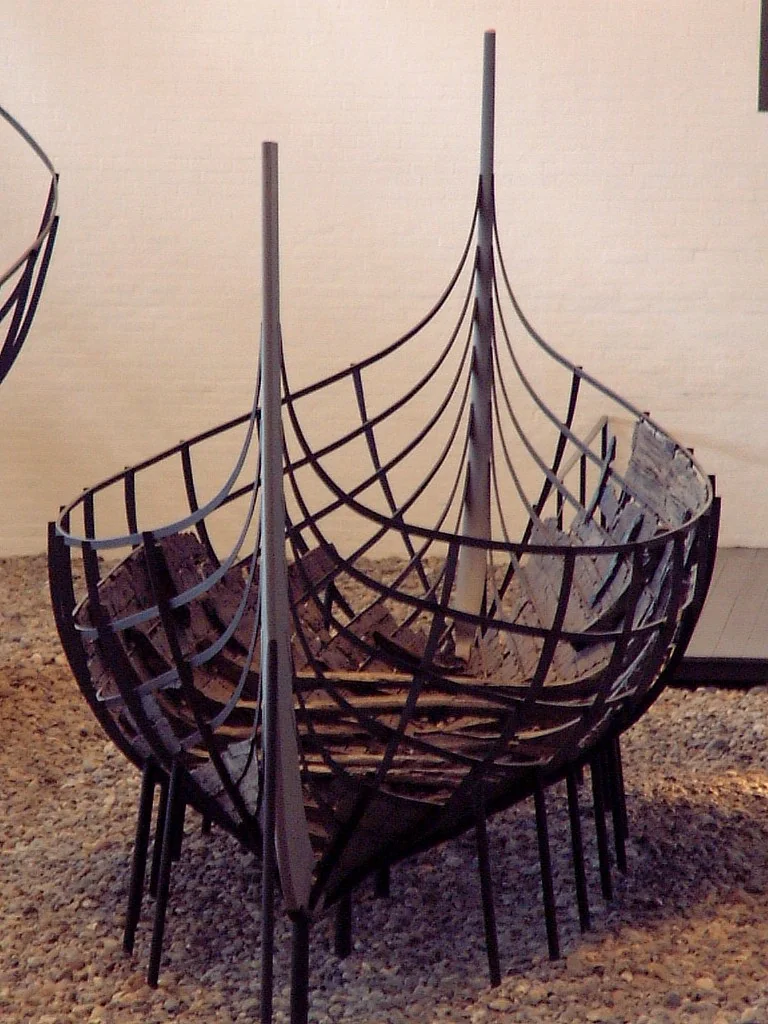
Skuldelev 6 was built in western Norway around 1030 and is interpreted as a boat originally used for fishing in the fjords. The museum reconstructs it at about 11.2 meters long and 2.5 meters wide. Approximately seventy percent of the vessel survives, using pine, birch, and oak. Its later alteration is central to its interpretation.
An additional plank was fitted along each side, raising the hull, while the original rowlocks were removed and the rowing arrangement reduced. The museum connects these changes with greater use for coastal transport. The physical modification is evidence; the precise commercial circumstances behind it remain unknown. We cannot identify the owner who ordered the work or the cargo carried afterward. What the hull does establish is that its useful life included adaptation, so describing it only as a fishing boat leaves out part of the archaeological story.
Sources for this section: 1
Many rowing positions could be useful without a full crew
The museum's account of Kraka Fyr, the first reconstruction, discusses the original low-sided form with six strakes and fourteen rowing positions. It suggests a practical advantage for fishing: gear or catches brought aboard could obstruct some positions while others remained available. That interpretation does not require every oar to have been in use continuously.
The difference between positions and people is important. Counting openings provides information about possible arrangements, not a direct census of the crew on a particular day. A boat could be worked differently according to the task, the weather, and what occupied the interior. This makes the original arrangement more flexible than a picture of fourteen permanently assigned rowers might suggest. It also connects propulsion with the work the boat carried out: oar access, fishing equipment, and available space formed a single practical problem inside a small hull.
Sources for this section: 2

Adding a strake changed the balance of activities
Raising the sides increased the enclosed space and changed the boat's relationship with waves and loading. Removing the earlier rowlocks at the same time reduced the number of usable rowing positions. The museum interprets the altered vessel as a carrier, while emphasizing that the conversion's exact date is unknown.
The change should not be reduced to a claim that higher sides always make a better boat. A fishing operation may benefit from easy access over a low gunwale, while carrying material calls attention to volume, containment, and the height remaining above water when loaded. These are practical tradeoffs, not a simple progression from primitive to advanced. Skuldelev 6 shows a structure being adjusted to a different balance of demands. Its later form can be more suitable for one task without making the earlier form a failed design.
Sources for this section: 1, 2
The internal structure kept upper space relatively open
Kraka Fyr's technical description highlights low transverse members and substantial frames that supported the hull without requiring the same arrangement of fixed higher crossbeams. Loose seating could provide rowing positions. This makes the interior relevant to both propulsion and the placement of material inside the boat.
The engineering issue is how to support the hull while preserving usable space. A crossbeam can provide a strong connection, but its position also determines what can pass beneath or around it. Low structural members leave a different working environment from high permanent obstructions. When a vessel is adapted, those existing arrangements influence what changes are practical. The surviving structure therefore deserves attention alongside the added upper plank. A conversion is not a new boat drawn on a blank sheet: it must work with a hull whose earlier design still governs many of its possibilities.
Sources for this section: 2
Reconstruction requires a network of crafts
Skjoldungen, the second reconstruction, was launched on October 20, 2012. The museum's project record names boatbuilders, a weaving and sewing specialist, rope makers, a sailmaker, a blacksmith, and specialists responsible for ship and sail reconstruction. That list is a useful reminder of the work hidden behind even a comparatively small vessel.
A complete boat combines components that need different materials and skills. Its hull may be the largest visible part, but without rigging, sail, fastenings, and suitable equipment it does not reproduce the operational problem posed by the original. Recording who made these elements also clarifies where modern decisions entered the experiment. Those contributions should not be collapsed into a claim that the entire object reproduces one uninterrupted ancient recipe. A reconstruction brings archaeological interpretation and practical craft together, and its research value improves when that collaboration remains documented and open to reassessment.
Sources for this section: 3
Testing local movement in a Greenland landscape
In 2016, eight sailors took Skjoldungen along southwest Greenland in a project developed with the Greenland National Museum. The stated research aims concerned travel between settlements and the effects of wind, tides, ice, and other conditions on progress under sail and oars. The boat was transported to Greenland before the coastal voyage; the project did not demonstrate an Atlantic crossing in this vessel.
The museum's completed-project account identifies both a book and a scholarly discussion of the experiment's possibilities and limits. That distinction between a journey and its analysis matters. The voyage can supply observations about moving a reconstructed small boat through a particular landscape, but it does not prove that Skuldelev 6 itself visited Greenland. The broader historical question is how small working boats could connect dispersed communities. Skuldelev 6 contributes through its adaptable structure and tested interpretations, while its own documented archaeological endpoint remains Roskilde Fjord.
Sources for this section: 4, 5
The Evidence
The sources below support this article. Interpretations and limits are explained in the text; this is not an exhaustive research review.
- Viking Ship Museum: Skuldelev 6, the fishing vessel ↗
- Viking Ship Museum: Kraka Fyr, construction and working arrangements ↗
- Viking Ship Museum: Building Skjoldungen in 2012 ↗
- Viking Ship Museum: Research aims of the 2016 Greenland trial voyage ↗
- Viking Ship Museum: Completed research projects and Greenland voyage outputs ↗