
Journeys & Encounters · Deep dive
Skuldelev 3: Coastal Cargo and the Value of a Small Trading Ship
In Brief
Skuldelev 3 offers unusually complete evidence for a fourteen-meter cargo vessel. Its two modern reconstructions connect coastal transport with questions about loading, skilled construction, and a working hull’s changing condition.
On this page
A hold surrounded by working spaceA small crew and a substantial transport taskLight construction required careful material choicesThe first reconstruction also built a research practiceAging fastenings changed the working hullA second hull tests a revised interpretationSourcesA hold surrounded by working space
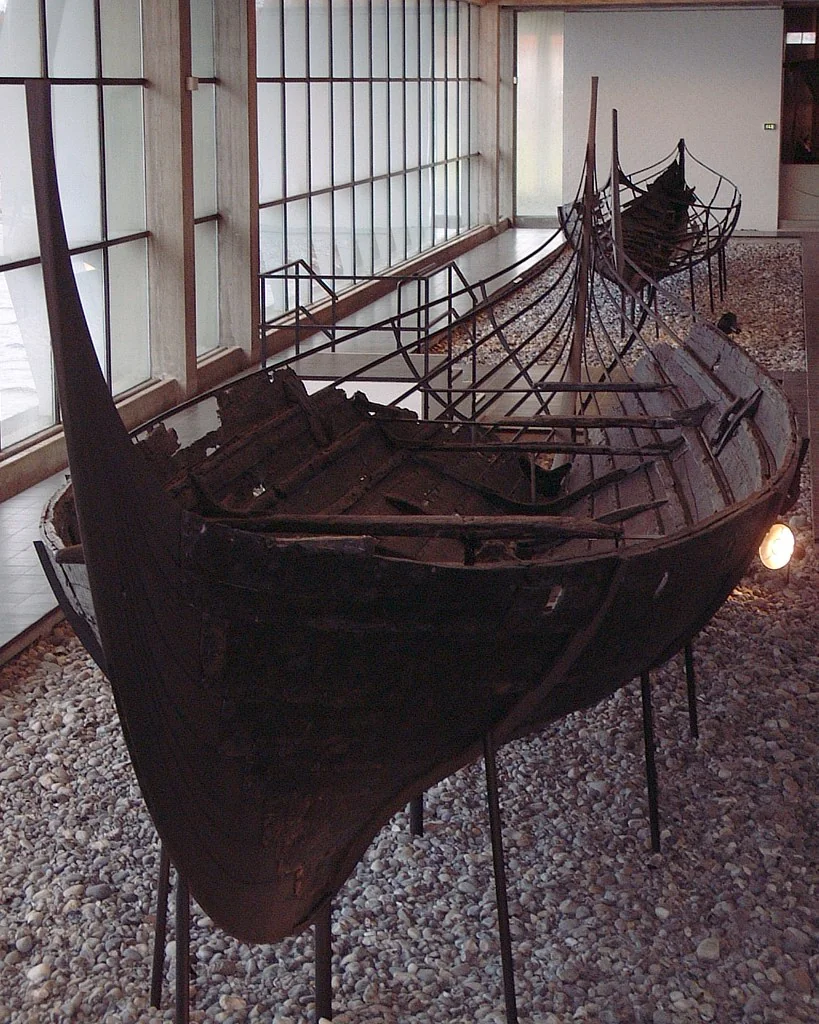
Built in Denmark around 1040, Skuldelev 3 had an open central cargo space and decking toward the ends. The museum estimates a load of roughly four tons. That arrangement places the cargo within a vessel that also had to accommodate people and the work of handling sail and oars.
The distinction matters when imagining coastal trade. A ship's usefulness was not limited to the value of a single luxury object; several tons of material could be moved together without requiring an equivalent overland carrying effort. Yet the load still had to be compatible with the boat's form and the crew's access. Loose material, tightly packed containers, and a few bulky objects would create different practical problems even if they weighed the same. The preserved hull establishes the available space; the contents of a specific ancient voyage remain a separate question.
Sources for this section: 1
A small crew and a substantial transport task
The museum's specifications for Roar Ege, the first full-scale reconstruction, describe a crew of five to eight and a cargo capacity in the range of three to four and a half tons. These are figures for an interpreted and operated modern vessel, useful for considering the relationship between labor and carrying capacity. They should not be presented as a surviving employment record for the eleventh-century ship.
As an analytical comparison, dividing a substantial load among a small crew illustrates why water transport could be attractive. The crew did not need to support the cargo's weight physically throughout the journey. Their work was instead concentrated in preparing, controlling, and maintaining the vessel, as well as loading and unloading. This advantage came with dependence on navigable water and weather. Skuldelev 3 makes that balance concrete at a scale smaller than an ocean-going cargo ship but much larger than a person's daily carrying capacity.
Sources for this section: 2

Light construction required careful material choices
Roar Ege's construction account describes fresh oak split and shaped while still moist. The resulting planks could be twisted into position without steaming or boiling. Tarred wool thread sealed the overlapping planks, following material identified in the archaeological vessel. The hull's lightness therefore did not mean casual construction; it depended on shaped components and carefully made connections.
For a transport vessel, unnecessary structural weight occupies part of the total weight that the hull must support. But removing wood indiscriminately would threaten the very strength that makes carrying a load possible. The practical problem is to retain material where it contributes to the structure and avoid carrying it where it does not. A reconstruction exposes that problem piece by piece. The original traces constrain what builders make, while working with the actual timber reveals the consequences of choices that a simple outline drawing cannot show.
Sources for this section: 2
The first reconstruction also built a research practice
Work on Roar Ege began in 1982 and the ship was launched in 1984. The museum deliberately selected a team open to interpreting an unfamiliar building tradition, rather than assuming that existing professional routines would automatically reproduce it. Decisions were documented with descriptions, drawings, and references. The completed project required about twenty thousand working hours, including about five thousand for ropework and the handwoven sail.
Those totals belong to a particular modern research project. They include its learning conditions and cannot simply be divided by a presumed Viking workday to produce an ancient construction schedule. Their greater value is showing where work occurs beyond the visible wooden hull. A trading ship required textile and cordage production as well as woodworking and metal fastenings. The reconstructed vessel therefore helps expand the idea of maritime labor from the people sailing it to the crafts that enabled it to move.
Sources for this section: 3
Aging fastenings changed the working hull
After more than three decades afloat, Roar Ege was retired in 2016. The museum describes repeated repairs and a critical problem in the iron rivets: corrosion caused expansion that split the overlapping planking and encouraged leaks. The project thus generated observations about deterioration as well as initial construction and sailing performance.
This evidence is particularly relevant to a cargo vessel because maintenance affects dependable service. The question is not merely whether a new hull can carry a load once, but how repeated use and repairs alter it over time. Roar Ege's thirty-two years afloat are not a universal life expectancy for Viking ships. Modern storage, materials, maintenance choices, and use all matter. The case instead identifies a specific failure process that can be compared with archaeological repairs and with the behavior of other reconstructions under documented conditions.
Sources for this section: 4
A second hull tests a revised interpretation
For Estrid Byrding, launched in 2022, the museum returned to the original excavation documentation rather than copying Roar Ege. A scale model incorporated the recorded plank shapes and fastening positions. The resulting interpretation had more curvature in the keel and a hull twelve centimeters wider amidships than the earlier reconstruction.
For coastal cargo movement, such changes raise practical questions about handling and loading. A slightly different form may alter how the vessel responds when turned, how it sits with a given load, or how its underwater surface interacts with the water. Those effects require testing; a new outline alone does not establish them. Having two successive interpretations is therefore useful rather than embarrassing. Skuldelev 3 becomes a long-term investigation in which an unusually well-preserved archaeological vessel anchors construction, use, deterioration, and revision, while each modern boat remains a particular answer that can be examined critically.
Sources for this section: 5
The Evidence
The sources below support this article. Interpretations and limits are explained in the text; this is not an exhaustive research review.
- Viking Ship Museum: Skuldelev 3, the coastal trader ↗
- Viking Ship Museum: Roar Ege specifications and construction ↗
- Viking Ship Museum: Building Roar Ege and Estrid Byrding ↗
- Viking Ship Museum: Skuldelev 3 project and retirement of Roar Ege ↗
- Viking Ship Museum: Launch announcement and reconstruction method, 2022 ↗