
Life & Society · Deep dive
Silk Imports and the Remaking of Scandinavian Dress
In Brief
Cut edges, silver braids, and tiny embroidered fragments show how imported silk acquired new uses in northern clothing.
On this page
Imported cloth became local clothingOseberg and the accumulation of small piecesA blue and gold fragment from BirkaCut edges and the work of reassemblySilk as a ground for an imageYork: an urban comparisonNetworks, not a single journeySourcesImported cloth became local clothing
Silk reached Viking Age Scandinavia in forms that could be transformed after arrival: woven cloth, decorative bands, and threads incorporated into embroidery. These categories matter because importing a textile did not necessarily mean importing a finished outfit. Eva Andersson Strand’s survey distinguishes broad woven fabrics from tablet-woven bands and embroidery, including metal thread carried on a silk core. A garment could therefore combine several histories of production. Its principal cloth, border, and applied decoration need not have originated in the same workshop. Looking closely at seams and attachments shifts the question from “Where did the silk come from?” to “What did people do with it after it arrived?” That second question reveals clothing makers as active participants in long-distance exchange.
Sources for this section: 1
Oseberg and the accumulation of small pieces
Marianne Vedeler’s investigation of the Oseberg textiles identified more than a hundred small silk fragments representing fifteen different fabrics. Their fragmented survival should not be mistaken for a hundred separate garments. Some silk had been cut into narrow strips for clothing decoration, while silk thread also entered embroidery and bands. The collection demonstrates the value of relatively small quantities of imported material. A border could visibly distinguish a garment without requiring an entire silk robe. It also complicates calculations of wealth based on fragment counts: many pieces can belong to one original textile, and one outfit can incorporate several textiles. The important unit may be a reconstructed fabric or garment component rather than the individual fragment recorded during conservation.
Sources for this section: 2


A blue and gold fragment from Birka
Birka grave Bj 944 contained a particularly revealing piece now cataloged as object 617937. The Swedish History Museum identifies its fabric as Chinese silk, describing a blue thread system with geometric decoration painted or printed in gold. A braid of spiral silver thread was sewn over the cloth. The museum tentatively associates it with a hat. Here, the visible luxury was not simply the silk itself: color, surface ornament, and a separately attached metal braid worked together. An imported fabric could serve as the foundation for further embellishment. The proposed headwear identification remains less secure than the observable construction, so a reconstruction should show the surviving decoration confidently while marking the complete hat shape as an interpretation.
Sources for this section: 3
Cut edges and the work of reassembly
Another textile from Bj 944, object 617950, preserves three lengths of samite silk with silver passementerie attached. Samite is a patterned weaving structure; passementerie here means a separate ornamental braid made from silver wound around a core thread. Sharp edges on parts of the silk led the museum to suggest that the cloth had been cut into ribbons. These may then have been joined with the braid or attached to clothing. The braid itself changes between single and paired knots. Such details make this more than a generic “eastern luxury.” They expose a sequence of cutting, arranging, knotting, and sewing. The surviving combination does not establish whether each operation happened in Birka, but it shows that cloth could acquire a new format after weaving.
Sources for this section: 4

Silk as a ground for an image
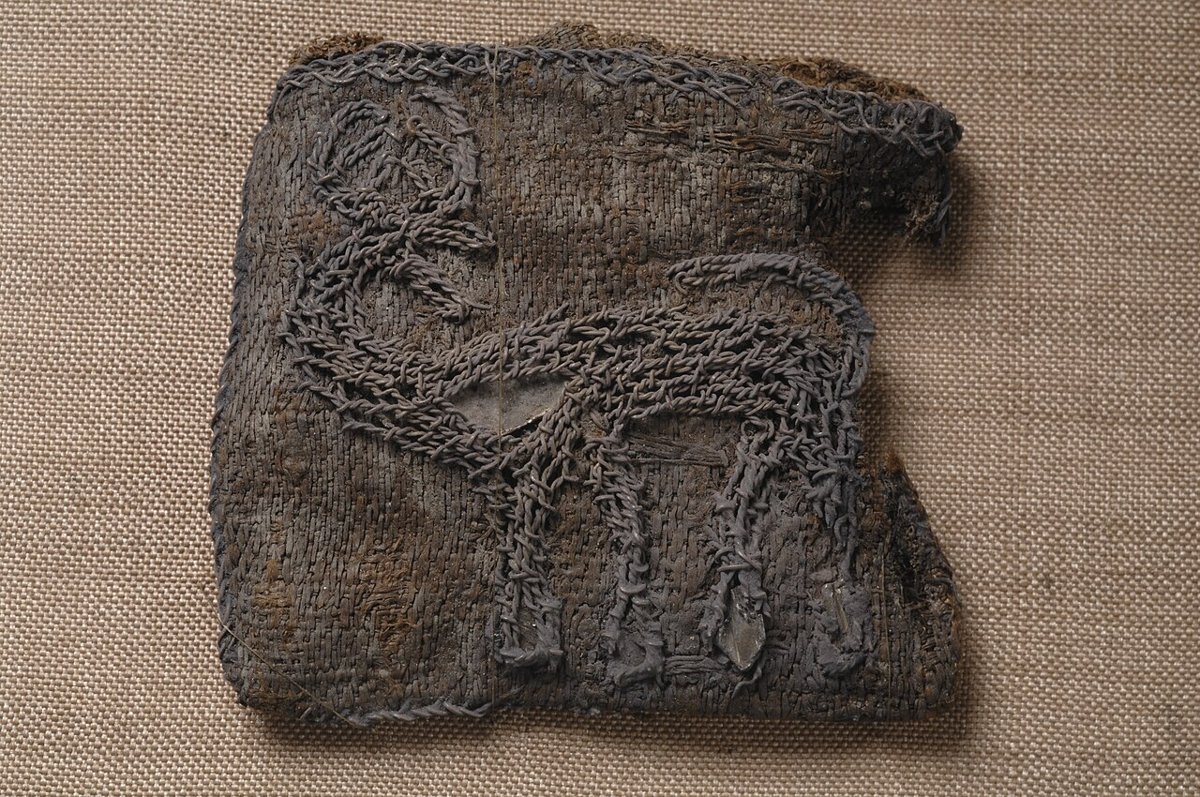
A small fragment from Birka grave Bj 735, object 617948, carries a deer embroidered in silver thread. The animal looks backward, and a small piece of white quartz forms a striking detail within the design. The Swedish History Museum proposes a Christian interpretation, connecting the deer and its emphasized heart with Christ. That reading is an interpretation of the image, not a direct statement left by its maker. What survives physically is a composite object: silk provided the ground, silver formed the figure, and stone supplied another visual effect. Its small scale illustrates why describing silk only as fabric for robes misses important uses. It could support an intricate applied image whose significance depended on the relationship among several materials.
Sources for this section: 5
York: an urban comparison
The tenth-century silk cap from Coppergate in York provides a useful comparison with Scandinavian grave fragments. It comes from an urban excavation and is recognizable as headwear, giving a different kind of evidence from small pieces preserved within burial assemblages. York Museums Trust also notes other silk scraps from Coppergate and interprets them as evidence consistent with the production of high-quality clothing on the street. The cap and scraps together place imported cloth within a working town. They do not identify the route taken by every length of silk or the birthplace of its wearer. Comparing York with Birka therefore reveals several stages of a textile’s life: material arriving through exchange, being worked or worn, and ultimately entering very different archaeological deposits.
Sources for this section: 6
Networks, not a single journey
Vedeler’s research challenges the older assumption that Scandinavian silk principally represented loot from churches in the British Isles. Her Oseberg study points toward connections with Persian and Byzantine production and wider exchange networks. Trade, gifts, and plunder can all belong in the explanation, but a particular fragment rarely specifies which transaction transferred it. River routes through eastern Europe help explain possible connections without providing a documented itinerary for an individual garment. This distinction changes the historical picture: a Scandinavian wearer did not have to travel to a silk-producing region to obtain its products. The fabric might pass through several owners, then be cut and embellished again. Its distant manufacture and its later local uses are separate, equally significant parts of its history.
Sources for this section: 2
The Evidence
The sources below support this article. Interpretations and limits are explained in the text; this is not an exhaustive research review.