
Life & Society · Deep dive
Tablet-Woven Borders: Small Bands with Complex Structures
In Brief
Gold thread, surviving tablet arrangements, and fragments sewn to silk reveal a craft whose detail often disappears in whole-costume reconstructions.
On this page
What the tablets controlledA gold trace of missing threadsA second Birka band differs in detailBands attached to an actual textileOseberg preserved work still on the tabletsAn ornament was not necessarily wornReading fine work at the right scaleSourcesWhat the tablets controlled
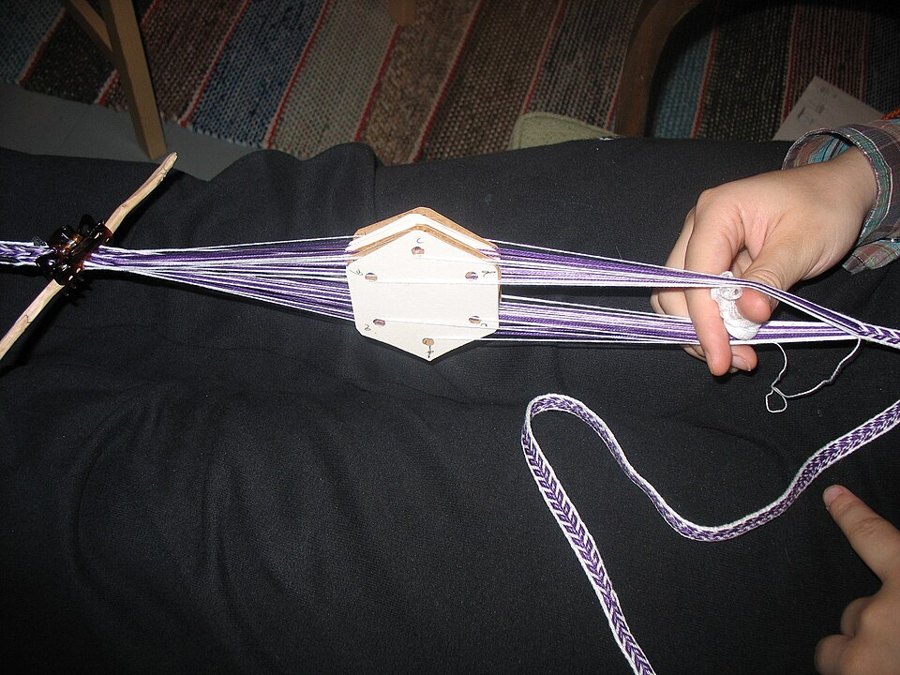
Tablet weaving uses small pierced tablets to organize groups of warp threads. Turning the tablets changes their relationship and creates openings for the weft. Different threading arrangements, colors, and sequences of turns can produce patterned narrow bands. The heritage network Follow the Vikings describes their use as straps, belts, and decoration. These functions should not be reduced to a single costume accessory. A band could be useful because it was strong, because it was visually elaborate, or because both qualities mattered. The basic mechanism also accommodated different materials. Wool, plant fibers, silk, and metal decoration did not all require identical working choices even when the resulting objects belonged to the same broad craft category.
Sources for this section: 1
A gold trace of missing threads
A band from Birka grave Bj750 survives principally through its gold weft. The Swedish History Museum explains that the lost warp nevertheless left impressions on the metal, allowing aspects of the pattern to be reconstructed. The museum identifies the warp as probably silk rather than claiming that it survives directly. Its reconstruction requires twenty-five tablets for a band only about a centimeter wide. This is a striking relationship between small scale and technical complexity. The object is not simply a strip of gold trim. Its arrangement preserves evidence of many coordinated threads, and the surviving metal records part of the structure that the organic material no longer supplies.
Sources for this section: 2

A second Birka band differs in detail
The museum’s entry for a band from Bj844 describes a surviving length of roughly twenty-six centimeters and a width of about one and a half centimeters. Its doubled, continuous gold weft belonged to a band made with at least nineteen tablets. Neither the warp nor the underlying base weft survives; silk is suggested. Comparing it with Bj750 shows why “gold tablet band” is not a sufficient technical description. Width, tablet number, thread arrangement, and survival differ. Even when expensive materials connect the examples socially, their construction requires separate examination. The measurements belong to the preserved pieces and reconstructions, not to a standard width used by every Viking weaver.
Sources for this section: 3
Bands attached to an actual textile
Birka grave Bj735 preserves a more direct relationship between garment fabric and ornament. The Swedish History Museum describes silk samite fragments with three differently patterned tablet-woven bands sewn onto them. The narrowest and widest bands required different numbers of tablets, and the recorded borders were not entirely uniform. Stitching also varied between the surviving attachments. Such details help distinguish the manufacture of a band from the later act of attaching it. The pieces need not be imagined as one uninterrupted operation performed by one person. A fabric, its narrow ornaments, and its sewing together could each have separate histories before they became part of the object deposited in the grave.
Sources for this section: 4
Oseberg preserved work still on the tablets
Bente Skogsaas’s study account for Oseberg Viking Heritage describes a partially completed band found with fifty-two tablets still threaded. The excavation documentation recorded the threading before the assemblage was lifted in1904. That record is valuable because the position of the tools captures a process rather than only a finished product. It provides constraints for later reconstruction that would be lost if the tablets had simply been collected as separate finds. The case also highlights the importance of early archaeological drawings. A researcher can return to the physical band and the recorded arrangement together, testing an interpretation against information preserved at excavation rather than relying only on a modern image of the fragment.
Sources for this section: 5
An ornament was not necessarily worn
The same Oseberg account warns that its bands were not found attached to clothing, while many were associated with tapestry fragments. This is an important correction to an easy assumption: narrow patterned textiles in a rich burial need not all be costume trim. The author also distinguishes reconstructable structures from a broader modern color palette chosen where chemical color identification was unavailable. A reconstruction can therefore be strong in one dimension and less secure in another. The position of a band, the way its threads interlace, and its original appearance should be recorded separately. Treating them as one undivided judgment conceals both the evidence’s strengths and its remaining gaps.
Sources for this section: 5
Reading fine work at the right scale
The Birka and Oseberg examples reward attention to details that a distant view of a reconstructed outfit cannot show. Impressions can stand in for lost threads; a stitched attachment can connect ornament with fabric; an unfinished band can preserve a working sequence. These relationships support a history of manufacture rather than only a catalogue of motifs. They also explain why a broad resemblance between patterns cannot alone prove a shared workshop or an identical meaning. Technique, materials, context, and attachment must be compared. The bands demonstrate sophisticated planning and material handling, while their varied uses keep that skill connected to garments, equipment, and furnishings rather than one imagined uniform Viking style.
Sources for this section: 1, 2, 3, 4, 5
The Evidence
The sources below support this article. Interpretations and limits are explained in the text; this is not an exhaustive research review.